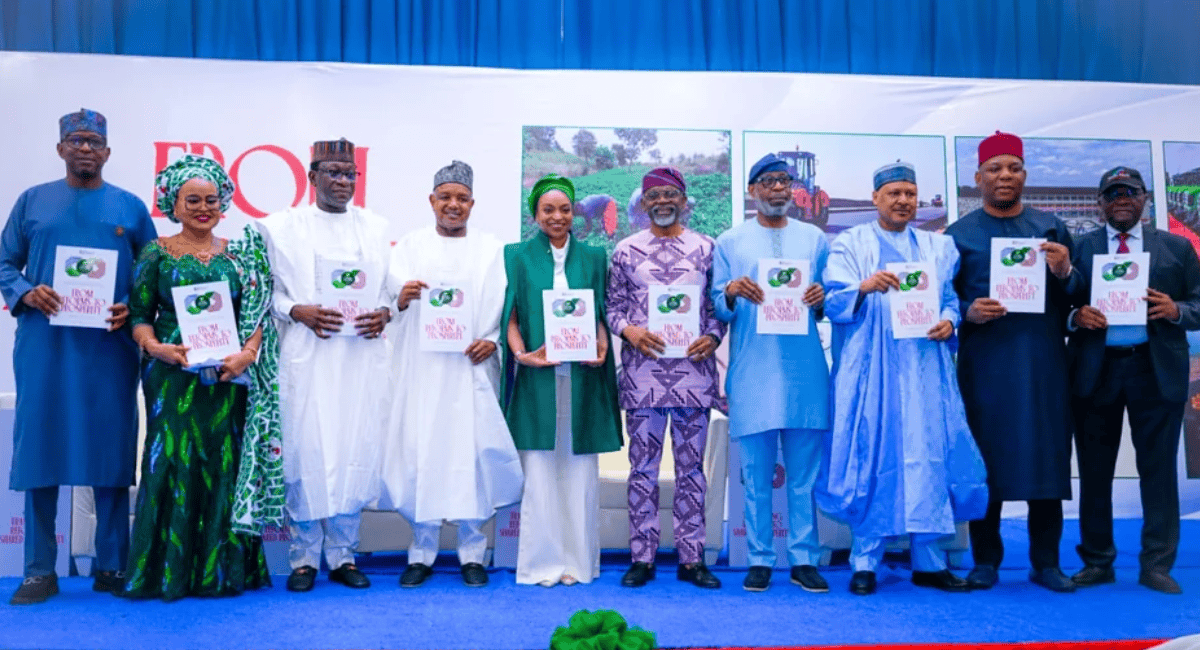
On Tuesday, 10 November 2026, the All Progressives Congress Presidential Campaign Council gathered in Abuja to launch the re-election manifesto for President Bola Ahmed Tinubu ahead of the upcoming electoral cycle. Although the president did not attend the event, key administration figures including Chief of Staff Femi Gbajabiamila, campaign spokesperson Dele Alake, and Minister of Budget and Economic Planning Atiku Bagudu acknowledged the heavy financial strains caused by recent structural economic adjustments since May 2023, while maintaining that these reforms are essential for long-term national stability.
Titled the Renewed Hope Agenda 2.0 and subtitled Translating Reforms into Shared Prosperity, the 109-page strategic document covers the projected 2027 to 2031 governance period. To support a second mandate, the publication highlights improving macroeconomic indicators, pointing to foreign reserves reaching $55.3 billion in September 2026, headline inflation easing to 14.63 per cent, second-quarter GDP growth touching 4.43 per cent, and Federation Account Allocation Committee distributions climbing significantly compared to earlier years.
What are the four main pillars of the manifesto?
Rather than launching an entirely new set of campaign slogans, the renewed blueprint consolidates the administration's initial eight-point agenda into four primary categories containing 35 specific targets.
The first pillar, a secure and resilient nation, prioritizes intelligence- driven security, the recruitment of additional police personnel to improve the officer-to-citizen ratio, border e-surveillance expansion, and increased enrollment in the national identity database.
The second pillar emphasizes affordable living conditions, targeting a reduction in youth unemployment, the construction of housing units across all 774 local government areas, lower out-of-pocket healthcare expenses, and expanded technical training.
The third pillar focuses on energy, infrastructure, and economic acceleration, aiming to scale electricity generation toward 10,000 megawatts, deploy millions of new meters, establish industrial clusters in every geopolitical zone, and achieve higher annual GDP growth.
The fourth pillar centers on effective governance, promising comprehensive digital transformation across judicial processes and federal ministries, alongside an independent public delivery tracker for accountability.
How does the blueprint address the technology sector?
Technology policy within the document extends across multiple sectors to support founders, startups, and digital service providers. Under economic growth provisions, the government pledges to generate one million export- linked jobs through digital and tech-enabled service exports by 2030, supported by specialized export credit and working capital facilities.
Additional commitments include the proposed Youth Bank Law to provide collateral-free capital, expansion of student venture grants, and nationwide broadband enhancements through extensive fibre-optic cable deployment. Furthermore, the administration plans to scale digital literacy initiatives to reach millions of citizens.
What are the operational challenges facing these proposals?
While the document addresses longstanding friction points for entrepreneurs, industry observers highlight potential hurdles in implementation. These include resolving overlapping tax collections between federal and state agencies, ensuring transparent distribution of state-backed credit without political patronage, and overcoming infrastructural bottlenecks such as right- of-way delays and power supply deficits.
Where do opposition parties stand?
As the ruling party details its second-term vision, major opposition figures such as Peter Obi and former Vice President Atiku Abubakar are expected to release competing manifestos. Analysts anticipate that opposition platforms will focus contrasting strategies on fiscal austerity, market liberalization, and structural governance changes, setting the stage for a policy-driven debate ahead of the polls.