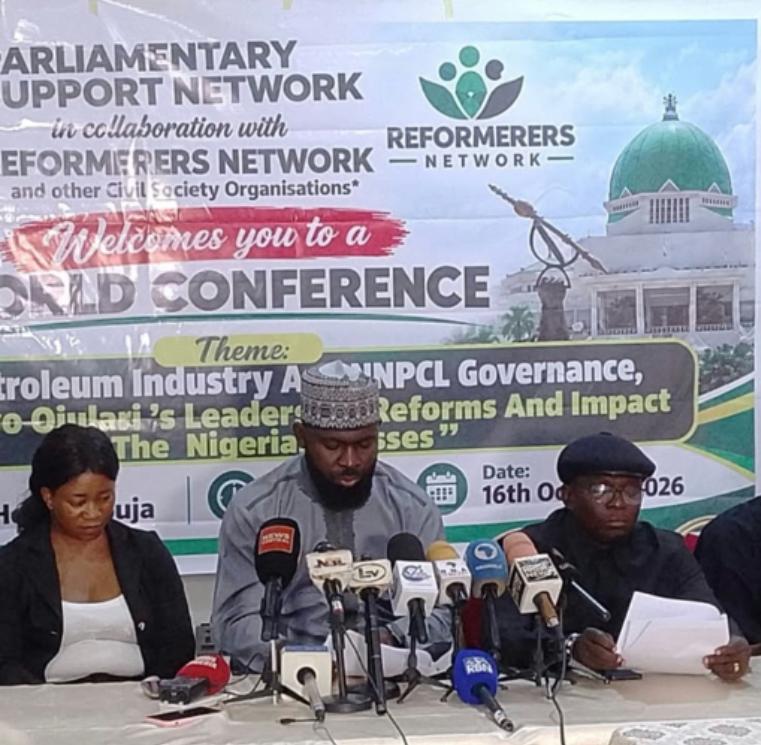
Civil society organisations have praised Group Chief Executive Officer Engr. Bashir Bayo Ojulari of the [Nigerian National Petroleum Company Limited](https://en.wikipedia.org/wiki/Nigerian_National_Petroleum_Company) for delivering the gains promised by the [Petroleum Industry Act](https://en.wikipedia.org/wiki/Petroleum_Industry_Act_(Nigeria)) during a press briefing in Abuja on Friday.
Representatives of the Parliamentary Support Network and the Reformers Network, Amb. Muhammad Abdulrazaq and Comr. Adams Umoren, addressed the media and highlighted the company’s audited 2025 financial statements and a nationwide N66‑per‑litre discount on Premium Motor Spirit as concrete evidence that the reform agenda is working.
**What were the key financial outcomes?**
- The audited accounts submitted to President [Bola Tinubu](https://www.president.gov.ng) recorded a Profit After Tax of N7.2 trillion, a 33 % rise over 2024 despite global price volatility.
- Dividends amounting to N5.8 trillion were declared.
- Remittances to the Federation Account increased markedly.
- Crude and condensate output reached a five‑year high of 1.77 million barrels per day.
The spokespersons argued that these figures translate into more resources for roads, schools, hospitals, security and social programmes, positioning the national oil company as a reliable fiscal contributor rather than a source of chronic budget shortfalls.
**How was the fuel discount structured?**
The N66‑per‑litre reduction on Premium Motor Spirit, introduced at NNPCL retail stations to mark Nigeria’s 66th Independence Anniversary, will run until the end of October. The discount is financed from the company’s own retail margin and does not draw on the Federation Account, the groups stressed, describing it as a corporate‑social responsibility measure rather than a revival of the old subsidy regime.
**What progress was noted on gas infrastructure?**
The civil groups also pointed to advances in gas projects, citing the AKK pipeline as a foundational asset for industrial expansion and power‑sector stability.
While acknowledging that legacy challenges, market volatility and the scale of reforming a decades‑old institution will continue to test resolve, the participants affirmed that the direction set by Engr. Ojulari is correct. They called on legislators, regulators and industry players to maintain focus on production growth, cost discipline, gas commercialisation and transparent governance to consolidate the gains achieved.