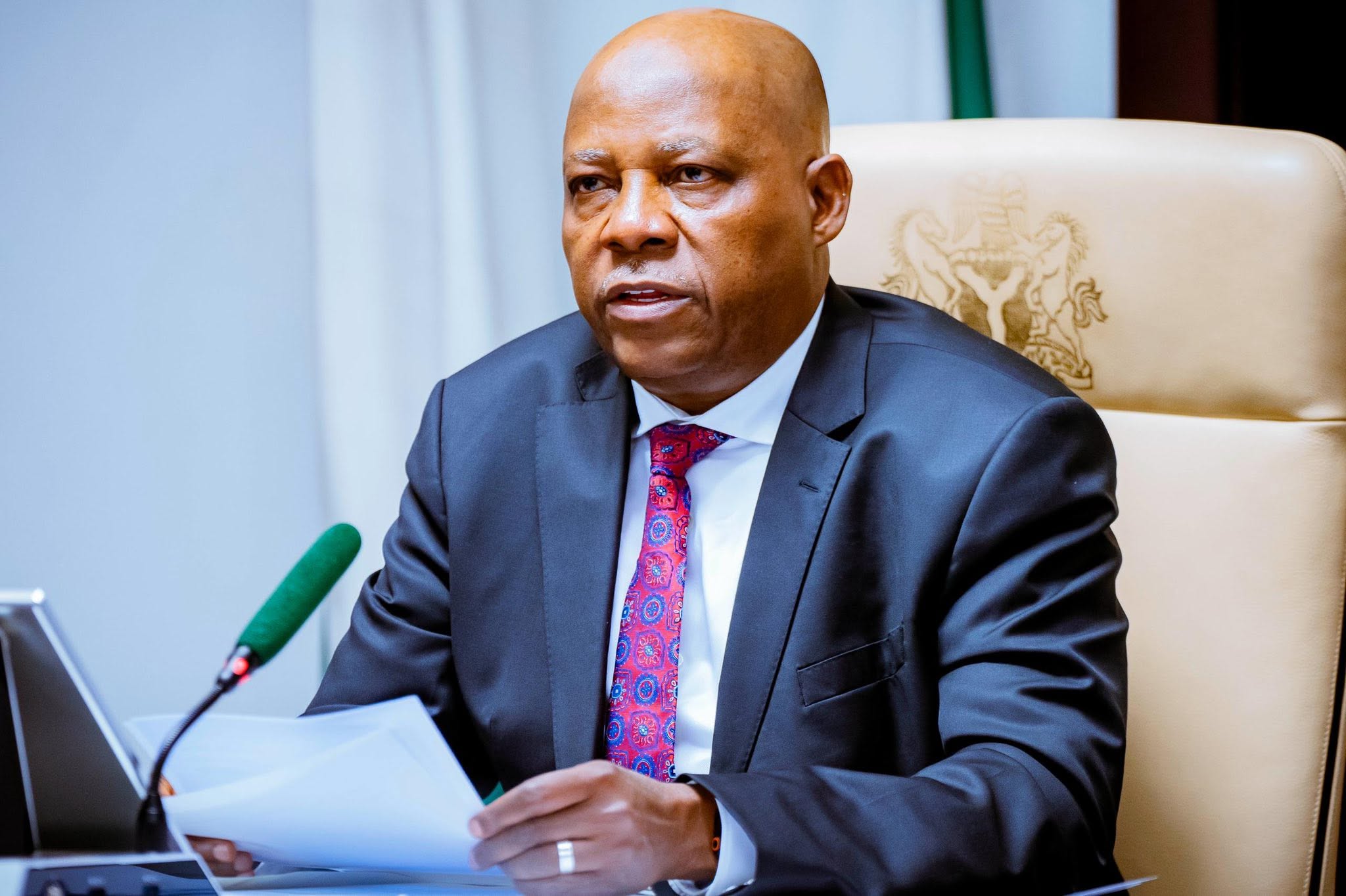
The Nigerian government has urged African countries to expand local manufacturing and raw-material processing, warning that the continent’s continued dependence on commodity exports limits its economic potential and participation in global trade.
Vice President Kashim Shettima made the call in Abuja, stating that Africa must move beyond exporting raw materials and importing finished products to developing industries that generate higher economic value.
Mr Shettima, who was represented by the Special Adviser to the President on Economic Affairs, Tope Fasua, spoke at an international conference centered on the African Continental Free Trade Area and the Geoeconomics of African States. The event was organized by the International Centre for Regional Integration and Trade Research of Nnamdi Azikiwe University, Awka.
“Resources confer potential. It is the capacity to process, transform, innovate, and negotiate that converts potential into prosperity,” Mr Shettima remarked.
He pointed out that Africa continues to supply raw materials to external industries while importing finished goods at inflated costs, thereby losing the bulk of the economic value derived from its natural endowments.
Highlighting specific sectors, the vice president referenced cocoa and crude oil as prime examples of commodities that Africa ships abroad without sufficiently establishing downstream manufacturing capabilities.
He revealed that the Federal Government is actively backing the development of three lithium-processing plants across Nasarawa, Kaduna, and Abuja to strengthen Nigeria's positioning in the critical minerals value chain.
Furthermore, he stressed that Africa’s long-term economic transformation relies heavily on shifting from primary production toward processing, advanced manufacturing, technology, and knowledge-driven services.
How can Africa leverage its resource wealth?
Echoing similar sentiments, the Director-General of the World Trade Organisation, Ngozi Okonjo-Iweala, encouraged African economies to ramp up industrialization and strengthen regional value chains to improve the continent's standing in international commerce.
Speaking through her Senior Adviser, Jean-Yves Remy, Mrs Okonjo-Iweala noted that Africa is uniquely positioned to capitalize on shifting global supply chains due to its abundant natural assets, youthful demographics, and growing market linkages.
She stated that the continent accounts for nearly 30 percent of global critical mineral reserves—including lithium, cobalt, manganese, copper, nickel, and graphite—yet commands only about three percent of total global exports.
According to her, intra-African trade accounted for approximately 17 percent of the continent’s merchandise exports, demonstrating significant room for regional expansion.
Mrs Okonjo-Iweala identified the AfCFTA as a vital instrument for widening production bases, though she noted that persistent infrastructure deficits, institutional bottlenecks, and non-tariff barriers continue to hamper its full execution.
She advocated for better roads, reliable power supply, upgraded ports, enhanced maritime logistics, and streamlined customs procedures to ease cross- border trade.
The WTO leader also encouraged academic institutions and specialized research chairs to deepen policy studies and training, emphasizing that intellectual capital remains crucial for expanding Africa's economic footprint.
Moving beyond market size to economic power
Ngozi Egbuna, a WTO chair and director at the ICRITR, asserted that Africa must look past mere statistics regarding its population and resources to focus on translating those advantages into tangible economic strength.
She observed that a population of roughly 1.6 billion people has not freed the continent from its reliance on external financing, foreign technology, and overseas value chains.
Weighing in on the discourse, former President Goodluck Jonathan stressed the necessity of deeper economic integration, stating that the ultimate goal should be establishing a unified productive economy rather than just a single consumer market.
Represented by John-Kennedy Opara, the executive secretary of the Nigerian Christian Pilgrim Commission, Mr Jonathan argued that Africa's future bargaining power rests on its ability to turn raw resources into finished industrial assets.
He called for aggressive investments in agro-processing, pharmaceuticals, machinery, automotive manufacturing, fertilizers, and renewable energy equipment.
Concluding the discourse, the Vice-Chancellor of Nnamdi Azikiwe University, Bond Anyaehie, warned that trade agreements alone cannot spur transformation unless African nations build competitive domestic enterprises capable of financing and driving local production.