
The female deputy governors of the All Progressives Congress (APC) have made a call for the party to actively support the nomination of at least one female governor from each geopolitical zone as the 2027 elections approach.
Organized under the Female Deputy Governors Forum in Nigeria, they also requested the re-nomination of current female deputy governors serving their first terms, emphasized the necessity for more women in appointive roles, and highlighted the importance of prioritizing women's involvement within party structures during primary election processes.
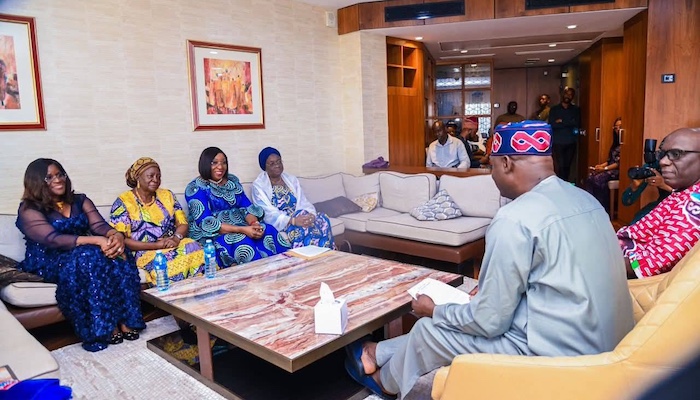
Leading the call was Mrs. Noimot Salako-Oyedele, the Deputy Governor of Ogun State, during their meeting with the party's National Chairman, Prof. Nentawe Yilwatda, on Friday in Abuja.
Other attendees included Senator Akon Eyakenyi from Akwa Ibom State, Lady Chinyere Ekomaru from Imo State, Miss Josephine Piyi from Plateau State, and Professor Ngozi Odu from Rivers State.
Salako-Oyedele remarked on Yilwatda's significant role in fostering unity and peace within the party, particularly in a time when many political parties in Nigeria struggle with internal discord.
As the APC gears up for the 2027 elections, she stressed the necessity for a strategic assessment of how to strengthen the party's electoral position and organizational framework.
She expressed concern about current statistics regarding women's participation in political roles, pointing out that only nine female deputy governors exist, along with four women in the Senate, seventeen in the House of Representatives, and forty-eight across State Houses of Assembly.
Salako-Oyedele noted that thirteen states lack any female legislators, with Nigeria’s overall representation of women in elective positions hovering around 4-5%, positioning the nation among those with the lowest global representation.
In comparison, she cited countries like Rwanda, where female parliamentary representation exceeds 60%, and South Africa and Senegal, which both surpass the forty percent threshold.
She emphasized that this disparity does not reflect a lack of qualified women, asserting that Nigeria is filled with capable and experienced women who have demonstrated leadership in various sectors.
Salako-Oyedele stated, “The challenge we face is structural. Political results are shaped by party systems, including how candidates are selected and how support is mobilized. If we want different results, it is essential that we make intentional changes within our party structures.”
She recalled a moment at the National Executive Committee meeting where the President recognized the insufficient representation of women, an acknowledgment that suggests the need for substantial change.
“With our party's current strength, we are in a unique position to respond to this call,” she declared. The APC has thirty-two governors, making it the most dominant political party in the nation.
“This puts us in a position not only to win elections but also to significantly influence the future of our democracy. We see this as a critical opportunity for our party to take bold steps forward.
“In this regard, we propose that the party implements a structured affirmative action framework ahead of the 2027 elections to ensure at least 35% representation for women in State Houses of Assembly, one female representative in the House of Representatives per Senatorial District, and at least one female senator per state.
“Furthermore, there should be a minimum of eighteen female deputy governors. Notably, Nigeria has yet to elect a female governor, and we urge the party to take concrete steps to facilitate the election of at least one female governor in each geopolitical zone.”
The deputy governors asserted that their requests are driven not merely by fairness, but also by strategic considerations, stating that enhancing women’s participation would bolster the voter base and enrich governance through diverse perspectives.
Salako-Oyedele reiterated the commitment of the women in the forum, stating, “This is a pivotal moment not just for women in our party, but for the legacy of the APC. We have the chance to transcend small-scale improvements and make decisive changes that could influence political engagement in Nigeria.”
Prof. Yilwatda responded affirmatively, assuring that his leadership of the National Working Committee would prioritize enhancing the representation of women in political roles. He remarked on the approximately 50% female population in the ruling party and deemed the current representation in the National Assembly, which is below 5%, as unacceptable.
He highlighted that federal character representation should reflect gender diversity as well, noting the need to enhance the participation of women in politics.
In a related development, the Renewed Hope Network (TRN) has advised Nigerians against believing falsehoods and misinformation about President Bola Tinubu and his administration as the nation gears up for the 2027 elections. The group, which has the backing of Senator Abdulaziz Yari, defended the President's track record of leadership and progress through his policies, arguing that citizens should recognize the advantages of the ongoing reforms.
The TRN leaders, during a rally coinciding with the APC national convention, decried the distortions propagated by opposition figures and stressed that the people’s will would prevail as the ruling party continues to gain support.
Key accomplishments mentioned include the resolution of financial difficulties faced by students and the decline of inflation, which has reportedly fallen from 34% to 15%, alongside the growth of foreign reserves.
“We are mobilizing Nigerians to support the Tinubu administration,” they stated, reinforcing their commitment to the ruling party's direction and legacies.
Comments (0)
You must be logged in to comment.
Be the first to comment on this article!