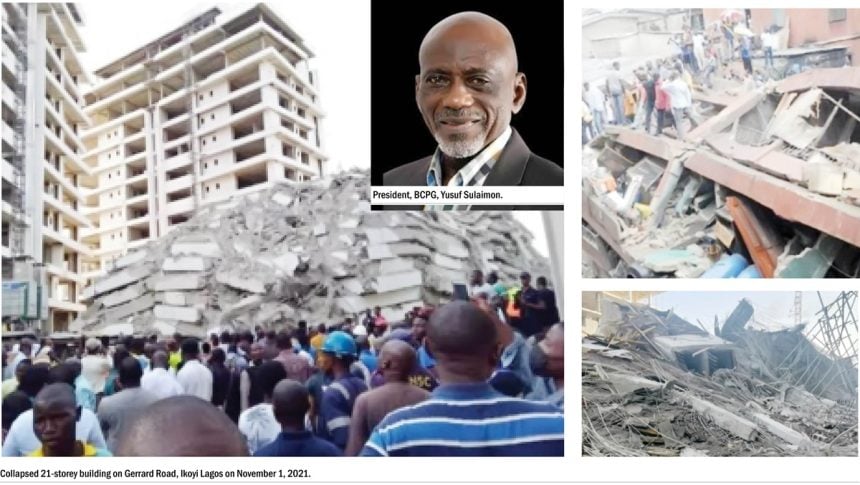
Five years after the catastrophic collapse of a 21-storey luxury tower on Gerrard Road in Ikoyi, Lagos, structural failures and lax enforcement continue to plague Nigeria's commercial hub, with more than 50 additional building incidents recorded across the state between 2022 and 2026. Industry experts and regulatory bodies warn that systemic weaknesses in construction oversight and professional compliance remain unaddressed.
On November 1, 2021, the high-rise structure under development gave way, claiming 44 lives and trapping numerous construction workers, artisans, and the project developer beneath tons of concrete. The disaster exposed severe regulatory lapses, particularly regarding how an edifice initially approved for 15 floors was allegedly expanded to 21 floors without appropriate safety interventions.
What are the statistics on building failures in Lagos?
Data compiled by the Building Collapse Prevention Guild (BCPG) indicates that Nigeria documented 817 building failures between October 1971 and July 2026, with Lagos accounting for 477 of those occurrences. Out of the Lagos incidents, roughly 68 percent involved occupied structures, while over 25 percent happened during the active construction phase.
Following the 2021 tragedy, subsequent years recorded dozens of structural failures, including a seven-storey building collapse in Banana Island in 2023 and an incident along Old Ojo Road near Alakija Bus Stop in June 2026 that resulted in eight fatalities and 26 rescues.
Why do experts blame weak enforcement and professional negligence?
During a recent stakeholder conference organized by the BCPG Amuwo-Odofin Cell, built-environment professionals stressed that permits alone cannot guarantee structural safety. Experts highlighted that the deployment of substandard building materials, employment of unqualified workers, and insufficient site supervision by certified professionals frequently compromise structural integrity.
Mrs. Florence Gbaye, General Manager of the Lagos State Building Control Agency (LASBCA), pointed out that practitioners who take on multiple projects often delegate critical monitoring duties to unqualified personnel. While noting that the agency utilizes private accredited professionals to improve oversight, stakeholders argue that consistent field inspections and severe sanctions for violations remain vital.
Furthermore, geotechnical experts like Dr. Sebastian Ozoamalu emphasized the necessity of thorough soil testing prior to construction, warning that uniform foundation designs across differing soil compositions invite disaster. Surveyors and urban planners also called for better drainage integration, flood mapping, and adherence to physical planning laws to mitigate environmental risks in low-lying areas.