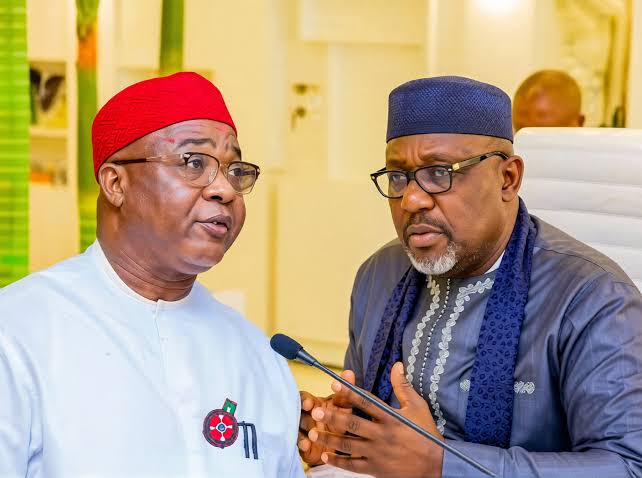
The political struggle for the All Progressives Congress ticket in the Imo West Senatorial District has escalated into an open dispute after twelve local government area chairmen rejected a court ruling that replaced Governor Hope Uzodimma with former Governor Rochas Okorocha. The local leaders insisted that the incumbent governor remains their legitimate candidate for the legislative contest.
Speaking at a briefing in Owerri, the state party chairmen dismissed the judicial outcome delivered by the Federal High Court in Abuja, which set aside Governor Uzodimma's candidacy. The party executives argued that the ruling disregarded the democratic choices made by registered members during the May 18 primary election within the Orlu zone.
What did the court decide?
Justice Obiora Egwuatu ruled that former Governor Okorocha had presented sufficient documentation proving he won the primary election monitored by the Independent National Electoral Commission (INEC). The court directed the ruling party to forward Mr Okorocha's documentation to the electoral umpire and barred the current governor from parading himself as the party's nominee for the scheduled legislative polls.
Legal representatives for Governor Uzodimma immediately announced plans to challenge the verdict at the appellate court, maintaining that the governor secured the highest number of valid votes during the exercise. State party officials reiterated that the legal department is reviewing the judgment to protect the mandate given by local delegates.
Conflicting primary records and political friction
The dispute centers on contrasting accounts of the internal party exercise. Affidavits submitted by the Okorocha faction claimed massive vote counts, while counter-affidavits from the governor's camp maintained that Mr Uzodimma won by a wide margin in the presence of election monitors. Electoral officials previously noted that returns submitted to headquarters underwent administrative scrutiny following discrepancies in documentation dates.
Political analysts note that the legal tussle also intersects with constitutional provisions regarding dual executive and legislative ambitions. Observers point out that holding simultaneous roles remains constrained by national laws, setting the stage for extensive legal battles as political factions vie for influence across the South-East region.