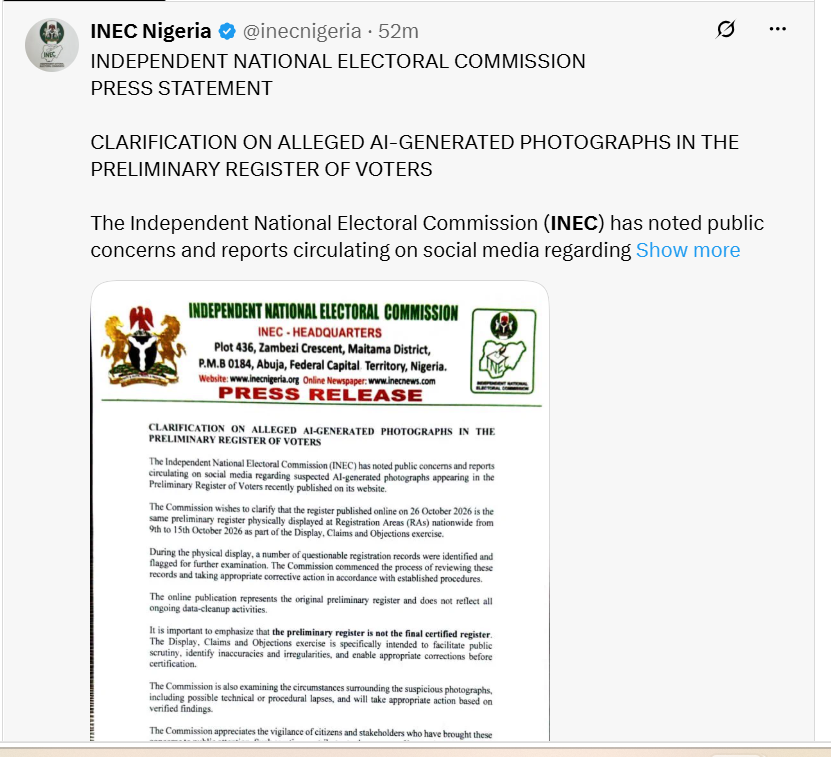
The Independent National Electoral Commission (INEC) has confirmed that its preliminary voters’ register, released online on 26 October 2026, contains a number of questionable entries, including photographs that appear to have been created with artificial‑intelligence tools and records of individuals who are no longer alive. The commission said it will cleanse the data and address verified irregularities before the final register is certified.
Key facts:
- The preliminary register was posted online on 26 October 2026 after a physical display that ran from 9 to 15 October 2026.
- During that display, INEC flagged several entries as doubtful and began a review process.
- The statement confirming the issue was signed by Mohammed Kudu Haruna, Chairman of INEC’s Information and Voter Education Committee, on 27 October 2026.
- Finance Minister Taiwo Oyedele later warned that a government survey showed some poor households spend up to 120 % of their income on food.
- Political economist Pat Utomi reacted on X, writing, “So sad, our people deserve better.”
What irregularities were identified?
Social media users who examined the online register posted images they believed were AI‑generated, alongside duplicate entries and the names of deceased relatives. INEC acknowledged these reports, stating that the photographs and records are under investigation to determine whether technical or procedural lapses occurred.
How is INEC handling the problem?
The commission explained that the online version reflects the original preliminary register and does not yet incorporate the corrections being made. It has launched a systematic review of the flagged records, promising to follow established procedures for verification, adjudication, and data‑cleanup. The final certified register is slated for release on 15 December 2026.
What did the finance minister say about poverty and food costs?
During a discussion at Chatham House in London, Finance Minister Taiwo Oyedele highlighted a survey indicating that the poorest households may spend as much as 120 % of their income on food, suggesting that many families resort to borrowing or other support to meet basic needs. He emphasized the need for reliable data to shape effective policies, noting that the National Bureau of Statistics struggles with funding for essential surveys.
Why is accurate data crucial for policy?
Oyedele argued that without credible data, policymakers are essentially “having a communion” rather than making informed decisions. He pointed to the importance of both the Consumer Price Index and the Producer Price Index in understanding inflation drivers, and praised the Central Bank of Nigeria’s shift toward inflation targeting.
What is the broader economic context?
The minister noted that Nigeria’s official unemployment rate hovers around five per cent, yet the poverty rate exceeds 50 %, underscoring the existence of a large “working poor” segment. He called for policies that consider both employment and poverty metrics to address the lived realities of Nigerians.
INEC thanked citizens and stakeholders for their vigilance, stating that public scrutiny will help improve the register’s accuracy and integrity. The commission assured Nigerians that any verified irregularities will be dealt with according to the law, and promised further updates as the review progresses.