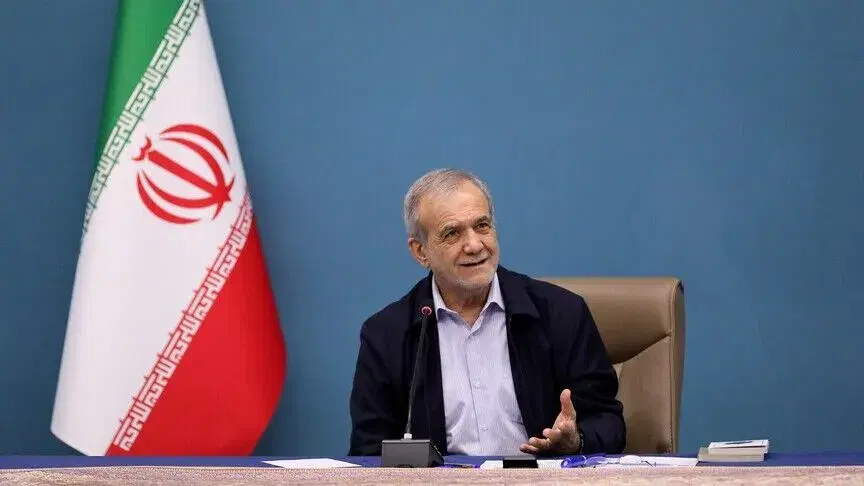
Iranian President Masoud Pezeshkian told delegates at a regional summit in Turkmenistan on Friday that any dialogue aimed at ending the months‑long Middle East conflict can succeed only if it is conducted without pressure or threats, and he warned that sanctions on Iran would hurt regional trade, connectivity, energy supplies and overall order.
**Key points**
- The war, which began in late February after US and Israeli strikes on Iran, has settled into a stalemate despite intermittent diplomatic overtures.
- Pezeshkian earlier this week dismissed recent US‑Iran talks as futile, saying they only led to renewed attacks.
- A memorandum of understanding signed in June outlined a framework for a permanent settlement, but Iranian attacks on vessels in the [Strait of Hormuz](https://en.wikipedia.org/wiki/Strait_of_Hormuz) reignited US military actions.
- Since early September, Washington has scaled back direct strikes, opting for economic pressure while maintaining a counter‑blockade of Iranian ports.
- Both the United States and Israel maintain that the conflict is necessary to stop Iran from acquiring nuclear weapons, a claim Tehran repeatedly denies.
**What did the president emphasize?**
He stressed that “dialogue holds meaning and a chance of success only when based on mutual respect and mutual commitments, and when devoid of pressure and threat.” He added that negotiations conducted under the shadow of force amount to “imposition and coercion.”
The president’s remarks were delivered during his speech at the [Commonwealth of Independent States (CIS) summit](https://en.wikipedia.org/wiki/Commonwealth_of_Independent_States), where he highlighted the broader economic repercussions of continued sanctions on Iran.
The conflict has also disrupted the vital shipping lane of the [Strait of Hormuz](https://en.wikipedia.org/wiki/Strait_of_Hormuz), with Iran targeting vessels that attempt to pass without its permission, while the United States has responded by targeting ships it accuses of violating its counter‑blockade.
Overall, Pezeshkian called for negotiations grounded in respect and free from intimidation, warning that continued pressure could further destabilise the region.