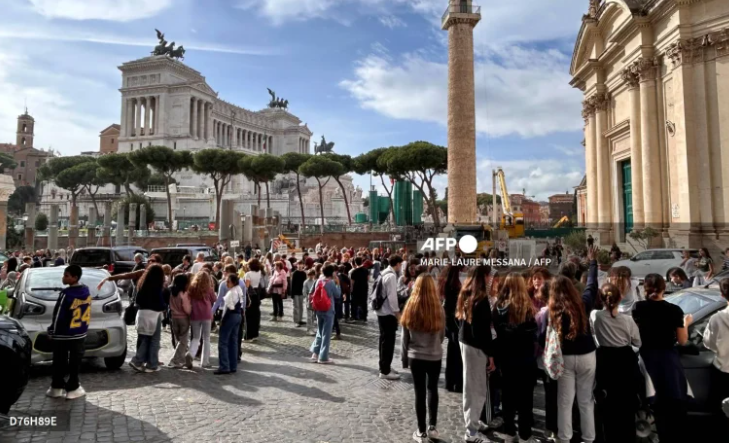
Educational institutions across Italy were forced to evacuate on Wednesday following a coordinated wave of bomb threats, which Prime Minister Giorgia Meloni dismissed as fabricated hoaxes while affirming that no genuine hazard existed. According to the Italian news agency Ansa, citing the country's Education Ministry, the malicious alerts affected approximately 6,000 schools and triggered similar security disruptions in Britain and Ireland, where threatening correspondence reached hundreds of learning centers.
In response to the widespread panic, Prime Minister Meloni convened an emergency security session on Wednesday with intelligence and law enforcement chiefs to evaluate the situation. While the exact count of Italian institutions that executed physical evacuations remained undetermined, throngs of students were observed standing outside school premises across various regions of the country.
What were the students' immediate experiences?
Numerous students recounted fleeing their classrooms in haste, leaving personal belongings behind while local authorities coordinated security inspections. Sofia De Ponte, a 19-year-old pupil at Rome’s Virgilio High School, explained to AFP that the institution's head initiated the evacuation after receiving a threatening electronic mail message.
"The principal came out into the courtyard and told us that an email had come in, a bomb threat, and right after that the building was evacuated," De Ponte stated, adding that police officers were delayed due to a high volume of calls across various facilities.
At the Brera school in Milan, art teacher Violetta Uboldi noted mixed emotional reactions among the pupils, remarking that some viewed the unexpected disruption with amusement. Meanwhile, a 16-year-old student named Angelica shared that the initial moment generated genuine fright because an instructor explicitly warned them the procedure was not a routine drill.
Italian media outlets disclosed that the intimidating messages were purportedly attributed to an individual using the alias “Mikhail Andropov, leader of the Vilayat of Misoginistan.” The correspondence alleged that an explosive mechanism had been concealed within a school facility and could be triggered from a distance.
How did authorities respond to the threats?
Despite the widespread disruption, the Italian administration moved quickly to calm public anxieties, confirming that initial security assessments yielded no proof of an active danger.
Through a statement shared on social media, Meloni noted: “At present, based on the checks carried out, no element has emerged that would suggest there is a concrete danger.” She further characterized the alerts as an intentional tactic aimed at generating widespread panic, noting that formal inquiries remain active.
Antonello Giannelli, who leads the ANP association representing Italian school directors, similarly characterized the warnings as apparent fabrications. Nevertheless, he cautioned that the episode illustrated how reckless behavior, magnified by contemporary digital communication channels, could instigate massive societal disruption.
This occurrence follows a sequence of recent security alarms throughout Europe, encompassing false bomb alerts targeting commercial flights and cyberattacks directed at supermarket refrigeration infrastructure in nations including Italy. Additionally, Italian Foreign Minister Antonio Tajani reported that malicious actors had targeted him online by leaking his personal data in retaliation for Rome's diplomatic backing of Ukraine, escalating broader European worries regarding modern hybrid warfare tactics. Concurrently, law enforcement agencies in Britain and Ireland confirmed ongoing inquiries into similar threatening emails sent to numerous schools on Wednesday, advising administrators against full evacuations while labeling the messages as fraudulent, though Scottish media reported that select regional schools opted to send pupils home.