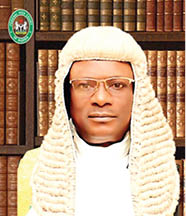
The courtroom is often called the last hope of the common man. But what happens when that hope itself becomes the subject of suspicion—when case assignment, judgment timing, and the judge's credentials become the story rather than the law? The recent trajectory of Justice Peter Odo Lifu of the Federal High Court, Abuja, offers a troubling case study in how judicial conduct—and the administrative choices that enable it—can erode public trust. It is also a question about whether the institution can police itself.
Justice Lifu is no novice. Born in 1965 in Okpoma, Cross River State, he studied law at the University of Jos, was called to the Bar in 1990, and later earned an LL.M. and an M.Sc. in Political Science from the University of Ibadan, where he lectured. Appointed to the National Industrial Court in 2013, he built a reputation for impatience with frivolous applications. Elevated to the Federal High Court in 2018, he was transferred to Abuja in January 2024. Casually, in 1987, the present INEC Chairman was appointed a lecturer at the University of Jos at the time Justice Lifu was a student in the Department of Law. His law-and-political-science background is unusual and, on paper, suited to electoral jurisprudence.
Yet that pedigree has become the point of contention. In June 2026, Justice Lifu ordered the deregistration of the African Democratic Congress (ADC) and four other parties. The Court of Appeal later vacated the judgment, finding that the trial court ignored proof that the parties had won elective seats, acted without jurisdiction over a suit filed by a non-juristic entity, and—most damningly—delivered judgment 25 days after the Court of Appeal had expressly ordered a stay of proceedings. The appellate court described the conduct as "a form of judicial impertinence" and "judicial rascality," citing Supreme Court precedent that such conduct makes a judge "unfit for the bench." Reports also indicate criticism of reliance on "concocted evidence."
This was not isolated. In November 2026, Justice Lifu nullified the ADC presidential primary, invalidating Atiku Abubakar's candidacy and the party's entire slate for 2027. He did so despite a conflicting subsisting judgment from Justice Musa Liman of coordinate jurisdiction, effectively overruling rather than distinguishing it. The timing—less than 24 hours after a major ADC rally in Sokoto—drew accusations of political choreography. Fairness requires noting that not every controversial ruling was overturned: his January 2026 decision upholding the Nenadi Usman-led Labour Party caretaker committee was affirmed on appeal. That balance matters, but it does not erase the appellate findings in the ADC matters.
The warnings from the profession's highest quarters are clear. Chief Justice of Nigeria, Justice Kudirat Kekere-Ekun, cautioned judges against "forum shopping, concealment of related proceedings and attempts to obtain conflicting orders," warning that "the integrity of judicial proceedings must not be compromised by competing political interests." The Nigerian Bar Association has condemned judicial interference in intra-party affairs as risking "transforming the judicial processes into avenues for political score- settling or electoral manipulation."
Professor Chidi Anselm Odinkalu has given the controversy its most authoritative voice. A Ph.D. in Law from the London School of Economics, Professor of Practice in International Human Rights Law at Tufts University's Fletcher School, and former chairman of Nigeria's National Human Rights Commission, Odinkalu is an astute legal luminary—which is why his questions carry weight. He has asked how a judge reportedly recovering from a stroke could have authored a complex 103-page judgment, suggesting it may have been drafted by external interests for a compromised bench to rubber-stamp. "Peter Lifu is sick and recovering from stroke," he stated. "How could he have written a 103-page judgment? I don't think our judges write their judgments anymore." He further accused the Chief Judge of the Federal High Court, Justice John Tsoho, of enabling "judicial decadence" through strategic assignment of politically sensitive cases. These are allegations, not proven findings; but they are made by a scholar of standing and demand answers, not dismissal.
Here lies the crux. Justice Tsoho, in assigning political cases to Justice Lifu—a man with a political science degree—may have believed that background equipped him for politically sensitive disputes. The Court of Appeal's reversal of the ADC deregistration judgment has failed that test. A political science degree is not a licence to disregard judicial hierarchy, ignore stay orders, or reinterpret the Constitution to achieve a predetermined outcome. If anything, the appellate findings suggest that assigning such cases to this judge produced results the superior court found legally perverse.
The opposition is not wrong to cry foul. The pattern is troubling: sweeping rulings against opposition parties by a judge whose assignments have drawn public rebuke, while petitions to the National Judicial Council accumulate. One need not endorse every allegation to recognise that a judiciary perceived—rightly or wrongly—as an instrument of executive convenience cannot credibly arbitrate electoral disputes. Defenders may argue he is simply strict; but strictness cannot explain defiance of a stay order.
This is not a partisan point; it is a democratic one. Every judgment overturned on grounds of "judicial rascality" erodes public faith. Trust is the judiciary's only currency; once spent, no verdict can buy it back. The NJC must act decisively on pending petitions—not merely to discipline one judge, but to reaffirm that case assignment cannot be a tool for predetermined outcomes. The last hope of the common man must not become the first resort of the powerful. If it does, democracy itself will be the casualty.