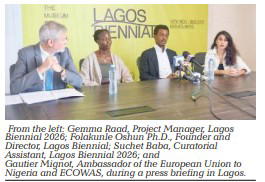
The fifth Lagos Biennial, curated under the theme “The Museum of Things Unseen,” will open to the public on 14 November 2026 and run until 6 December 2026 at Eko Atlantic City, Victoria Island, Lagos, featuring more than 70 artists from Nigeria and the wider world, with special pavilions from the European Union, Floating Museum Chicago and other cultural bodies.
Key details
- Dates: preview on 13 Nov 2026; public opening 14 Nov 2026 – closing 6 Dec 2026.
- Venue: Eko Atlantic City, one of Africa’s most ambitious urban projects.
- Participants: over 70 visual artists, plus international cultural organisations.
- Curators: Furen Dai, Chinyere Obieze and Sam Hopkins; artistic direction by Folakunle Oshun.
- Quote: “The Museum of Things Unseen invites us to reconsider what museums preserve, what they leave out, and how we might imagine new institutions that respond to our own histories,” said founder and artistic director Folakunle Oshun.
What is the central theme?
The exhibition interrogates the invisible layers of museum spaces, asking whose histories are omitted and whose voices are amplified. It imagines a museum built without structural inequities, prompting visitors to consider alternative forms of cultural preservation.
Who are the organisers and curators?
The Biennial was founded in 2017 by Nigerian artist and curator Folakunle Oshun. This edition is curated by Furen Dai, Chinyere Obieze and Sam Hopkins, with Oshun continuing as artistic director. Their combined vision seeks to blend installations, sculpture, photography, film and performance to explore visibility politics and collective memory.
Where is the event taking place?
The venue, Eko Atlantic City, represents a rapid urban transformation in Lagos. By situating the Biennial there, the organisers link contemporary artistic practice with the city’s evolving skyline, highlighting how cultural heritage interacts with modern development.
What new initiatives are introduced?
A highlight is the Akete Collection, an initiative aimed at establishing a permanent contemporary art museum in Lagos. The programme also includes public conversations, performances, and the Curatorial Lab Lagos, an international professional‑development platform for emerging curators.
How does this edition build on past Biennials?
Since its inception, the Lagos Biennial has repurposed historic sites—such as the Nigerian Railway Corporation compound in Yaba (2017), Independence House (2019) and Tafawa Balewa Square (2024)—into contemporary art venues. The 2026 edition continues this tradition by turning a cutting‑edge urban district into a space for artistic dialogue, reinforcing Lagos’s status as a growing cultural hub in Africa.
The event is expected to attract artists, curators, collectors and visitors from across the globe, further contributing to Nigeria’s expanding creative economy.