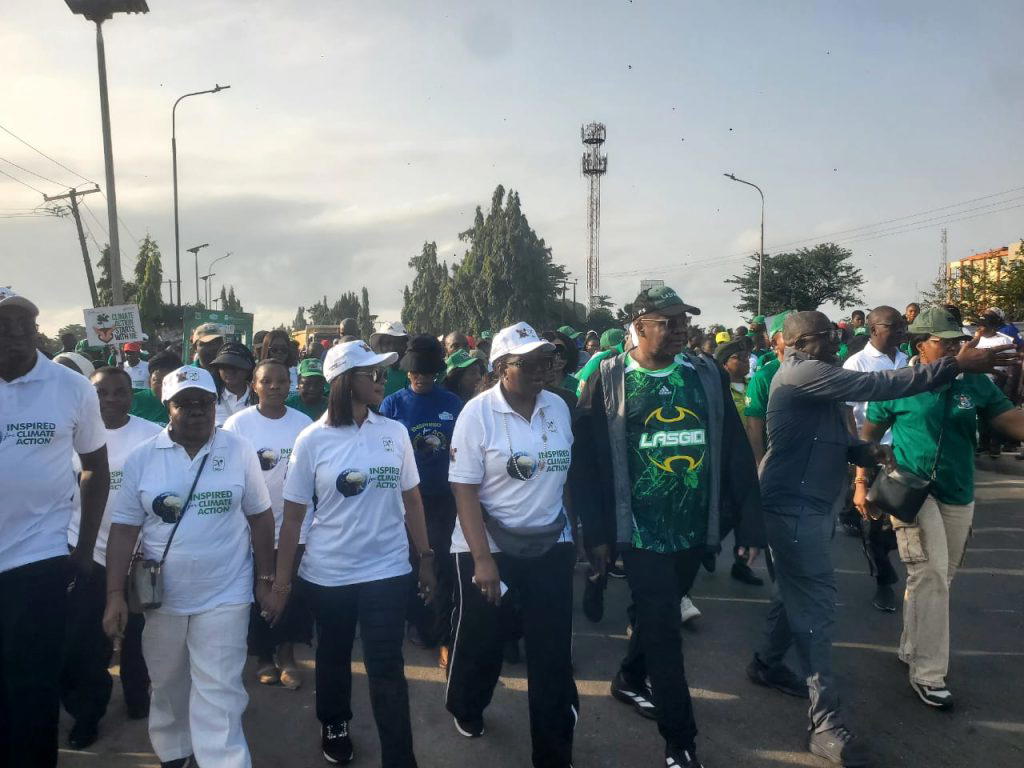
Governor Babajide Sanwo-Olu of [Lagos State Government](https://lagosstate.gov.ng) cautioned citizens and property developers on Saturday, October 20, 2026, that constructing on wetlands and drainage channels worsens flooding and coastal erosion. Speaking at the 20th Annual Walk for Nature, organised by the [Nigerian Conservation Foundation](https://www.ncf.org.ng) in partnership with the state, he announced a suspension of all reclamation activities that lack the required Environmental Impact Assessment (EIA) and drainage permits.
**Key points announced**
- Lagos produces roughly 13,000 tonnes of waste each day, with plastics making up about 15 % of that volume.
- Plastic debris frequently ends up in drains, canals and the lagoon, aggravating environmental degradation and flood risk.
- The state has banned Styrofoam and other single‑use plastics, enforcing the ban since 1 July 2025, with penalties for non‑compliant outlets.
- Development projects must now obtain both drainage and environmental approvals before proceeding.
- The administration is investing in drainage upgrades, mangrove restoration, tree‑planting and new park development.
> "Our wetlands, mangroves and lagoons are our first line of defence against > floods and coastal erosion. Where they are filled or built over, water has > nowhere to go," the governor said.
**What measures are being taken to protect wetlands?**
The governor disclosed that in September 2025 the state halted all reclamation works affecting wetlands, floodplains and lagoon fronts where developers failed to secure the necessary approvals. He stressed that Lagos’ coastal position, low‑lying topography and dense population make wetland preservation vital for public safety.
**How is the government addressing plastic waste?**
Sanwo‑Olu highlighted a ban on Styrofoam and other single‑use plastics, with enforcement actions already underway. He also announced collaborations with innovators to create sustainable alternatives and a push for environmental education in schools and communities.
**What role do educational institutions play?**
Represented by Dr. Omobolaji Gaji, Permanent Secretary of the Ministry of Environment and Water Resources, the governor urged Lagos State University ([LASU](https://lasu.edu.ng)) students to adopt waste‑separation practices, plant trees and hold both neighbours and authorities accountable for environmental stewardship. The Walk for Nature featured a campus‑to‑bus‑stop walk and the unveiling of a large plastic‑waste bin to promote responsible disposal.
Justice R. Adebiyi, Chair of the NCF National Executive Council, warned that Lagos sits at the forefront of Nigeria’s climate vulnerability, facing rising sea levels, flooding, extreme heat and wetland loss. She cited the Lekki Conservation Centre as a successful example of preserving ecosystems amid rapid urban growth and called on universities to champion waste separation, campus clean‑ups and energy conservation.
Corporate partners such as 7UP Bottling Company, Zenith Bank and Fidelity Bank pledged further support for sustainability initiatives, underscoring a collective effort to translate two decades of environmental awareness into concrete action for a livable Lagos.