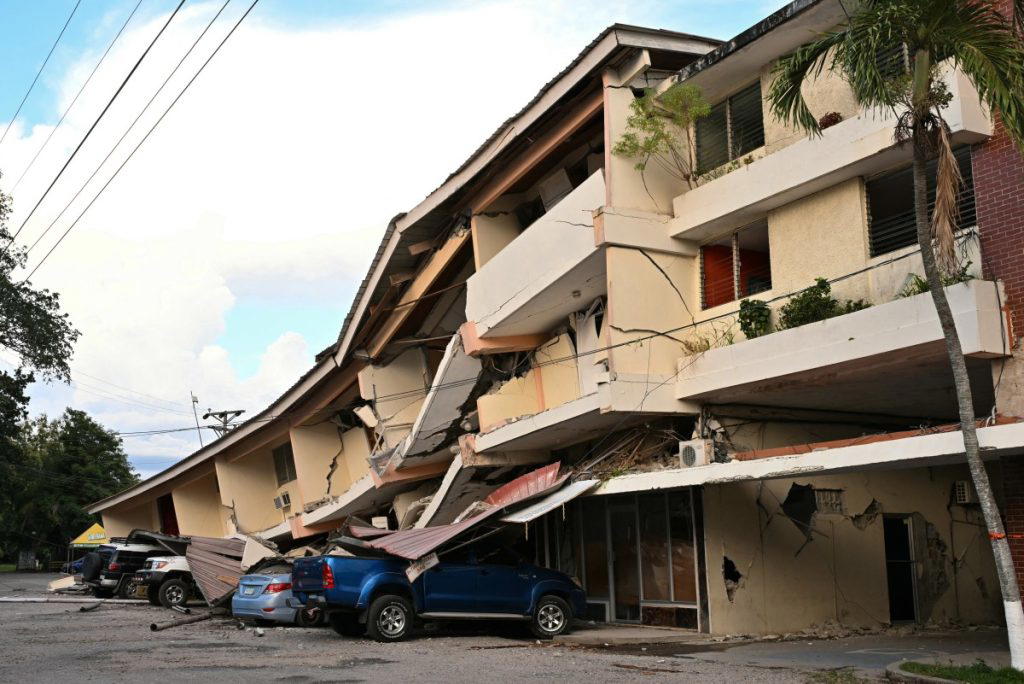
A powerful magnitude‑7.7 tremor hit central **[Panama](https://en.wikipedia.org/wiki/Panama)** on Friday at 12:56 pm local time (1756 GMT), causing building collapses, road failures and injuring at least 27 individuals, though no deaths have been reported so far.
The quake’s shallow focus was felt by roughly 4.5 million residents, according to the **[National Civil Protection System](https://www.gob.pa/)**, which also confirmed the casualty count and described the damage as “major.”
**What damage was observed?**
In Panama City, about 200 km (120 mi) from the epicentre, crowds fled iconic skyscrapers amid panic. One resident, 46‑year‑old Salomon Andion, recounted evacuating his 15‑storey block twice after aftershocks, describing furniture and kitchen items shaking violently. Video clips circulated online showing water spilling from a rooftop pool of a 20‑storey building and a bridge over the Panama Canal swaying yet remaining intact as traffic continued.
President **[Jose Raul Mulino](https://en.wikipedia.org/wiki/Jos%C3%A9_Raul_Mulino)** labelled the incident a “major disaster,” noting that several roads had completely collapsed. Residents such as 38‑year‑old cashier Juana Alveo from Penonomé reported personal trauma, including her daughter being trapped at school.
**How did authorities react?**
The US Geological Survey, which initially estimated the quake at magnitude 8.0 before revising it to 7.7, pinpointed the epicentre 10 km (six miles) from the small town of Pitaloza Arriba in Herrera province. A tsunami warning for the eastern Pacific was briefly issued and later withdrawn.
U.S. Secretary of State Marco Rubio announced on X that the United States was closely monitoring the situation and mobilising resources at Panama’s request. The Panama Canal Authority assured that shipping through the canal continued unaffected. Meanwhile, Panama City’s international airport was temporarily shut, prompting flight diversions as a precaution.
Health Minister Fernando Boyd identified Herrera, Coclé and Los Santos provinces as the hardest‑hit areas, noting that the town of Tonosí in Los Santos was completely isolated, with air access being the only viable option.
**What about aftershocks and further impacts?**
Local geoscience institutes recorded more than 80 aftershocks, including one exceeding magnitude 6.0. Former President Ricardo Martinelli posted images of his collapsed home in Veraguas province, while a church and hotel in Penonomé suffered extensive damage. The education ministry suspended classes nationwide, and President Mulino urged calm, warning against the spread of alarm.
Regional leaders from Colombia, Ecuador and Guatemala expressed solidarity and offered assistance. Residents in affected towns described widespread devastation, power outages and lingering fear of additional tremors.
The quake marks at least the fourth magnitude‑7.0‑plus event in Latin America this year, following severe earthquakes in Venezuela’s Guaira region in June and western Colombia in August.