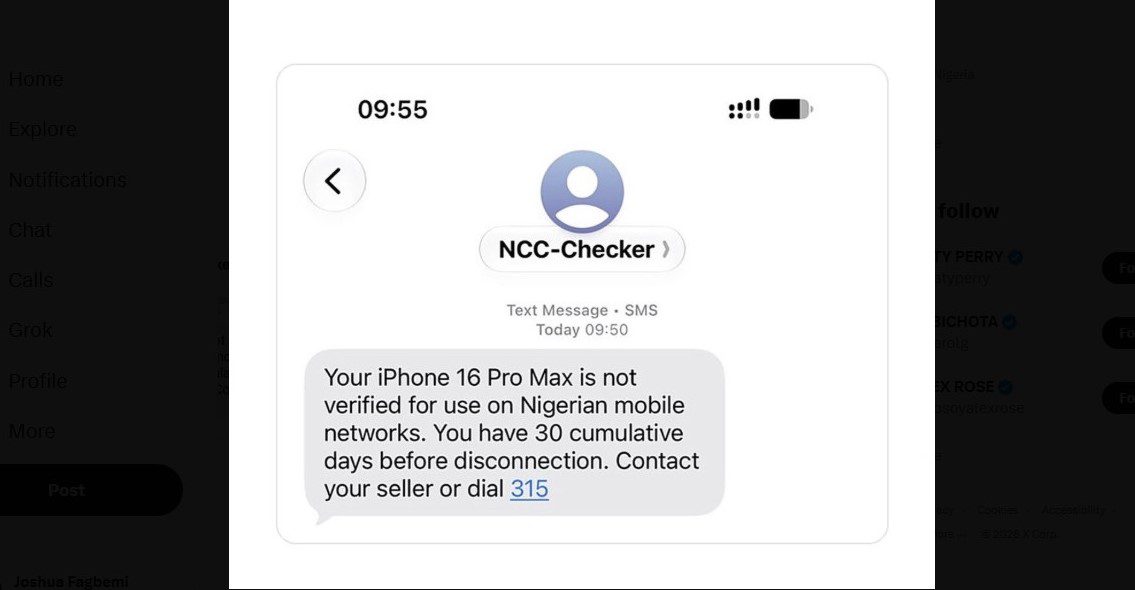
The [Nigerian Communications Commission (NCC)](https://ncc.gov.ng/) started sending SMS alerts on Saturday morning to owners of phones and other SIM‑enabled devices that have not been registered, giving them a 30‑day window before the devices are disconnected from Nigerian mobile networks.
**What does the warning say?**
The message, sent under the sender ID “NCC-Checker”, reads: “Your (Device Model) is not verified for use on Nigerian mobile networks. You have 30 cumulative days before disconnection. Contact your seller or dial 315.”
**Why is the NCC enforcing this rule?**
The latest directive from the commission’s [Device Management System (DMS)](https://en.wikipedia.org/wiki/Device_management) requires that every SIM‑enabled device – including smartphones, tablets, POS terminals and routers – be registered and verified before it can operate on any telecom network in the country. The move aims to eliminate fake, substandard or illegally imported phones that fail to meet safety and quality standards.
**How will the NCC track devices?**
By linking each device’s [International Mobile Equipment Identity (IMEI)](https://en.wikipedia.org/wiki/International_Mobile_Equipment_Identity) to a national register, the agency plans to deploy an automated [Central Equipment Identity Register (CEIR)](https://en.wikipedia.org/wiki/Equipment_Identity_Register) that can flag and block unregistered units.
**What should phone owners do?**
Owners are urged to contact their vendor or an authorised retailer to confirm that the device’s IMEI has been cleared and entered into the NCC’s database. They can also dial *315#* and follow the prompts. A successful check will display the message “This device is NCC Type Approved and verified for use on Nigerian mobile networks.” If the device is not approved, the 30‑day countdown to possible blocking begins.
**What is expected of vendors?**
The commission stresses that the regulation is not intended to hinder legitimate business. Phone sellers, especially those dealing in imported or refurbished units, must work with original equipment manufacturers (OEMs) and distributors to ensure every device complies with the registration framework, thereby avoiding customer disconnections.
**How have trade groups reacted?**
The Association of Mobile Phones and Allied Products Traders of Nigeria, which opposed the compulsory registration fee introduced in September, warned that the levy could be passed on to consumers, raising the cost of phones, routers, POS machines and tablets. Its president, Musa Haruna Mamza, said, “The registration fee might have an indirect impact on Nigerians as vendors will look to recover the levy by increasing the cost of mobile phones, routers, POS machines and tablets.”
**What next for the enforcement?**
The NCC’s rollout marks the start of active blocking of unregistered devices. Prospective buyers are advised to verify a device’s registration status before completing any purchase, whether new or used, to avoid future service interruptions.