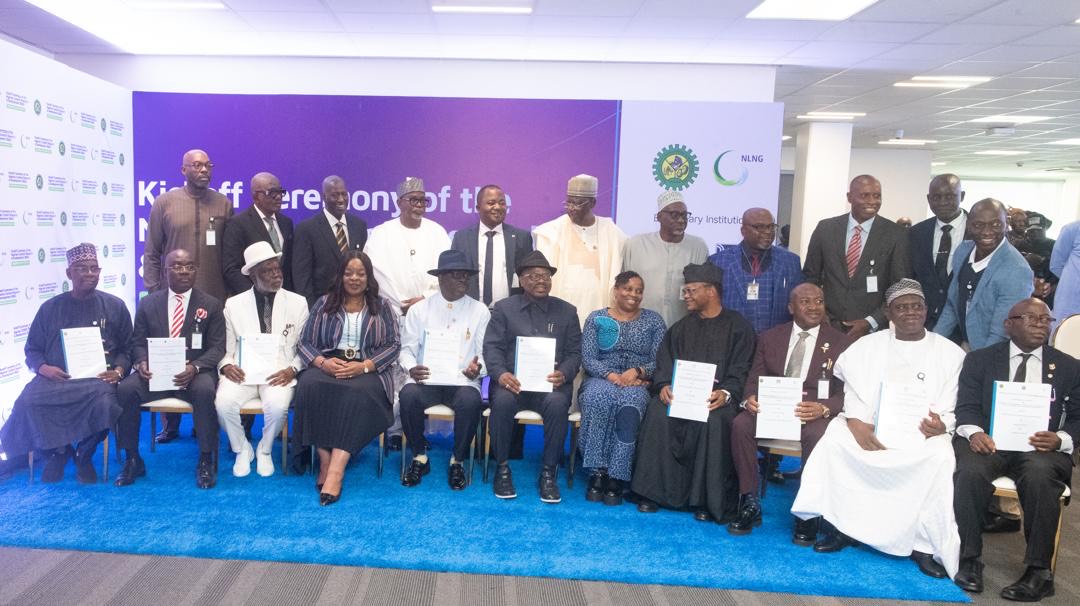
The Nigerian Content Development and Monitoring Board (NCDMB) alongside Nigeria LNG Limited (NLNG) has rolled out a $9 million professorial chair endowment scheme across six tertiary institutions in Nigeria. The initiative is designed to engineer commercially viable solutions for industrial bottlenecks, deepen domestic research capabilities, and stimulate technological advancement within the country.
Under the Nigerian Content Research and Development (NC-R&D;) Professorial Chair Endowment Programme, each participating institution is slated to receive $1.5 million. This capital will fund a specialized professorial chair tailored to predetermined industrial research demands under the regulatory guidance of the NCDMB's Planning, Research and Statistics Directorate.
The beneficiary ivory towers comprise the University of Ibadan in Oyo State, Rivers State University, Modibbo Adama University in Yola, Aliko Dangote University of Science and Technology in Kano State, the University of Nigeria, Nsukka, and Yakubu Gowon University, previously known as the University of Abuja.
What did industry leaders say about the initiative?
During the formal inauguration, NLNG’s Managing Director and Chief Executive Officer, Adeleye Falade, characterized the funding as a vital commitment to converting theoretical scholarship into tangible industrial outputs. Delivering his keynote address titled “Reshaping Nigeria’s Future Through Innovation, Research and Capacity Development,” Falade underscored the necessity of robust partnerships spanning the public sector, commercial enterprises, and academia.
“In the energy industry, we understand that technology and energy systems are evolving and the requirement for sustained research cannot be overemphasised,” Falade remarked.
He explained that the endowment will channel resources into pressing energy sector concerns, such as boosting operational efficiency, reducing carbon footprints, upgrading safety protocols, preserving vital infrastructure, and greening industrial processes. Falade further advocated for a collaborative "triple helix" model that unites government agencies, corporate entities, and universities through joint curricula, staff exchanges, and practical testing grounds.
How will the universities distribute their research focuses?
The six institutions have been assigned unique investigative domains. The University of Ibadan will concentrate on natural gas processing alongside pollution control and environmental management. Rivers State University is tasked with digital engineering, intelligent automation, and asset integrity, with its NLNG Research and Innovation Centre for Computer and Electrical Engineering (RICCEE) acting as a collaborative hub.
Modibbo Adama University will pursue studies in energy transition and ecological preservation, while Aliko Dangote University of Science and Technology takes on sustainable energy innovation and climate-resilient agricultural systems. Furthermore, the University of Nigeria, Nsukka, will specialize in green energy generation and geoenvironmental engineering, leaving Yakubu Gowon University to focus on geoscience and satellite intelligence for safeguarding gas pipelines and infrastructure.
Speaking on behalf of the NCDMB, Executive Secretary Felix Omatsola Ogbe—represented by Senior Technical Adviser Austin Uzoka—stressed that the investment bridges the historical divide between academic theory and practical manufacturing application. He urged the institutions to pivot away from publishing for the sake of promotion toward actionable innovation that fuels industrial transformation in Nigeria.