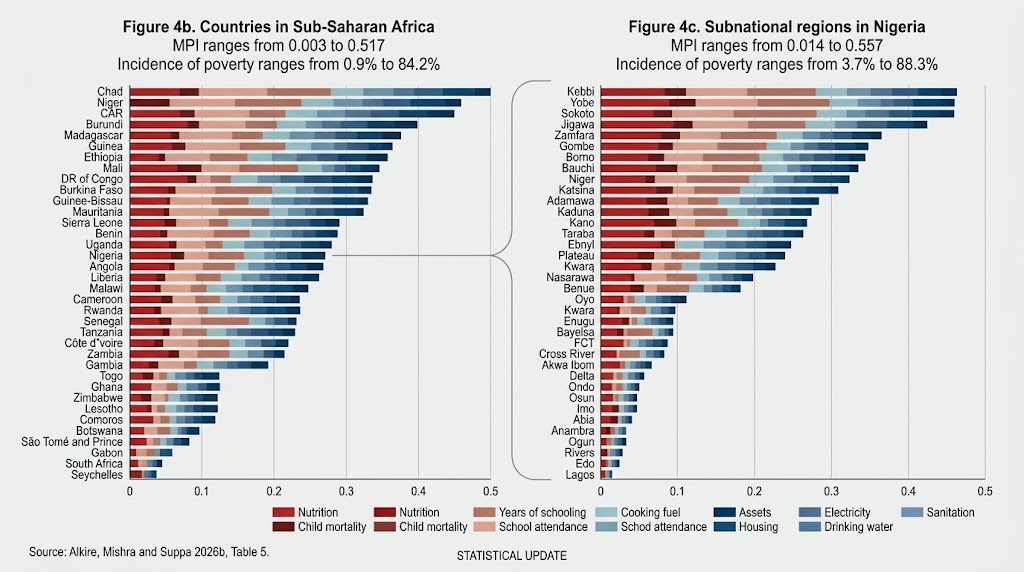
Nigeria’s tech ecosystem faces a stark reality: between 2021 and 2024 an extra 17.9 million people slipped into acute multidimensional poverty, raising the national poverty incidence from 33.0% to 38.7% and shrinking the effective consumer base for digital products.
**Key facts**
- The [2026 Global Multidimensional Poverty Index (MPI) Report](https://en.wikipedia.org/wiki/Multidimensional_Poverty_Index) recorded 113.3 million Nigerians living in multidimensional poverty, up from 95.4 million in 2021.
- Standard‑of‑living deprivations account for 40.6% of Nigeria’s overall poverty index, with 31.3% lacking electricity and 37.6% without clean cooking gas.
- Lagos enjoys a poverty incidence of just 3.7%, while Kebbi records 88.3%; northern states such as Sokoto, Yobe and Zamfara exceed 80% poverty rates.
- Only five countries saw an absolute rise in poor populations during the latest survey period, and Nigeria experienced the largest increase.
- A quoted analyst warned, “Scaling a consumer‑tech product to a household battling basic survival is a fundamentally flawed strategy.”
What does the MPI report reveal about Nigeria’s economy?
The report, compiled by the [Oxford Poverty and Human Development Initiative (OPHI)](https://www.ophi.org.uk/) and the [United Nations Development Programme (UNDP)](https://www.undp.org/), paints a picture of policy sequencing failures. While earlier years (2018‑2021) showed gradual poverty reduction, the recent surge has erased those gains, indicating that macro‑economic reforms under [President Bola Ahmed Tinubu](https://en.wikipedia.org/wiki/Bola_Ahmed_Tinubu) have weakened average purchasing power.
How does rising poverty affect the tech market?
Tech founders often tout Nigeria’s 200 million‑strong population as a demographic dividend. The MPI data, however, shows that a large share of the populace cannot afford basic electricity, clean cooking fuel, or reliable internet—prerequisites for most digital services. Consequently, the realistic total addressable market for fintech, SaaS, or Web3 solutions is limited to affluent urban clusters rather than the whole nation.
Which regions are most affected?
Sub‑national figures expose a deep north‑south divide. While Lagos records a modest 3.7% poverty incidence, Kebbi’s rate soars to 88.3%. Northern states such as Sokoto, Yobe and Zamfara each exceed 80% poverty, driven by severe deficits in water, electricity and child nutrition. Start‑ups that assume a uniform national market are, in effect, targeting only a handful of prosperous cities.
What strategic shifts should tech founders adopt?
- **Prioritise essential utility over convenience** – Products must directly cut living costs, generate income, or bypass broken infrastructure (e.g., micro‑insurance, off‑grid energy solutions).
- **Design offline‑first, low‑bandwidth solutions** – Heavy data usage and battery drain are barriers; USSD interfaces, lightweight protocols and agent‑led distribution can reach the bottom‑of‑the‑pyramid.
- **Move to B2B2C revenue models** – Direct household subscriptions are unsustainable; partnering with corporations, development agencies or cooperatives can subsidise end‑user costs.
What actions are needed from the government?
The federal response has been largely uniform, failing to address state‑specific poverty drivers. Effective intervention should:
- **Localise social registries** so states can pinpoint communities needing off‑grid solar versus maternal health services.
- **Fund state‑level innovation ecosystems** rather than awarding national contracts to large incumbents.
- **Redirect cash handouts toward physical infrastructure** such as mini‑grids, cold‑storage facilities, skill‑acquisition programmes and community broadband, thereby creating an environment where micro‑enterprises can thrive.
In summary, Nigeria’s massive population only translates into economic advantage when paired with human‑capital development, reliable digital access and disposable income. Without these, the sheer size of the market becomes a liability rather than an asset.