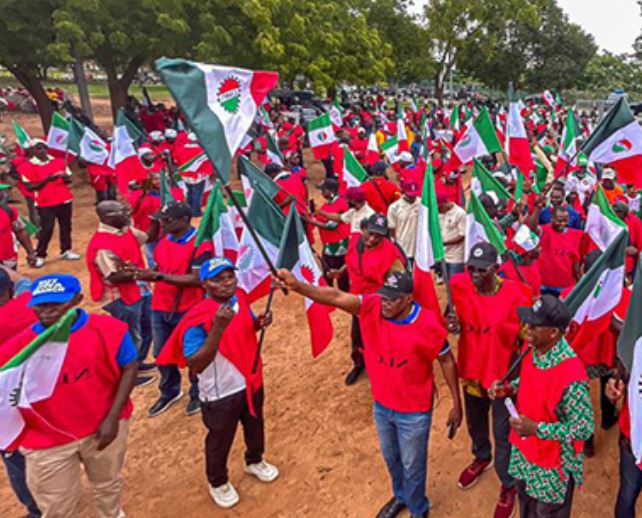
Abuja — The Nigeria Labour Congress (NLC) has accused the Federal Government of disregarding the statutory timetable for the next national minimum wage review, insisting that negotiations should already be under way rather than waiting until 2027.
NLC Acting General Secretary Comrade Benson Upah, speaking to Vanguard in Abuja, said the current N70,000 minimum wage was agreed on July 28, 2024 and backdated to May 1, 2024, but argued that the backdating did not alter the three-year review cycle introduced by the 2024 amendment to the Minimum Wage Act.
"In our estimation, the negotiations ought to have been on the way, or ought to be on the way, because one, the economic realities have since wiped out the value of the ₦70,000, upon which the minimum wage was premised," Upah said.
He explained that the 2023 amendment changed only two things: the wage figure, from ₦30,000 to ₦70,000, and the review cycle, from five years to three years. He added that neither change authorised government or labour to shift the commencement date of the three-year cycle at will.
"The principal act was not amended, and there was nothing in the amended items that states that the three yearly cycle can be abridged by either of the parties," Upah said.
He argued that, on the NLC's reading of the law, the three-year period should be counted from the earlier wage cycle, meaning negotiations ought to have started in June. He said the NLC had already alerted government to that position.
"But if you want to follow the government logic, which is actually an error, that because it took effect from May, that the three years will start from May, if you follow that logic, the negotiations ought to start in November, because the act talks about starting six months before the process.
"So, in our view, there is no reason to do tomorrow what can be done today."
Upah said the process of reviewing the minimum wage was lengthy and required hearings, consultations, a cost-of-living assessment and engagement with social partners.
"It is important for us to start early. Why must we run on a deficit calendar when we knew full well that this thing was going to start on a so-so date? It speaks to our state of unpreparedness," he said.
His position comes amid an ongoing dispute over when the next review should begin. The Federal Government has maintained that the current N70,000 wage is due for review on June 1, 2027, while organised labour has demanded immediate preparations for a new negotiation.
Asked about suggestions by some labour leaders that the next minimum wage would commence in August 2027, Upah dismissed the claim sharply, saying: "Whichever union leader that made that comment clearly spoke out of ignorance, and acted in error.
"Whichever index you use in assessing this matter, whether by way of fact or by way of law, we are on the right side of history."
Pressed on whether the government was right to rely on the Minimum Wage Act's stipulated duration, Upah said the NLC's interpretation was the correct one.
He said the 2024 amendment did not annul or alter the entire Minimum Wage Act, but only amended the wage figure and review cycle.
"So the presumption is that the cycle is a three yearly cycle, and it is not a cycle that either party can vary whimsically or at their whims and caprices, no.
"It is a statutory issue. It is already stated there, so I cannot wake up and say, okay, this is when the three years will start. Neither can government now say this is when the three years can start."
He hinted that the NLC was prepared to seek judicial interpretation if necessary.
"On this matter, let me tell you, we can go to court for an interpretation."