
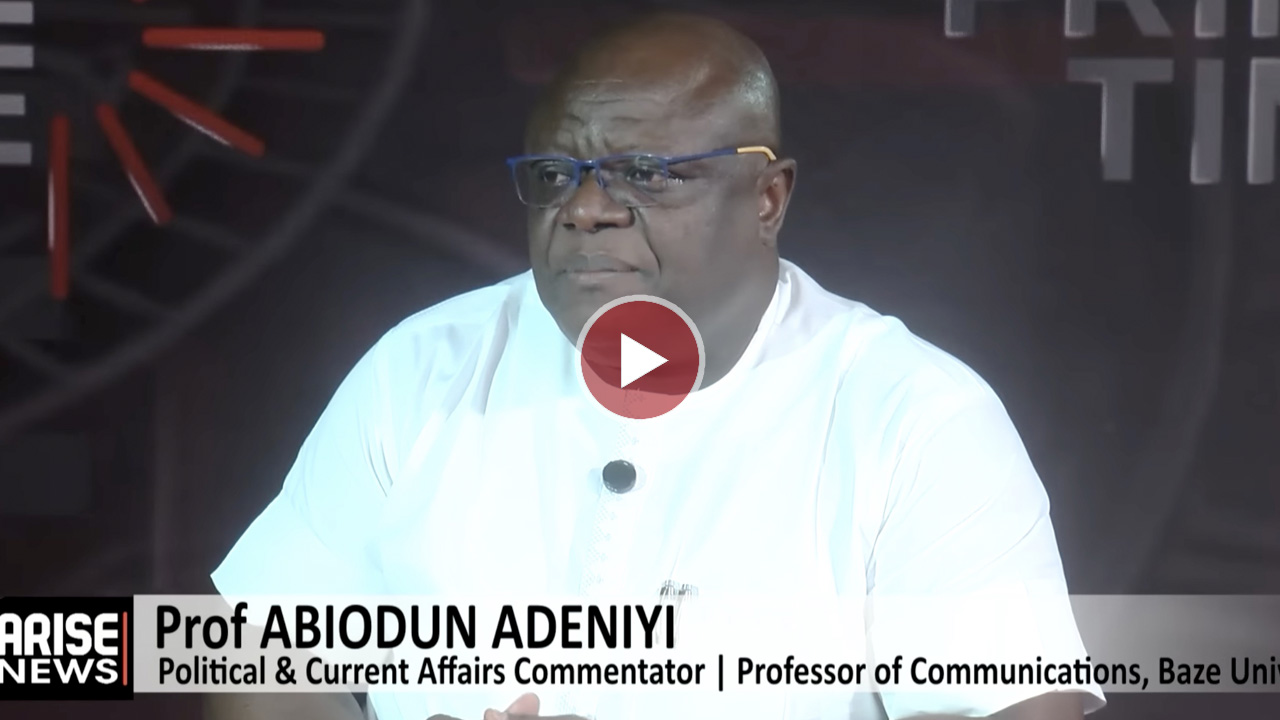
Professor Abiodun Adeniyi, a commentator on political and current affairs and a Communications professor at Baze University in Abuja, has observed that Peter Obi consistently provides a counter-narrative to the governing party, especially amidst notable fragmentation within Nigeria's opposition parties.
During a discussion with ARISE NEWS on Monday, Professor Adeniyi shared his insights on a recent interview featuring Peter Obi and the broader political landscape of Nigeria.
"It's beneficial that we're hearing from him again, as the opposition has been divided in recent months. Since the last election concluded, we've largely depended on figures from civil society, rather than opposition political parties, to articulate an alternative narrative against the ruling party. Along with former Vice President Atiku Abubakar, he stands as one of the few individuals offering such an alternative," Adeniyi stated.
Professor Adeniyi also touched upon the ongoing disagreements surrounding electoral administration and internal party conflicts, cautioning that these tensions expose deeper issues within Nigeria's democratic and judicial systems.
"It is unfortunate for the INEC Chairman that controversies have begun so early. While he attempts a legalistic interpretation, political processes in Nigeria are not solely about legal technicalities; political considerations are also vital. A significant flaw in our system is the transfer of internal party conflicts to the judiciary, where technicalities often overshadow the core issues of party dynamics," he warned.
Regarding Nigeria's security challenges, Professor Adeniyi emphasized that they stem from a combination of structural and socioeconomic factors. These include widespread poverty, high unemployment rates, weak governmental institutions, and diminishing prospects for the youth.
"He has maintained a consistent message about transforming the arable land in the North into the 'new crude oil.' When such consistency is evident, people begin to place their trust in it. However, we understand that insecurity is a complex issue arising from multiple sources: de-industrialization, inadequate education, widespread hopelessness, poverty, and poor governance."
He noted that while Peter Obi's proposals, such as enhancing agricultural development in the North, could help address some underlying causes, they might not be sufficient on their own to resolve the intricate nature of the crisis.
"Nevertheless, we recognize that insecurity is a confluence of factors: de- industrialization, a lack of education, pervasive hopelessness, poverty, and misgovernance. Although promoting agriculture in the North is a step towards a solution, it may not provide a complete answer. There's always an 'X-factor' in governance where the full reality isn't apparent until one is in a position of leadership. However, we can find some comfort in his conviction and the fact that he presents a distinct alternative," he remarked.
On whether Peter Obi's approach signifies a lasting transformation in Nigeria's political culture, Professor Adeniyi suggested it demonstrates a more measured and thoughtful demeanor.
"In general, he is composed. He is instinctively and thoughtfully introspective when he speaks. He maintains a calm disposition, chooses his words with care, and often imparts profound wisdom."
He further commented that political realities are typically more intricate than campaign promises, as developing alliances, party structures, and leadership discussions can rapidly alter expectations.
"One illustration is the notion that transforming the North into arable land is the exclusive solution to the crisis. Furthermore, concerning the ADC, he portrayed the situation as if it would not present the difficulties we are now observing. It would have been intriguing to witness the internal political strategizing within the ADC unfold—who would carry the party's banner or serve as the running mate—but currently, there is considerable uncertainty. We are also aware that it will not be an easy path; I doubt he would retain his current level of popularity if he were to play a secondary role to anyone else within that party," he elaborated.
He concluded that the interview did not significantly alter existing perceptions of Peter Obi, merely reinforcing his consistency and recognizable political style. According to Adeniyi, Obi continues to differentiate himself from a system frequently criticized for insufficient accountability and transparency, thereby offering Nigerians a distinct choice.
"It didn't truly change anything; it's the Peter Obi we've come to know. He remains exceptionally consistent. He stands apart from a system often plagued by a lack of transparency and accountability. His personal conduct, modesty, and earnest approach reflect his character. Even if he doesn't ultimately achieve his goals, Nigeria benefits from having an individual who embodies a genuine alternative."
Comments (0)
You must be logged in to comment.
Be the first to comment on this article!