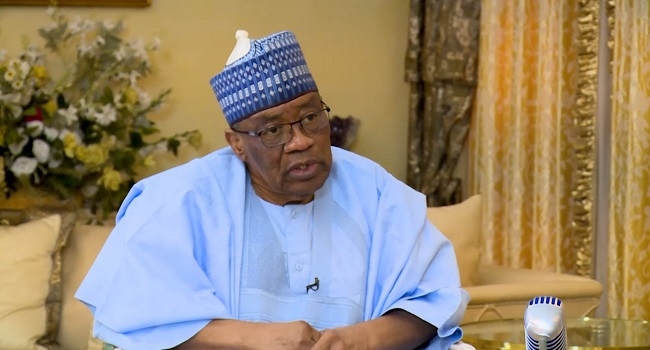
Monica Oguta, Head of Aviation Security at Bi‑Courtney Aviation Services, writes a personal reflection on former Head of State [Ibrahim Badamasi Babangida](https://en.wikipedia.org/wiki/Ibrahim_Badamsi_Babangida)’s autobiography *A Journey in Service*, emphasizing the book’s revelations about nation‑wide institution‑building, security restructuring and diplomatic outreach.
**Key points from the memoir**
- The autobiography was published in 2026 and covers Babangida’s tenure as Commander‑in‑Chief from 1985 to 1993.
- It documents the creation of several lasting bodies, including the Federal Road Safety Corps, the Nigeria Deposit Insurance Corporation, the National Drug Law Enforcement Agency and the National Broadcasting Commission.
- Babangida acknowledges the June 12, 1993, presidential election and Chief M.K.O. Abiola’s victory, noting the subsequent annulment.
- The author quotes herself: “I was struck by the breadth of institution‑building, reforms and strategic thinking that characterised your administration.”
What institutions emerged under Babangida’s rule?
During the eight‑year period, the government launched the [Federal Road Safety Corps](https://www.frsc.gov.ng/), a dedicated agency to enforce traffic laws and reduce road fatalities. It also established the Nigeria Deposit Insurance Corporation to protect depositors, the National Drug Law Enforcement Agency to combat narcotics, and the National Broadcasting Commission to regulate the airwaves. These entities continue to operate decades later, illustrating the durability of the reforms.
How did the security architecture change?
The memoir details a comprehensive overhaul of Nigeria’s security and intelligence framework. Separate bodies were created for domestic policing, external intelligence and defence intelligence, a structure that has largely persisted for four decades. As a security professional, Oguta finds this compartmentalisation particularly noteworthy.
Which foreign‑policy initiatives were highlighted?
Babangida’s book devotes a chapter to the Technical Aid Corps, a programme that sent Nigerian experts to African, Caribbean and Pacific nations. The initiative, linked to the [Technical Aid Corps](https://en.wikipedia.org/wiki/Technical_Aid_Corps), was designed to project soft power and foster goodwill while showcasing Nigeria’s human‑capital capacity.
What controversies does the autobiography address?
The author notes that the memoir does not shy away from contentious topics such as the Structural Adjustment Programme, the June 12 election annulment and other difficult decisions. Babangida’s own reflections on these events provide a nuanced perspective that invites further scholarly debate.
Why does the book matter to contemporary readers?
Oguta argues that the lasting value of the memoir lies in its illustration that institutions outlive individuals. Policies may shift, governments change, and public opinion evolves, but the creation of enduring bodies embeds a leader’s legacy within the state’s machinery. The reading, she says, deepened her appreciation for the complexity of leadership, the weight of decision‑making and the inevitability of mistakes.
In conclusion, the autobiography offers more than a personal chronicle; it serves as a window into a pivotal era of Nigerian history, reminding readers that a nation’s development is built on the institutions its leaders establish.