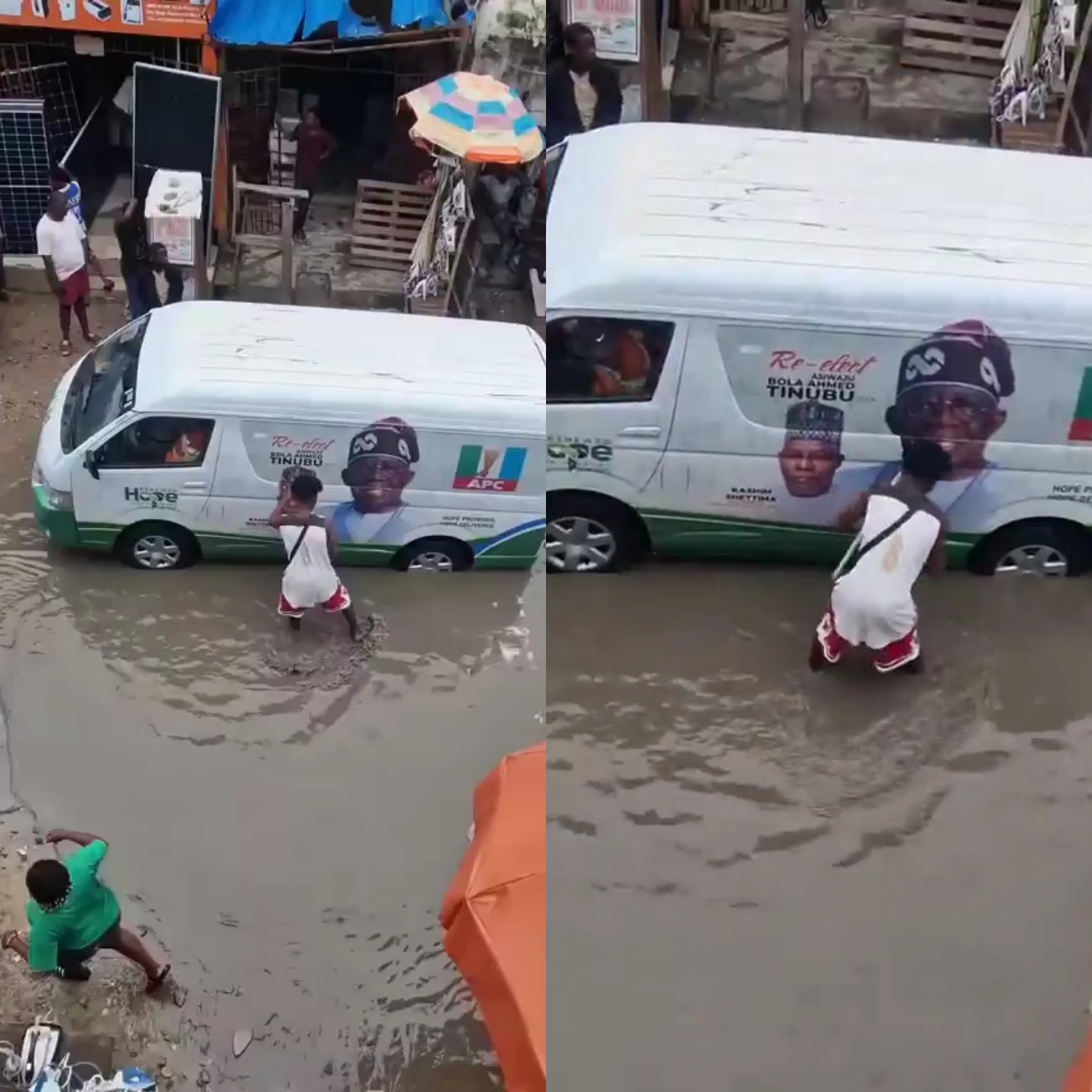
Residents of Lagos State were captured on camera openly ridiculing the occupants of a campaign vehicle belonging to the All Progressives Congress (APC) after the transport became deeply stuck in a flooded and severely damaged roadway at the Alaba Market.
Footage circulating online depicts individuals inside and outside the Toyota Hiace minibus, which was branded with party insignia and candidate photographs, struggling to extricate the vehicle from thick mud and standing water. Onlookers refused to assist, with voices heard declaring that the ruling party vehicle would receive no help.
What are the key facts surrounding the incident?
- The event occurred on a deteriorated road within the Alaba Market commercial district in Lagos.
- Bystanders utilized the opportunity to voice sharp criticisms regarding infrastructural decay and the governance track record of the administration.
- Similar occurrences have been documented previously, including an incident roughly one month prior where another party campaign bus got bogged down on a bad road in Ebonyi State.
- Prominent public figures, including political analyst Professor Pat Utomi, publicly commented on the irony of the situation in relation to prevailing national political slogans.
Why did onlookers refuse to assist the vehicle?
Passersby and local traders used the unfortunate situation to vent their frustrations over prolonged neglect of local infrastructure. Many pointed out that commercial hubs generating significant economic activity continue to grapple with impassable roads during the rainy season.
Reacting to the development via social media commentary, Professor Pat Utomi remarked sarcastically about the condition of the infrastructure and political catchphrases, noting that patience and endurance were being tested by abandoned public works.
This occurrence adds to a growing list of public infrastructure embarrassments for political actors moving through grassroots areas during campaign periods, drawing sharp contrasts between official promises of renewal and the physical reality of Nigerian roads.