Senator Ben Obi, former Special Adviser on Inter‑Party Affairs to President Goodluck Jonathan, says he launched the National Peace Committee and coordinated the Abuja Peace Accord that united Jonathan and Muhammadu Buhari ahead of the 2015 general election, an effort later praised by the United Nations and recognised with a Vanguard Lifetime Achievement Award.
**Key facts**
- The National Peace Committee was conceived in 2014 while Obi served as the President’s Special Adviser on Inter‑Party Affairs.
- The Abuja Peace Accord was signed in early 2015, bringing the two presidential contenders together under a memorandum of understanding for peaceful elections.
- Former UN Secretary‑General Ban Ki‑moon noted the accord, and his envoy Ambassador Ibn Chambas later commended Obi for the initiative.
- Vanguard announced that Obi will receive its Personality of the Year Lifetime Achievement Award in January 2027.
- Obi introduced the Nigerian Anti‑Terrorism Agency Bill and the Anti‑Terrorism Bill during his first Senate term in 2005.
- He quoted, “I founded the National Peace Committee. It was my baby,” reflecting his personal investment in the peace process.
How did the National Peace Committee take shape?
Obi explained that his role in the presidency gave him direct access to political parties across the country. “At the time, I was the Special Adviser to the President on Inter‑Party Affairs. Most of the political parties were, in one way or another, under my direct engagement, while others had their offices on the premises of my office. So, I knew all of them, and I got them involved,” he said.
He identified the Inter‑Party Advisory Council (IPAC) as the primary channel for securing party participation. Working with Bishop Hassan Kukah, Obi selected former Head of State General Abdulsalami Abubakar (rtd) as the committee’s chairman and later approached John Cardinal Onaiyekan to join a 23‑member steering team. The bishop’s centre was chosen as the committee’s base because it offered suitable facilities.
What was the Abuja Peace Accord?
The accord materialised as a memorandum of understanding signed by [Goodluck Jonathan](https://en.wikipedia.org/wiki/Goodluck_Jonathan) and [Muhammadu Buhari](https://en.wikipedia.org/wiki/Muhammadu_Buhari) in early 2015, committing both to conduct peaceful elections. Obi coordinated the meeting that led to the signing, an effort that attracted the attention of former UN Secretary‑General Ban Ki‑moon. He noted that the accord continued to be referenced in Jonathan’s overseas engagements between 2015 and 2018, with the former president often attributing the initiative to his special adviser.
Obi also recounted that Ambassador Ibn Chambas, the UN’s Special Envoy for West Africa, visited him to commend the accord and suggested formalising the National Peace Committee.
Why is Obi being honoured by Vanguard?
Vanguard’s award citation highlights Obi’s long‑standing contribution to Nigeria’s democratic development. Beyond the peace initiative, he introduced anti‑terrorism legislation in 2005, served as National Secretary of the All Peoples Party, ran as the Action Congress vice‑presidential candidate in 2007, and held various senior advisory roles. The newspaper described him as an elder statesman whose experience spans multiple administrations and whose perspectives remain vital for the nation’s stability.
What does the future hold for political peace in Nigeria?
Obi stresses that while the Abuja Peace Accord set a precedent, the ongoing challenge is to ensure that political competition never undermines peaceful elections or national stability. He urges continued dialogue among parties and sustained commitment to the principles that guided the National Peace Committee.
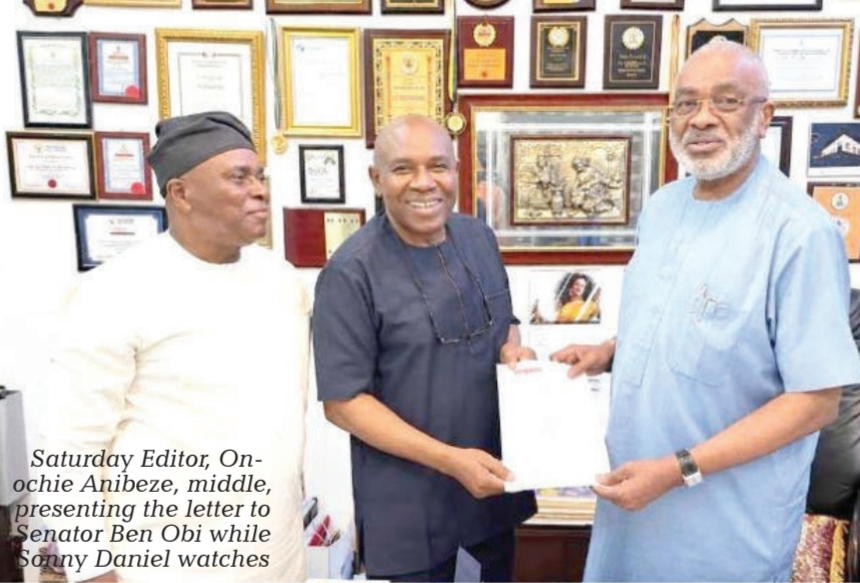
*The Vanguard team visited Obi at his Abuja residence to present the award letter and record his recollections of the peace process.*