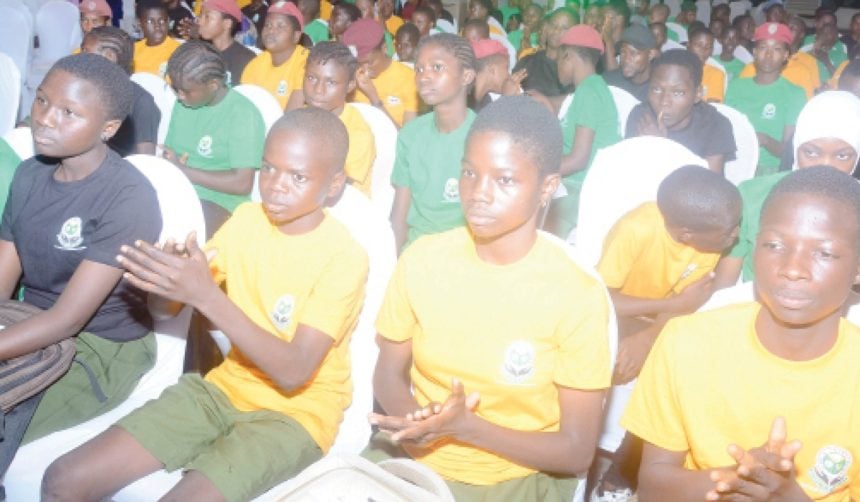
Secondary school students from public institutions across the South-West region gathered at the University of Ibadan on Friday to exhibit homegrown digital applications addressing local challenges, including security threats and examination malpractice. The event marked the second edition of the Byte Busters Coding Club Showcase, an initiative promoted by the Odu'a Investment Company Limited through its foundation.
Key figures from the region's academic and corporate sectors attended the exhibition at the institution's International Conference Centre. Prominent among them was Ambassador Olatokunbo Awolowo Dosumu, Chairman of the Advisory Council for the Odu'a Investment Foundation, alongside Professor Seun Kolade, the Director of the Digital Education for Innovation and Economic Development (DEFINED) Project.
Which innovations took center stage at the exhibition?
Students from Aramoko District Commercial Secondary School clinched the top prize by developing a mobile application named the Safe Guardian App. Team leader Johnny Pius explained that the tool allows users in emergency situations—such as kidnapping and banditry—to quickly alert trusted contacts and share their live geographical coordinates.
Other notable inventions featured at the showcase included an artificial intelligence-driven computer-based testing platform, an agricultural tool known as Tomato AI, sign language translation software, and digital marketplaces tailored for local traders. Additional projects focused on mitigating maize post-harvest losses and translating languages between Yoruba and English.
How has the Byte Busters initiative grown?
Launched in the previous year with approximately 100 learners across nine centers, the DEFINED Project has expanded rapidly. Project Director Seun Kolade reported that the scheme now operates across 20 centers spanning 18 local government areas in the six South-West states, impacting over 4,500 beneficiaries.
Furthermore, the initiative has integrated a train-the-trainer model for educators. During the inaugural teacher training cohort, 67 out of 72 participants successfully completed the curriculum, with organizers targeting 3,000 trained teachers by the close of the year.
What did stakeholders say about the future of digital education?
Ambassador Awolowo Dosumu emphasized the necessity of preparing young people to actively create technological solutions rather than remaining passive consumers. She appealed to state governments, corporate entities, alumni associations, and philanthropists to increase funding and resource allocation for the project.
Echoing similar sentiments, Professor Ayoade Ogunkunle, Pro-Chancellor of Emmanuel Alayande University of Education, drew parallels between historical educational milestones in the region and contemporary digital drives. He noted that while Chief Obafemi Awolowo pioneered free primary education in Western Nigeria decades ago, his descendants and modern stakeholders are championing free digital literacy to prepare youths for a knowledge-driven global economy.