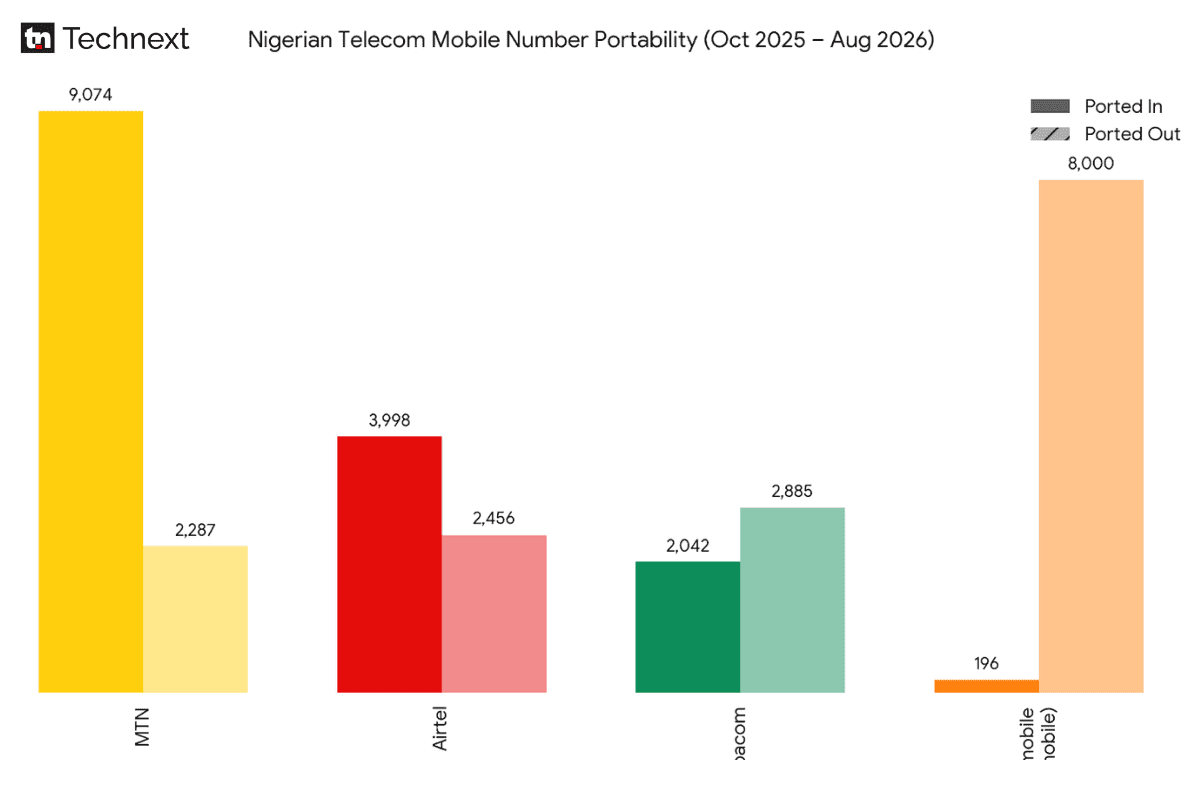
T2mobile, the new brand for former 9mobile, entered a three‑year national roaming agreement with MTN Nigeria on 1 October 2025 in an effort to improve coverage and halt a falling subscriber base, yet NCC data shows the operator lost nearly 8,000 customers between October 2025 and August 2026, leaving it with only about 3.6 million users – the lowest of the four major Nigerian operators.
**Key figures from the regulator**
- Between Oct 2025 and Aug 2026, about 7,950 lines were ported away from T2mobile.
- In the same period, MTN recorded the fewest outbound ports (2,287), followed by Airtel (2,456) and Globacom (2,885).
- T2mobile attracted only 196 inbound ports, the smallest number among the operators.
- MTN gained the most new lines (9,074), with Airtel adding 3,998 and Globacom 2,042.
- The operator’s total subscriber count stood at 3.6 million as of August 2026, compared with MTN’s 11.5 million, Airtel’s 8.4 million and Globacom’s 1.8 million.
What prompted the rebrand and roaming deal?
[9mobile](https://en.wikipedia.org/wiki/9mobile) officially changed its name to T2 on 8 August 2025 after Lighthouse Telecommunication Limited acquired a 95.5 % controlling stake. The new brand was paired with a three‑year national roaming agreement with [MTN](https://www.mtn.com.ng) to allow T2mobile customers to use MTN’s infrastructure where the former’s network was weak or absent, offering a cost‑effective way to improve service reliability.
How does the roaming agreement work?
The deal lets T2mobile users make calls, send SMS and access data on MTN’s towers in coverage gaps, while MTN gains access to under‑utilised 900 MHz, 1800 MHz and 2100 MHz spectrum owned by T2mobile, boosting its capacity in densely populated areas.
What did the leadership say?
Obafemi Banigbe, Chief Executive Officer of T2mobile, described the partnership as a “commercial partnership focused on operational efficiency”, emphasizing that it is a model of “co‑opetition” rather than a merger or coalition.
Did other initiatives help?
The operator also signed a multi‑million‑dollar agreement with Huawei to upgrade its network, but later faced a setback when IHS Towers demanded the removal of 2,576 tower sites over unpaid debts.
How is the network performing?
A joint Quality of Experience study by the [Nigerian Communications Commission](https://ncc.gov.ng) and Ookla, covering tests from June 2025 to May 2026, recorded download speeds of 18.9 Mbps in urban areas and 10.1 Mbps in rural zones for T2mobile. Upload speeds lagged at 1 Mbps (urban) and 1.3 Mbps (rural). Latency averaged 77.5 ms, higher than MTN’s 33 ms, Globacom’s 35.5 ms and Airtel’s 36 ms.
What lies ahead?
One year after the roaming arrangement began, T2mobile’s subscriber base remains the smallest in the market, suggesting that network sharing alone may not be enough to revive the brand’s standing.