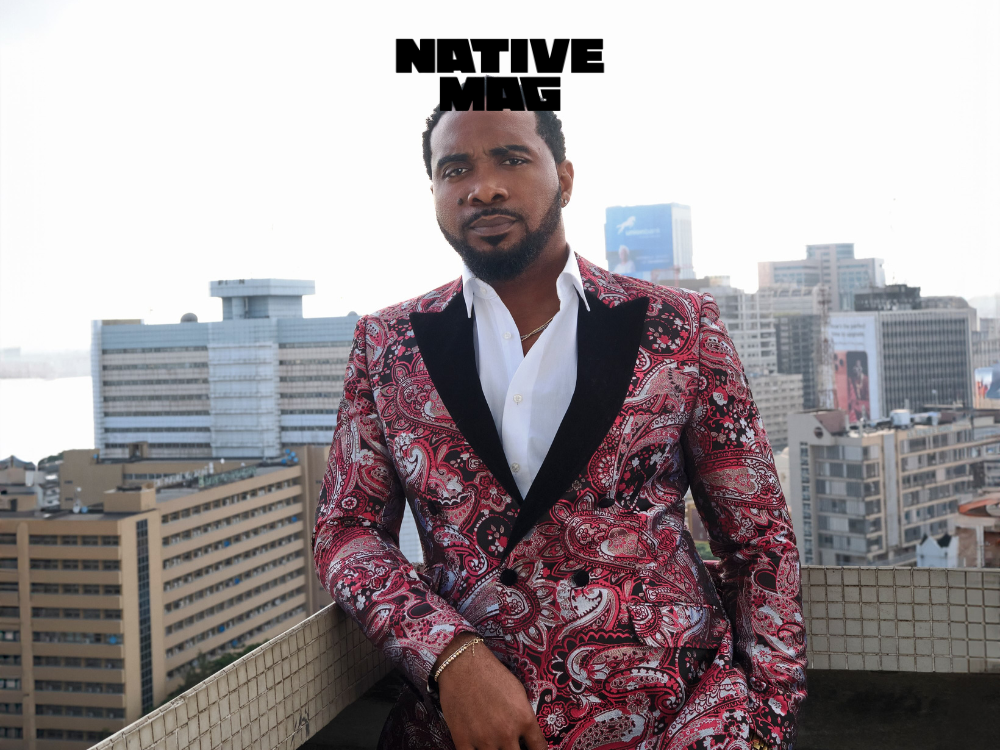
An Odogwu, a warrior, a zombie slayer, conflicted twins: throughout Uzor Arukwe's career, the actor has collected characters like infinity stones. When you browse through Nollywood's large catalogue, you realize that there is an Uzor Arukwe film for every season; the actor made it deliberately so. This choice was a bet on himself. He wanted everyone to see what he knew he had: talent! 'Back in the day, my colleagues used to diss me because I took on everything that came my way,' he says. 'But I tried to tell them I'm an artist and if you hire me for a job, I'll do the job well. I don't want to do just cinema films, the big screen films or small screen films. I want to be an actor that cuts across every platform.'
This non-discriminatory ethos he built was one of the good cards he played in the long game that is his career. It landed him his most recognizable roles: Love in Every Word's Odogwu Paranran, and his AMVCA-winning Akinbode from Colours of Fire. 'I never go into any film thinking it will be a success,' Arukwe says on the performance of Love in Every Word. The romantic comedy follows a wealthy man played by Arukwe who falls in love with a woman (Bamike 'Bam Bam' Olawunmi) at first sight and becomes willing to go to any lengths to win her heart despite her doubts.
The first week of the film's release saw remarkable reception; the viewing numbers shot up to millions and are currently at thirty-four million views. There were tweets that rolled over tweets, reels upon reels, and the term 'Odogwu Paranran'—an endearment the leading lady reserved for Arukwe's character—became embedded in Nigerian Pop culture. In the West, women seek their prince charming, but in Nigeria, the women long for their Odogwu Paranran.
As it is the business ritual of most films that do well, Love in Every Word secured a sequel. While it is the desire of every actor to keep moving from set to set, Arukwe is not too big on sequels. His opinion on sequels only tilts a bit if the film's ending was open-ended: 'At some point, I didn't think Love in Every Word needed a sequel. We did it, but Omoni Oboli will tell you that I was reluctant'.
Movie industries across the globe are being run on existing IPs: sequels, prequels, and reboots. And because the Hollywood blueprint is leading this charge, the rest of the world follows suit. This is not to say that sequels have not long been a business strategy, but it is happening at an alarming rate, and actors are left to grapple with this. It is first the wish of an actor to be on screen, and this wish is followed closely by the hope that it pays their bills. It's a conundrum that Arukwe understands. 'If the franchise extends into a part 3 and 4, I'm open as long as the money and script are right,' he says.
It then begs the question: when does an actor walk away from a character?
'I would say it depends,' he admits. 'It's very subjective and depends on where the actor is headed, whether they have a team, and what the entire team wants for their career. But I think that at any point, if you no longer agree with the character, you have every right to walk away from it, no matter how lucrative it is. We've seen it happen over and over again, even in Hollywood, where actors say, 'You know what? I'm done playing this character.'
The actor believes there is a character he might walk away from someday, but that decision, he says, is not fully his to make. He shares a relationship with his management, Guguru Media, that has made him comfortable with never making decisions alone. He also lives by a creed: 'My body is a canvas,' and in the span of his career he has been painted over time and time again.
The answer to how he's been able to shapeshift several times lies in connection: 'I always look for some connection between myself and the character,' he admits. 'There is always something that connects me to the character and makes the performance as natural as possible.' For Odogwu Paranran, he shared the same tribe with the character. He also had uncles who are chiefs, and he imitated them. For Colours Of Fire's Akinbode, he related to the male instinct to protect, and he saw a man whose love was ridden by roadblocks.
The role of Akinbode was particularly a sharp turn from the Odogwu Paranran character that fans fell head over heels for. He didn't think much of the pivot. To him, it was another day at work. 'It's the work,' he says. 'It's what we live for as actors. Love in Every Word was a YouTube film, while Colours Of Fire was a cinema film. A person away from the craft would think that the preparation for both films would be different because of the nature of their distribution. People tend to turn their noses up at Nollywood films on YouTube because of their low budgets, and are more receptive to films showing in the cinemas.'
He continues, 'I always try to bring my A game to everything I do, regardless of whether it's cinema, YouTube, African Magic, streaming, Netflix, Amazon, or whatever platform it is. I just try to perform at the highest level I possibly can. And for me, that's what does the magic.'
In his latest outing, One Gidi Night, Arukwe takes on dual characters. It was his first time playing twins. The characters wear contrasting looks, one with dreads, the other bald, reminiscent of P-Square. Described as a 'gritty, real- time neo-noir thriller,' One Gidi Night is a story about how far a 'good' man will go when pushed to the wall. This was the role he admits stretched him the most in recent times. 'Aside from the hairstyles, the voice pitches were different,' he shares. 'One of them spoke on a higher octave than the other, and the mannerisms were different. It was a lot of work.'
All the shoes he has taken miles in have shown him the kind of actor he is becoming. 'I want to be an actor's actor, a director's actor,' he admits. 'I want my colleagues to be able to say, 'I love acting with Uzor because he gives me everything I need to shine and perform.' I want directors to say, 'I love working with Uzor because he understands exactly what I need.'
When the credits roll, the screen goes blank and the curtains close, Uzor Arukwe wants to be remembered as 'one of the best to ever do it.' Looking at all the strides he's made in recent years, he is well on his way to achieving this objective.