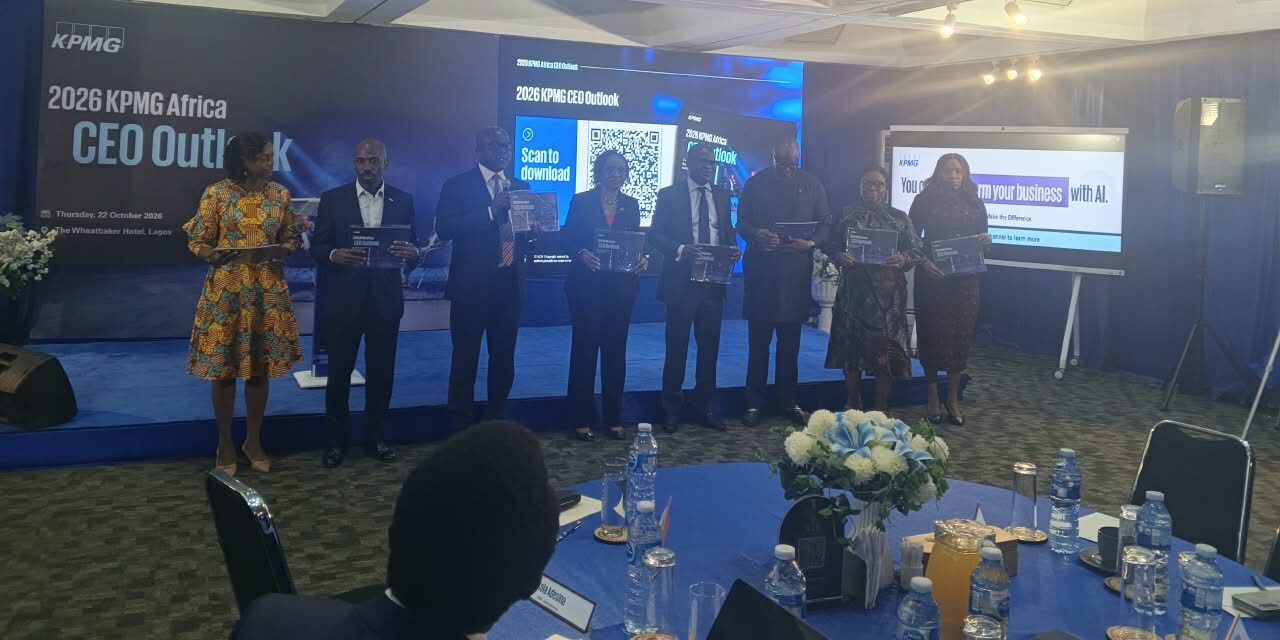
A [KPMG](https://home.kpmg/ng/en)‑commissioned study unveiled in Ikoyi, Lagos on Thursday indicates that 72 % of African [chief executive officers](https://en.wikipedia.org/wiki/Chief_executive_officer) consider artificial intelligence (AI) a top investment focus, but merely 14 % think their companies are keeping pace with or surpassing AI developments.
**What does the survey reveal about AI investment timelines?**
- Only 48 % of African CEOs anticipate seeing returns from AI projects within one to three years, compared with 71 % globally.
- Conversely, 42 % expect a payoff period longer than three years, versus just 12 % of their global peers.
- The extended horizon is attributed to the need for stronger data infrastructure, system integration, governance frameworks and skill development.
**How are CEOs viewing workforce implications?**
- 84 % of African CEOs forecast an increase in headcount over the next three years, slightly below the 89 % global figure.
- 86 % plan to retain and up‑skill high‑potential staff, while 82 % are redesigning roles to enable human‑AI collaboration.
- Nevertheless, 59 % cite skills shortages, 58 % highlight AI‑specific upskilling needs, and 52 % struggle to attract and keep talent.
**What security concerns are emerging?**
- Cybersecurity and data security rank as the top threats for 31 % of African CEOs, alongside supply‑chain resilience.
- In response, 45 % intend to boost spending on cybersecurity and digital‑risk resilience, 36 % on regulatory compliance, and 31 % on AI integration.
**What is the overall economic outlook?**
- Confidence in the global economy stands at 66 % for African CEOs, mirroring the 65 % global benchmark.
- Domestic confidence reaches 72 %, and 79 % are optimistic about their own organisations’ growth.
- Revenue growth was reported by 86 % of CEOs in the latest financial year, yet only 58 % expect earnings to rise by at least 2.5 % annually over the next three years.
**What did senior KPMG leaders say at the launch?**
Tola Adeyemi, senior partner and chief executive officer of KPMG One Africa, remarked that the survey was designed to challenge prevailing assumptions, spark fresh ideas and validate decisions already being taken. He warned that ambition alone will not deliver outcomes, stressing the need for disciplined execution and resilience. Adeyemi also disputed the notion that AI adoption will inevitably cut jobs, arguing that African CEOs anticipate workforce expansion as technology is embedded, describing it as “rescaling the workforce and seeking different talent to work alongside technology to optimise results.”
**How does sustainability feature in the findings?**
- 65 % of CEOs say their firms can meet new sustainability reporting requirements, up from 55 % a year earlier.
- However, only 48 % report embedding sustainability deeply into core strategies, lagging behind the 63 % global average.
**What broader challenges are highlighted?**
The report points to economic uncertainty and geopolitical disruption—particularly volatile energy prices and supply‑chain pressures—as key factors influencing operating costs and investment decisions across the continent.
Overall, the KPMG Africa CEO Outlook underscores that while AI is high on the agenda, realising its benefits will depend on closing the readiness gap through infrastructure upgrades, skill development, robust governance and sustained investment in security and sustainability.