
Aliko Dangote, recognized as Africa's wealthiest individual, recently spoke to The Economist during an interview on March 12th at his Lagos office. Upon returning after a brief absence, he noted a significant 10% surge in crude oil prices attributed to recent developments in the Gulf region. He remarked, "It’s a crazy situation right now, and I believe it will persist for a while."
In times of global economic upheavals, African entrepreneurs often find themselves on the sidelines. However, Dangote stands out as a notable exception. In 2023, almost a decade after its conception, the 68-year-old businessman inaugurated the largest refinery complex in Africa, located just outside Lagos and occupying an area nearly half the size of Manhattan. Capable of processing 650,000 barrels of oil daily, Dangote's new venture has drawn considerable interest from potential buyers. He remarked, "People are willing to pay anything now," albeit with a hint of exaggeration.
The refinery not only epitomizes Dangote's rising affluence and influence but also marks the largest project undertaken by the Dangote Group, the business empire behind his estimated net worth of $28.5 billion. This fortune allows him to be the sole African included in Forbes' list of the world's 100 richest individuals. Nevertheless, Dangote suggests the refinery signifies a larger vision: Africa's need for self-sufficiency. He asserts, "If we Africans don’t lead in the industrialization of Africa, Africa will never industrialize."
Historically, Mr. Dangote did not begin his career in manufacturing; rather, he was a trader like many of his family members, with roots in commerce tracing back to his great-grandfather. Transitioning from importing soft commodities like sugar and salt since the 1970s, he eventually shifted focus. A leaked diplomatic cable from the U.S. government in 2005 indicated that his wealth had largely relied on familial connections and political alliances, along with exclusive import rights for key commodities such as cement and rice.
At the dawn of the 21st century, driven by government encouragement, Dangote pivoted from cement imports to local production, ultimately laying the groundwork for Dangote Cement, the cornerstone of his fortune. The company, listed on the Nigerian stock exchange, boasts a market capitalization of 13.6 trillion naira ($10 billion), achieving profit margins that frequently surpass those of international competitors, even in emerging markets.
Proponents cite this as a testament to operational efficiency, while detractors argue that it highlights his advantages gained through government policies favoring domestic production, including tax breaks and import restrictions designed to deter competition.
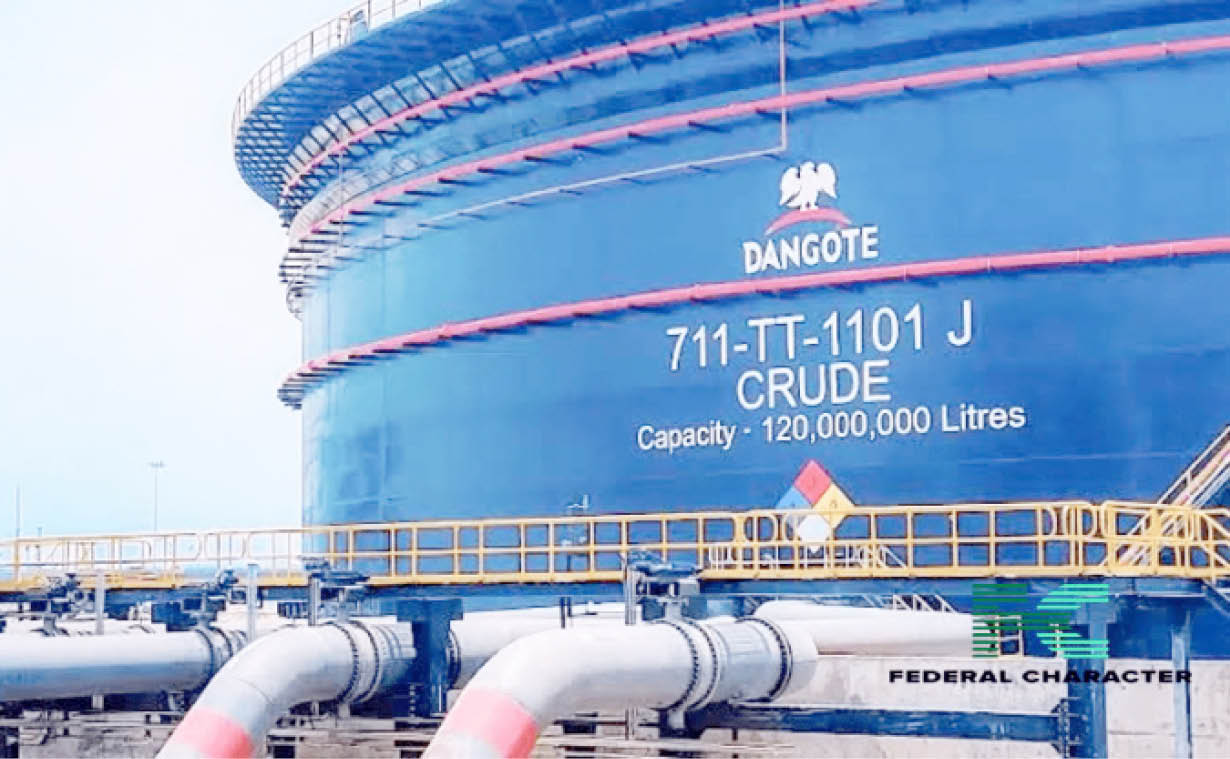
The refinery, however, operates on an entirely different scale, bringing a monumental economic impact to both Dangote and Africa as a whole. Constructing this sprawling industrial facility required extensive dredging of swampland and building a specialized port to accommodate colossal machinery. During a prior visit to the site, The Economist observed a complex maze of pipes and chutes, with a distillation tower that dwarfs even the iconic Big Ben. The facility includes nearly 200 fuel storage tanks capable of holding over 4 billion litres of fuel—an amount exceeding France's annual wine production. "Actually, we’re building a runway there," Dangote said, asserting, "Nobody believes something like this exists in Africa. We can bring people to see it."
The refinery doesn't only serve an industrial purpose; it represents a macroeconomic breakthrough. According to IMF estimates, operating at full capacity could enhance Nigeria's non-oil GDP by 1.5% between 2025 and 2026 and increase official dollar reserves by $5.5 billion each year. For years, Nigeria, the leading crude oil producer in sub-Saharan Africa, has relied heavily on imported petrol, a cost frequently subsidized by the government. When fully operational, Dangote’s refinery is set to meet Nigeria’s domestic petrol needs, diminishing the reliance on foreign currency and strengthening the local naira. "Without the refinery, Nigeria would have been at a standstill," he claims.
Dangote also rebuffs claims that he is replicating his traditional strategies with the refinery, which involve leveraging tax incentives and import restrictions. He contends that current regulations are obstructing the issuance of new petrol import permits, similar to previous actions taken concerning cement imports, while implying that vested interests within the oil sector resist change.
Beyond its energy utility, the refinery also manufactures polypropylene for plastics and plans to introduce vital chemicals for detergent production. In extensive warehouses akin to airport hangars, conveyor systems transfer large quantities of fertilizer for export via his custom port. The refinery can produce an impressive 3 million metric tons of fertilizer per year, outpacing any other facility in Africa. The geopolitical instability affecting the Strait of Hormuz, a vital shipping route for global fertilizer trade, further underscores Dangote's strategic importance to the continent's agricultural sector.
Looking ahead, Dangote intends to list a portion of the refinery on the Nigerian Stock Exchange and potentially in London, despite past plans for similar initiatives with his cement business having failed to materialize. He aims to expand the refinery's capacity to nearly match the entirety of Saudi Arabia's facilities combined over the next three years, additionally leveraging the produced gas to provide power for nearby manufacturing operations.
The Dangote Group's ambitions are not confined to Nigeria alone, as it already operates in 16 African nations. Recently, it announced plans for a $2.5 billion joint venture in Ethiopia to establish a fertilizer plant of comparable size to that in Nigeria. Additionally, Dangote plans to invest another $1 billion into cement and energy projects in Zimbabwe. He envisions further ventures, including potash and phosphate mining, copper processing in Zambia, cocoa processing in Ghana and the Ivory Coast, and a petroleum pipeline stretching from Namibia to central Africa.
Dangote emphasizes the necessity of local investment in Africa's development, questioning who genuinely led the investments in East Asia—their efforts stemmed primarily from local sources, not European ones. He draws parallels with India's current industrial scene, asserting that industrialists are largely homegrown. Observers have likened Dangote's continental ambitions to those of India's Mukesh Ambani, owner of Reliance, which operates the largest refinery in India. "Keep an eye on this space. Aliko Dangote is poised to become Africa's Ambani," declares Amit Jain from Nanyang Technological University in Singapore.
Although Dangote underscores the need for African entrepreneurs to step up their investments in the continent, he points to a reluctance stemming from financial constraints and risk aversion. "I can’t envision any African nation constructing a refinery today, and should anyone attempt it, I wish them luck," he reflects on the considerable effort required for his undertaking. "Many Africans may lack the necessary capital, and even when they do, there's a fear of investing. We are undeterred."
Dangote possesses 650,000 reasons each day that affirm his position as the leading figure in Africa's industrial landscape. No other entrepreneur has the comprehensive financial resources, supported by his cement operations, to realize such large-scale ambitions. His track record of successes adds further credence to his capabilities. That said, the optimal scenario for the continent—having a single dominant figure like him instead of various competing business magnates—remains debatable.
Moreover, Dangote's enterprises continue to heavily rely on foreign contractors for much of their technical expertise across multiple domains, including construction and machinery upkeep. A substantial number of managers within the refinery come from India, while his cement operations maintain relationships with Sinoma, a major Chinese enterprise. Nevertheless, Dangote dismisses these critiques, highlighting his firm's innovative capabilities demonstrated in their advanced refining and cement production processes.
As the interview concludes, a sudden influx of staff members signals his continual quest for new partnerships and agreements. Aliko Dangote is undoubtedly a man pressed for time, hinting, "When you return in three years, this will be three times larger than what you see today."
Comments (0)
You must be logged in to comment.
Be the first to comment on this article!