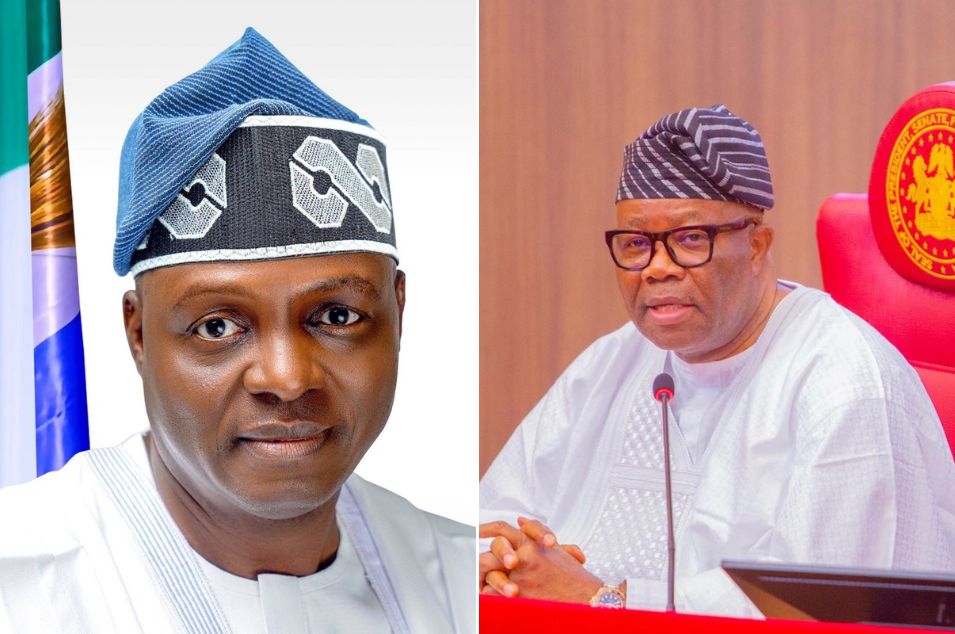
Professor Nentawe Yilwatda, the National Chairman of the All Progressives Congress (APC), said on Monday that the party's leadership has not yet decided whether to retain or replace Godswill Akpabio as the president of the 11th Senate, which is expected to be inaugurated in June 2027.
Mr Yilwatda, a professor by training, explained that the decision would ultimately rest with the newly elected senators who will take their oaths of office at the inauguration. The party leadership, he said, would only determine who emerges as the Senate majority leader.
"The Senate actually determines it (Senate President). Let's wait for the election first. Do you know what? I don't have anybody in mind. The Senate will determine whoever they want to make as senate president. Well, the party will only just bring the majority leader," he told Channels Television's Politics Today programme.
The 11th National Assembly is expected to be inaugurated next year following the 2027 general elections and a presidential proclamation. At its inauguration, newly elected senators will elect the Senate President and Deputy Senate President as part of their first official duties. The Senate Presidency is Nigeria's third-highest political office after the President and Vice President, while the Deputy Senate President is also one of the country's senior legislative leaders.
Godswill Akpabio, who currently occupies the position, was elected by his colleagues in June 2023 after defeating Abdulaziz Yari, a former governor of Zamfara State and now the Director General of the APC Presidential Campaign Council. Mr Akpabio is seeking to retain the Senate presidency in the 11th National Assembly after the 2027 elections.
In October, senators expressed satisfaction with Mr Akpabio's leadership and declared their support for his re-election as Senate President in the next assembly. However, his ambition could face competition from other political heavyweights.
There have been speculations that Imo State Governor Hope Uzodimma, an ally of President Bola Tinubu, is considering a bid for the Senate presidency after completing his tenure as governor. Mr Uzodimma previously represented Imo West Senatorial District in the Senate from 2011 to 2019 before becoming governor in 2020. However, a Federal High Court in Abuja recently nullified the primaries that produced him as the party's senatorial candidate.
Similarly, Adams Oshiomhole, the senator representing Edo North Senatorial District, is also believed to be interested in the position.
The APC currently holds a majority of seats in the 109-member upper chamber and is likely to retain it after the 16 January election to the federal legislature.
APC chairman defends Muslim-Muslim ticket
Mr Yilwatda also defended his party's decision to retain the Muslim-Muslim presidential ticket for the 2027 general elections.
President Bola Tinubu, a Muslim, is seeking re-election with his running mate, Vice-President Kashim Shettima, who is also Muslim. The arrangement has continued to attract criticism from opposition figures and some religious groups.
However, the APC national chairman said the party had engaged several Christians on the issue and that those consulted had expressed satisfaction with the arrangement. He argued that Christians had not been molested or denied their rights under President Tinubu's administration because of their religious identity.
"Most Christians that we've engaged and we've spoken to are very okay with the Muslim-Muslim ticket, and I can give the reasons. I am okay with it. No Christian, in the course of the three years of President Tinubu, has been molested or denied their privilege because he's a Muslim," he said.
Mr Yilwatda, a Christian from Plateau State in North-central Nigeria, also argued that the Tinubu administration had appointed more Christians to strategic government positions than previous administrations.
"Beyond the office of the vice-president, are there any other communities that have been given to the Christian communities in the North? The answer is yes. I am the national chairman of the party, and I am a Christian. There are prominent ministries and ministers. I'll give an example.
"Kaduna State has never gotten a minister as a Christian before; now they have one. And most times, the ministries that are given to Christians in the North are not principal ministries, but today we have them: Minister of Humanitarian Affairs, Minister of Mineral Resources, Minister of Defence.
"Apart from that, we even have the INEC chairman, who is from the North- central, and several other appointments. So, when you talk about inclusion in governance, the fear and thought of most Christians was that the Muslim-Muslim ticket may suppress their voices, but their voices are heard loud and clear now," he said.