
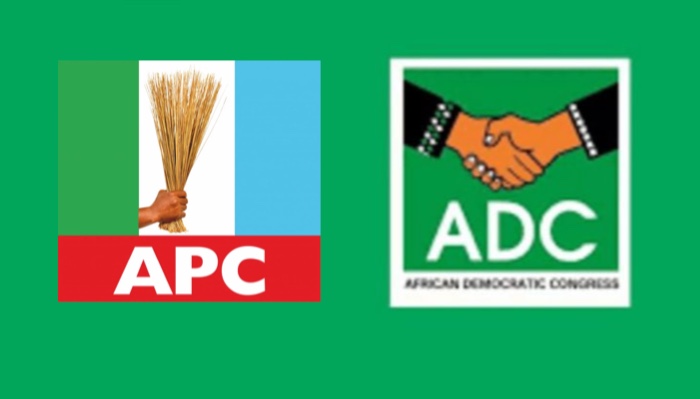
The ruling All Progressives Congress (APC) has declared that the incessant attacks launched by the African Democratic Congress (ADC) will not earn the opposition party the support of Nigerians.
The APC further asserted that the ADC does not appear to recognise itself as a political entity, noting its failure to put forth a single alternative policy stance.
According to the APC, the ADC's primary approach seems to be the condemnation of the APC and its policies, a strategy it views as an "operating manifesto" with no substantive contributions from its leadership.
Felix Morka, the National Publicity Secretary of the APC, released a statement on Saturday addressing the ADC's accusations that the ruling party had impoverished Nigerians. He stated that the APC believes the ADC's reliance on mere criticism demonstrates a flawed strategy for gaining public approval.
Morka commented on the ADC's interpretation of a recent report from an Agora Policy dialogue, which indicated a rise in poverty. The ADC had labelled this a "damning verdict on this administration’s economic policies." Morka suggested this interpretation reflects either a profound ignorance of economic policy or a deliberate disregard for the necessity and positive outcomes of the ongoing economic reforms.
The ruling party's spokesperson highlighted that the report the ADC attempted to politicise acknowledged the crucial need for reforms to rectify long- standing, detrimental economic distortions.
The APC emphasised that there is a national consensus regarding the unsustainable nature of the fuel subsidy and multiple foreign exchange regimes that were in place before May 29, 2023, describing them as an existential threat to Nigeria's economic stability.
He noted that addressing or reforming these systems had been a long-standing objective on the national agenda, but previous governments lacked the political will to implement such changes, primarily due to concerns about the temporary economic hardships these reforms would inevitably impose.
Morka recalled that President Bola Tinubu announced the cessation of the fuel subsidy upon his inauguration and subsequently unified the country's foreign exchange markets.
He maintained that these decisive and significant policy shifts have freed Nigeria from economic stagnation and potential disintegration, offering the nation an opportunity to rebuild a more robust and prosperous economy.
Morka elaborated, "It is evident that the ADC does not see itself as a political party. The ADC has not presented any concrete alternative policy or solution for Nigerians.
"Their strategy revolves around criticising the APC and its policies, serving as their sole platform, with no original contributions from themselves or their ambition-driven leaders.
"The ADC persists in the belief that its baseless criticisms will somehow make the party popular with Nigerians. However, Nigerians are far more discerning. They recognise the party that actively works for their benefit and distinguish it from those, like the ADC, that merely engage in rhetoric and generate noise.
"The discontinuation of the fuel subsidy is one of the most impactful fiscal policy decisions in the nation's recent history.
"For many years, the fuel subsidy programme placed an immense strain on public finances, consuming trillions of Naira annually – representing over 90 percent of total government revenue – while offering minimal advantages to the average Nigerian."
Morka stressed that the subsidy regime facilitated widespread inefficiency, corruption, illicit fuel smuggling across borders, and benefited middlemen and import cartels at the expense of ordinary Nigerians.
He concluded that this programme was a significant drain on national resources, and these funds are now being reallocated to crucial sectors such as infrastructure, education, healthcare, and social development under the current APC administration.
Comments (0)
You must be logged in to comment.
Be the first to comment on this article!