
A businesswoman has offered a counter-perspective to actor Jim Iyke's recent social media commentary, which drew parallels between relationships with consistent financial demands and prostitution.
Iyke had previously stated on Instagram, "If it cost you money every time you see her, that’s pr0stitution not a relationship." This statement has now drawn a detailed response from Roberta Edu, a businesswoman.
Edu contends that men who label financial expectations in relationships as prostitution are often attempting to manipulate women into accepting disadvantageous positions. She highlighted common arguments used by such men, questioning why a woman might need money for transport when she is expected to cook for the man, or why she would ask for money to leave after spending a weekend with him. Edu also pointed out the expectation that a woman might ask for money for her hair while simultaneously fulfilling "wifey duties" for a man.

She argued that the phrase "We are dating, not doing prostitution" is often employed to pressure women into providing their services, sacrifices, and intimacy without compensation, solely to avoid being labelled negatively.
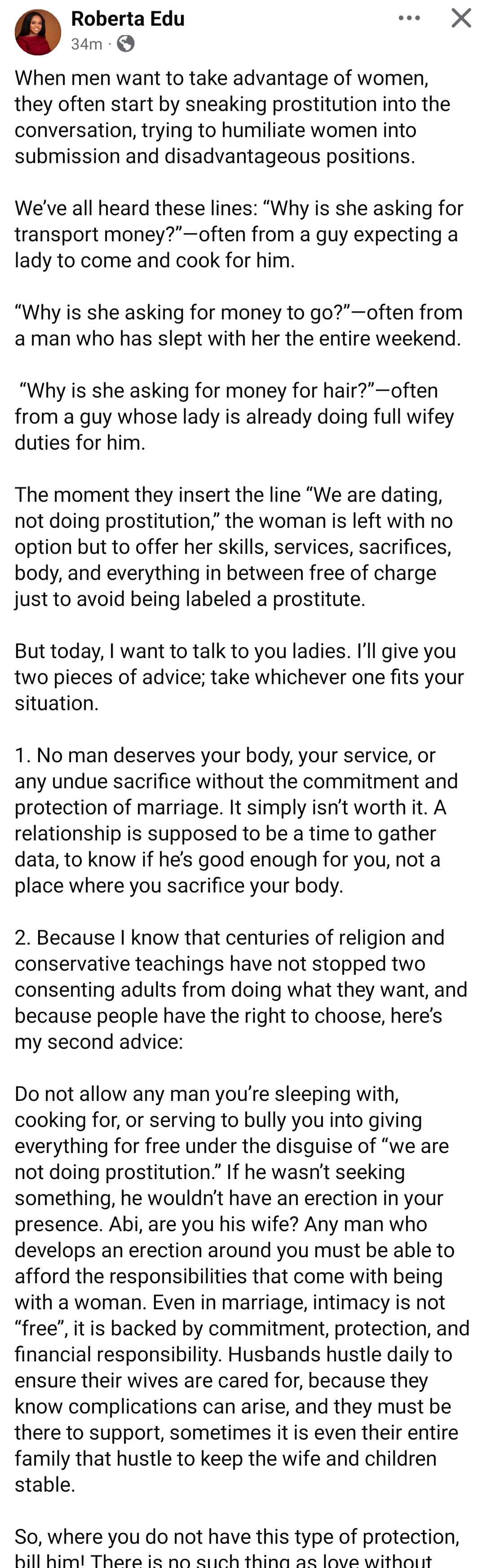
Edu then offered two pieces of advice to women. Firstly, she advised that no man is entitled to a woman's body, service, or sacrifices without the commitment and protection of marriage. She suggested that dating should be a period for assessment rather than a time for significant personal sacrifice.
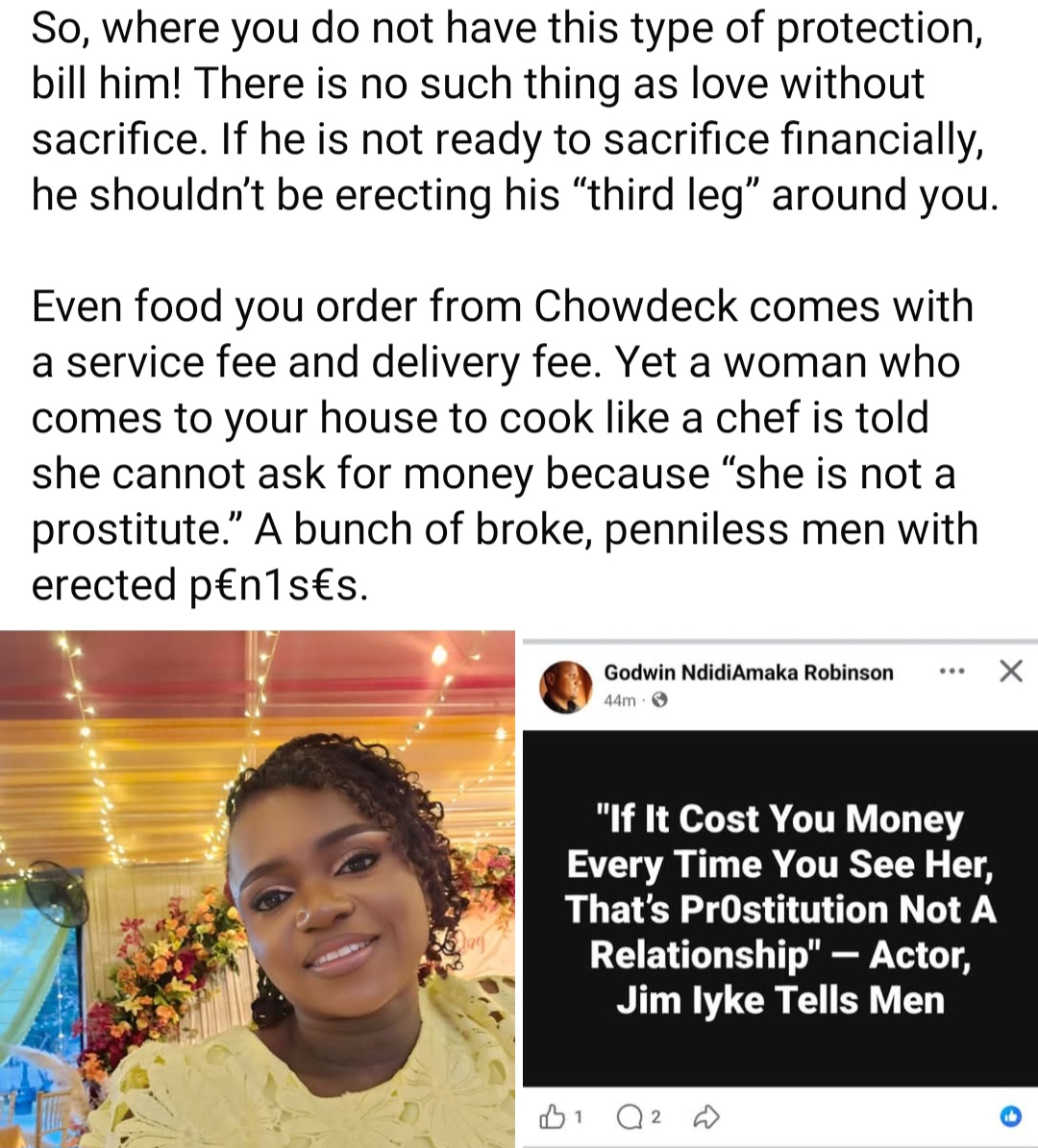
Secondly, acknowledging that personal choices exist outside of traditional teachings, Edu advised women not to allow men they are intimate with, cook for, or serve, to coerce them into providing everything for free under the guise of avoiding the label of "prostitute." She asserted that a man's interest, indicated by his physical arousal, implies an ability to meet the associated responsibilities. Edu extended this to marriage, stating that even intimacy within marriage is not 'free' but is underpinned by commitment, protection, and financial responsibility, requiring husbands to provide for their wives and families.
Edu concluded by stating that in the absence of such marital protection, women should "bill" men, as she believes there is no true love without sacrifice. She drew an analogy to food delivery services like Chowdeck, which include service and delivery fees, questioning why a woman providing services like cooking should be denied compensation simply because she is "not a prostitute." Edu characterized men who hold these views as "broke, penniless men with erected p€n1s€s."
Comments (0)
You must be logged in to comment.
Be the first to comment on this article!