
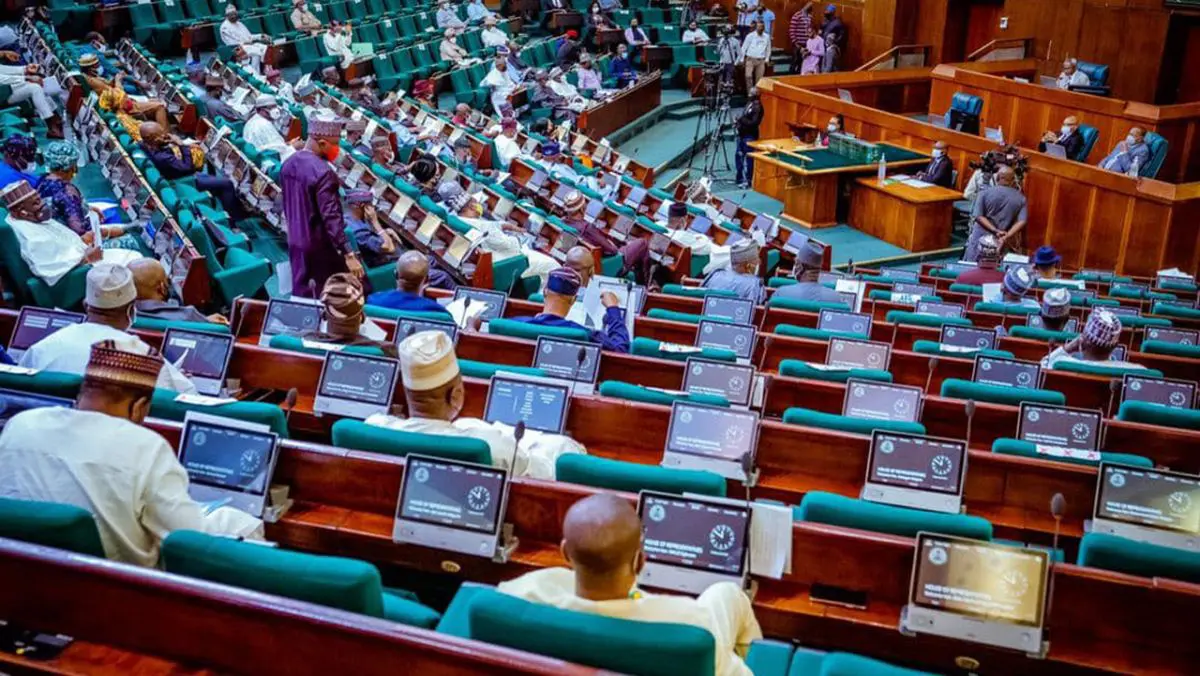
On Wednesday, the House of Representatives successfully moved the N58.47 trillion Appropriation Bill for the 2026 fiscal year to its second reading. This progression occurred after House Leader Hon. Julius Ihonvbere presented the preliminary debate.
The budget aims to authorize a total of N58,472,628,944,759 from the Federation's Consolidated Revenue Fund for the year ending December 31, 2026.
Of the total proposed budget, N4.09 trillion is designated for statutory transfers, N15.91 trillion for debt servicing, N15.25 trillion for recurrent (non-debt) expenditures, and N23.21 trillion is allocated for capital expenditures through contributions to the Development Fund.
During the debate, Ihonvbere described the 2026 budget as “The Budget of Consolidation, Renewed Resilience, and Shared Prosperity,” highlighting that it was presented to the National Assembly by President Bola Tinubu on December 19, 2025. He characterized this budget as a vital step towards achieving peace, growth, stability, and sustainable development in Nigeria.
He emphasized that development without sustainability is merely ephemeral and acknowledged that economic growth often necessitates challenging adaptations, particularly in light of the “distorted and disarticulated institutions and structures” inherited by the current administration.
Ihonvbere also remarked on the necessity of statistics as indicators of progress, revealing that Nigeria experienced a 3.98 percent economic growth rate leading up to the 2026 budget, while inflation had decreased to 14.45 percent, down from approximately 25 percent.
He pointed out advancements in revenue generation, export growth, and foreign direct investment, attributing some of these improvements to the President’s global diplomatic efforts aimed at enhancing economic collaborations.
The House Leader noted that the naira has maintained a relatively stable exchange rate around N1,400 to one dollar, a significant improvement from over N1,800. He added that the Federal Government has not printed new currency since taking office, a choice he claimed contributed to economic stabilization.
Moreover, Ihonvbere reported that Nigeria's external reserves have reached around $47 billion, marking a seven-year peak and sufficient to cover over ten months of imports.
Presenting the fiscal structure of the 2026 budget, he stated that total revenues are estimated at N34.33 trillion, against total expenditures of N58.18 trillion, resulting in a deficit of N23.85 trillion.
He explained that capital expenditures are set at N26.08 trillion, surpassing recurrent spending, reflecting a dedication to sustainable development, contrasting with prior budgets dominated by recurrent expenses.
Budget assumptions include an oil benchmark of $64.85 per barrel, with oil production estimated at 1.84 million barrels daily.
Prioritized allocations in the budget include N5.41 trillion for security and defense, N3.56 trillion for infrastructure, N3.54 trillion for education, and N2.48 trillion for health.
Describing the budget as a commitment and a reflection of the government's aspirations, he assured that the administration supports fiscal discipline, enhanced revenue generation, macroeconomic equilibrium, improved business conditions, human capital development, and adept debt management.
He called upon legislators to endorse the budget proposal, indicating that a substantial portion of it had already undergone discussions in the preceding fiscal year.
Upon concluding the debate, the Speaker conducted a voice vote, which saw the 'ayes' approving the motion. Consequently, the bill was then read a second time and referred to the House Committee on Appropriations for subsequent legislative deliberations.
Comments (0)
You must be logged in to comment.
Be the first to comment on this article!