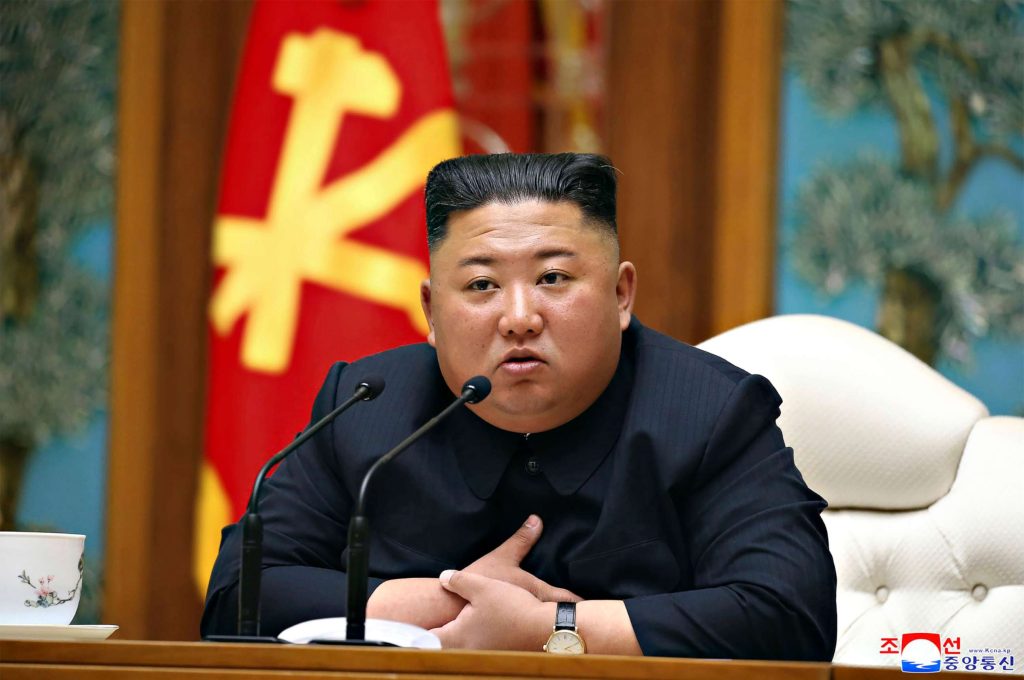
North Korea’s leader [Kim Jong Un](https://en.wikipedia.org/wiki/Kim_Jong-un) instructed his troops to become the world’s strongest fighting force during a two‑day gathering of company commanders in Pyongyang, state media reported on Saturday. The directive, framed as a “Korean‑style military revolution,” aims to reshape the entire army into elite, technically advanced combat units.
**What was the core demand?**
Kim said the meeting, held on Thursday and Friday, was intended to devise a plan “to train the strongest armed forces in the world.” He urged that every company be turned into a strong elite unit in both military and technical aspects, consolidating them into perfect combat forces.
**When did the event occur and why is it significant?**
The conference follows a February party congress where Kim reaffirmed the need for stronger conventional forces and reiterated North Korea’s commitment to expanding its nuclear and missile programmes. It also coincides with a series of recent weapons tests, including a new‑type precision‑guided torpedo and an intermediate‑range hypersonic missile that reportedly incorporate artificial‑intelligence technology.
**How does this relate to recent inter‑Korean tensions?**
The call for a military overhaul comes the same week that [South Korea](https://en.wikipedia.org/wiki/South_Korea) proposed talks to clarify the border after an explosion inside the heavily fortified [Korean Demilitarized Zone (DMZ)](https://en.wikipedia.org/wiki/Korean_Demilitarized_Zone). Seoul blamed North Korean landmines for the blast that injured its soldiers, a claim Pyongyang denied. Pyongyang also rejected Seoul’s demand for an apology and has not responded to the latest proposal for dialogue.
**What is the broader geopolitical context?**
Despite long‑standing UN sanctions, North Korea has codified its nuclear‑armed status in domestic law, repeatedly declaring its arsenal permanent and irreversible. Since Russia’s invasion of Ukraine in 2022, the regime has deepened its alliance with Moscow, providing troops for the war effort in exchange for economic aid and advanced military technology.
**What are the implications for regional security?**
Analysts warn that the emphasis on creating an “elite” force could intensify the arms race on the peninsula, especially as both sides remain technically at war following the 1950‑53 Korean War, which ended with an armistice rather than a peace treaty. The proposed South Korean talks aim to restore communication channels and reduce the risk of further incidents along the DMZ.
Overall, Kim’s appeal underscores a strategic push to elevate North Korea’s conventional capabilities while its nuclear and missile programmes continue to evolve, heightening concerns across the region and among the international community.