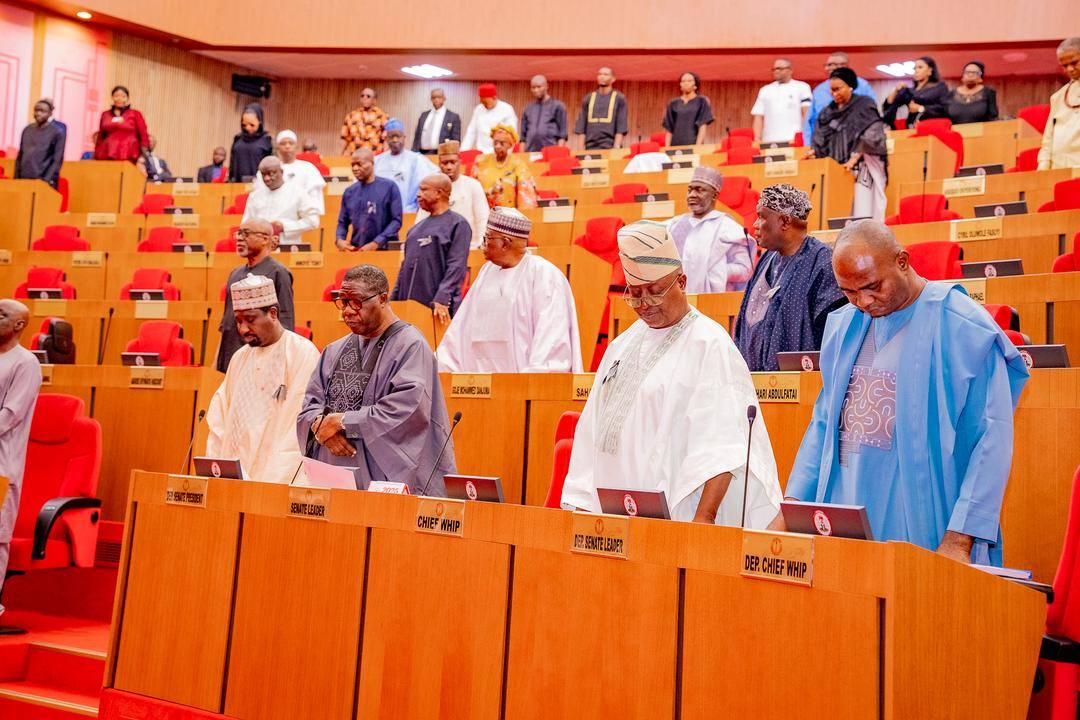
The Nigerian Senate has called upon national aviation regulatory bodies to overhaul their operational frameworks, ensuring that commercial planes are rerouted to alternative airfields whenever presidential and VIP transits necessitate temporary closures of the airspace.
Lawmakers emphasized that redirecting flights to alternate landing sites provides a significantly safer alternative for passengers compared to leaving them circling in the sky for extended periods while landing slots are frozen for high-profile security protocols.
The resolution followed a comprehensive debate on a motion highlighting the inherent dangers of maintaining aircraft in holding patterns across domestic terminals due to official government movements and related security measures.
Sponsored by Isah Jibriin, who represents Kogi East under the All Progressives Congress (APC), the motion directed key oversight bodies to review their operational guidelines. These bodies include the Nigerian Civil Aviation Authority (NCAA), the Nigerian Airspace Management Agency (NAMA), the Federal Airports Authority of Nigeria (FAAN), and the Nigerian Safety Investigation Bureau (NSIB).
What risks are associated with prolonged holding patterns?
Senator Jibrin pointed out that domestic commercial flights scheduled to land at various airports are occasionally forced to remain airborne for over an hour when landing activities are halted for VIP transits. He observed that international arrivals similarly experience diversions to other local airports when primary destinations face temporary airspace blocks.
While acknowledging that security protocols for senior state officials are legitimate and necessary, the lawmaker maintained that these requirements must be managed without exposing commercial aviation to avoidable hazards. Extended holding patterns deplete fuel reserves, increase consumption, and heighten operational vulnerabilities—particularly during adverse weather conditions or air traffic congestion.
To mitigate these safety concerns, the Senate urged regulators to enforce mandatory advance coordination and timely alerts to airline operators regarding upcoming airspace limitations. Lawmakers suggested that when restrictions are anticipated, authorities should halt departures at origin points rather than letting flights take off only to circle indefinitely.
What did the Senate leadership decide?
During the legislative deliberations, several lawmakers voiced strong support for the motion. Diket Plang, representing Plateau Central, questioned the logic of permitting planes to depart when authorities already know VIP movements will disrupt landing schedules, warning that poor airspace management could precipitate a major disaster.
Abdul Ningi from Bauchi Central criticized regulators and airlines for operating with lax disregard for passenger welfare, citing persistent flight disruptions. Following the contributions, Senate President Godswill Akpabio put the prayers to a voice vote, securing widespread approval.
Akpabio subsequently mandated the Senate Committee on Aviation to convene stakeholder meetings with the NCAA, NAMA, FAAN, and NSIB to guarantee full adherence to the newly proposed safety measures.
What is the historical context of VIP flight protocols?
Under the Nigeria Civil Aviation Regulations (Nig.CARs) 2023, aircraft ferrying heads of state or government are granted priority air traffic handling upon pilot request, alongside emergency, search-and-rescue, and medical missions. However, existing protocols also dictate that actual airborne emergencies take precedence over standard priority flights.
The friction between VIP movement security and commercial flight schedules is a long-standing issue in the country's aviation sector. In April 2023, local airline operators similarly voiced apprehension over economic losses and resource depletion caused by sudden airspace closures. Previous legislative efforts, including a House of Representatives motion in December 2017, also sought to address how official transits interfere with scheduled commercial landings.