
According to Trade Minister Jumoke Oduwole, Nigeria's economy is witnessing a resurgence with growth exceeding 4%, inflation rates easing, and a boost in investor confidence, as stated at the World Economic Forum in Davos.
Oduwole shared these insights during an interview with CNN’s Richard Quest, highlighting Nigeria House’s inaugural appearance at the Promenade.
She emphasized that various reforms, investment endeavors, and international partnerships are positively influencing Nigeria's economic landscape, attracting new financial influx.
Recent statistics indicate that Nigeria is experiencing its best economic performance in over ten years. "We are seeing growth upwards of 4%, with projections from the World Bank indicating a continuation of this trend. This marks the highest growth rate in over a decade, with inflation being halved between 2024 and 2025," she remarked.
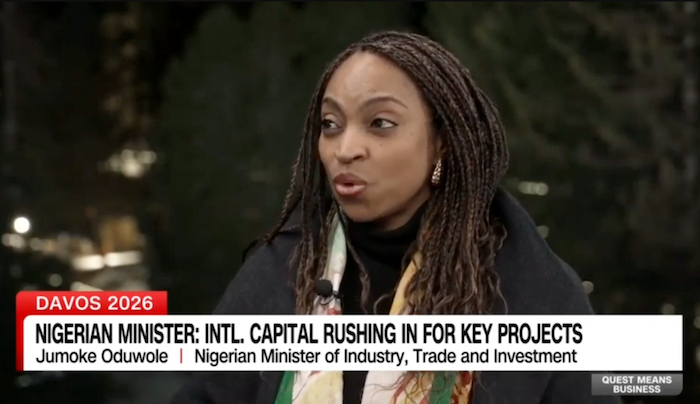
Further explaining, Oduwole noted that beyond the prominent statistics, overall confidence within the economy is gaining traction, with domestic businesses reinvesting in critical sectors. "Many economic indicators exist, but I want to highlight that domestic investors are actively reinvesting in key areas, while international capital is also being attracted to our fundamental projects," she elaborated.
Oduwole described Nigeria House’s debut at the Promenade as a valuable platform for presenting the country’s reform initiatives, investment prospects, and trade objectives to global investors and decision-makers.
She assured that the ongoing reforms are strategic and long-term. "I recognize that this is a gradual process... I can confirm that we are making sustained efforts," she stated, noting improvements in trade operations, including port activities. "We anticipate the launch of a single window project by the end of this quarter."
The Minister remarked that the response from investors towards Nigeria's enhanced business climate has been positive. "When discussing incoming investments, the decisions made are primarily based on the ability to engage effectively with Nigerian stakeholders," she clarified.
Oduwole also underscored Nigeria’s trade relations with the United States, affirming their strength despite recent shifts in global tariffs. "The United States continues to be our key strategic ally. We initiated a commercial investment partnership in June last year. U.S. businesses collaborate closely with their Nigerian counterparts, and they fundamentally seek opportunities to do business," she noted.
On the evolving global economic landscape, she asserted that countries must act with precision and clarity. "We are witnessing a redefined global framework. Every nation has to determine what is optimal for itself," Oduwole stated, warning that a race to the bottom could occur without a coherent strategy and execution.
Additionally, she alluded to Nigeria's broadening global partnerships, including agreements with the UAE and increased cooperation with Brazil and the UK. "We are cultivating new relationships while reinforcing existing ones; the focus must remain on our core interests," she expressed.
Oduwole stated that Nigeria’s main priorities revolve around infrastructure growth, expanding exports, and trade access. "We require investments to enhance our infrastructure, and we are focused on securing access for our non- oil exports. Our aim is to pinpoint what we must deliver," she indicated.
Regarding regional commerce, Oduwole mentioned Nigeria's leadership role within the African Continental Free Trade Area (AfCFTA). "Nations like Nigeria take the agreement seriously, leading from the front," she observed.
She disclosed that Nigeria has advanced export logistics across Africa through the establishment of new air cargo routes. "We have launched an air cargo corridor with 13 African nations, which effectively reduced freight costs for Nigerian exporters by half," she revealed.
These statements come as the World Bank forecasts Nigeria's economy will grow by 4.4% in 2026, reaffirming governmental initiatives to stabilize and attract investments, as well as to reposition Nigeria as a pivotal trade and investment center in both Africa and the global market.
Comments (0)
You must be logged in to comment.
Be the first to comment on this article!