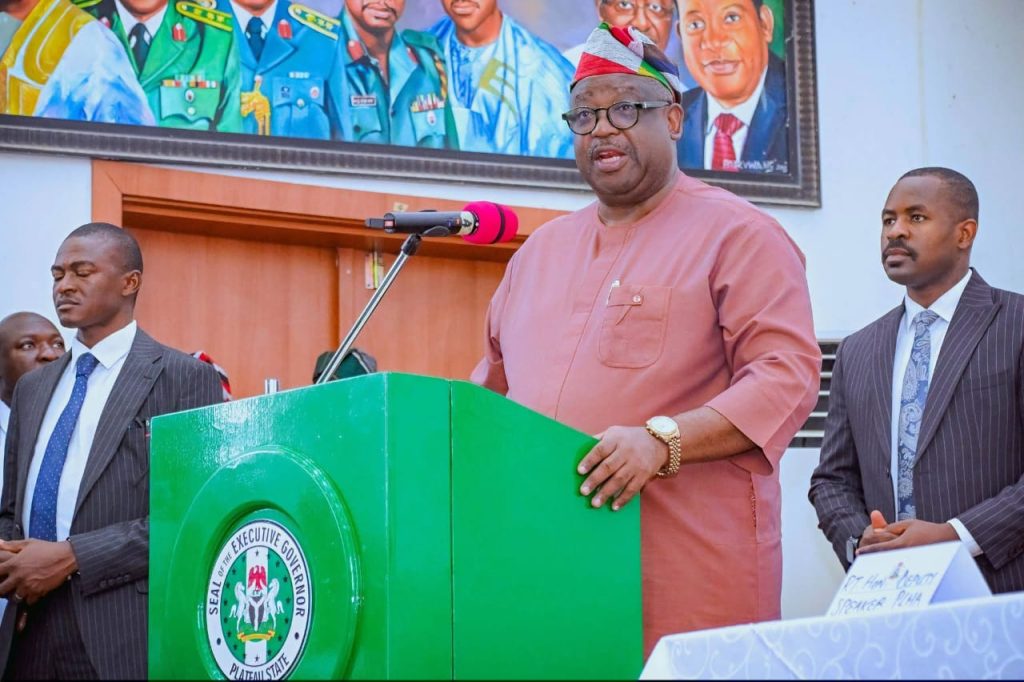
Plateau State Governor Caleb Mutfwang asserted on Monday that President Bola Tinubu assumed leadership in 2023 over a Nigerian state teetering on economic collapse due to the policies of the preceding administration led by former President Muhammadu Buhari. Addressing attendees during the inauguration of the All Progressives Congress (APC) campaign council in Jos, the governor defended ongoing federal reforms and rallied local residents to secure a presidential victory in upcoming polls.
Elaborating on the fiscal state of the nation upon the current administration's inauguration, Mutfwang highlighted severe foreign exchange shortages and dwindling reserves. What was the state of the treasury in 2023?
"Where did President Tinubu meet Nigeria in 2023? He met Nigeria, tottering on the brink of collapse, Nigeria that could not service its external debts, Nigeria that would not even allow businesses outside the country to take their proceeds back home," Mutfwang stated. He added that foreign carriers previously suspended operations into the country due to trapped revenue, while external reserves plummeted from historic highs above $40 billion down to roughly $3 billion. According to the governor, prudent management has since restored external buffers to over $50 billion.
How did the previous government manage fiscal deficits?
The Plateau governor further alleged that the Buhari administration engaged in massive unauthorized currency creation through the Central Bank of Nigeria (CBN) to sustain state finances. He claimed that over N30 trillion was printed without viable economic backing, a practice he noted has since been curtailed to stabilize the apex bank.
Addressing the controversial removal of petroleum subsidies, Mutfwang characterized the former framework as a fraudulent enterprise driven by artificial claims and extensive borrowing. Despite the subsequent rise in pump prices, he emphasized that regular product availability has replaced the crippling queues previously witnessed across retail outlets nationwide. Furthermore, he claimed past leadership resorted to forward sales of unextracted crude oil, leaving present authorities to service outstanding supply obligations.
What local palliatives are being implemented in Plateau State?
To mitigate immediate economic hardships for local constituents, Mutfwang pointed to several state-level interventions. These include the procurement of metro buses, the rehabilitation of urban rail services within Jos, a fifty percent reduction in tuition fees for indigenous tertiary students, and a threefold increase in student allowances. He also lauded federal intervention schemes like the Nigerian Education Loan Fund (NELFUND), which has provided monetary support to numerous students from the state.
Looking toward the 2027 general elections, Mutfwang advocated for the principle of power rotation between northern and southern regions to preserve national stability. Domestically, he affirmed his commitment to seeking a second term while urging party stakeholders to campaign transparently based on tangible governance achievements.
How is the administration tackling regional security concerns?
Acknowledging ongoing security challenges and public anxiety regarding living conditions, the governor maintained that his administration remains proactive. He explained that resolving insecurity requires deliberate and sustained tactical measures rather than instant fixes, outlining forthcoming initiatives aimed at securing rural territories and facilitating the return of internally displaced persons to their ancestral communities.