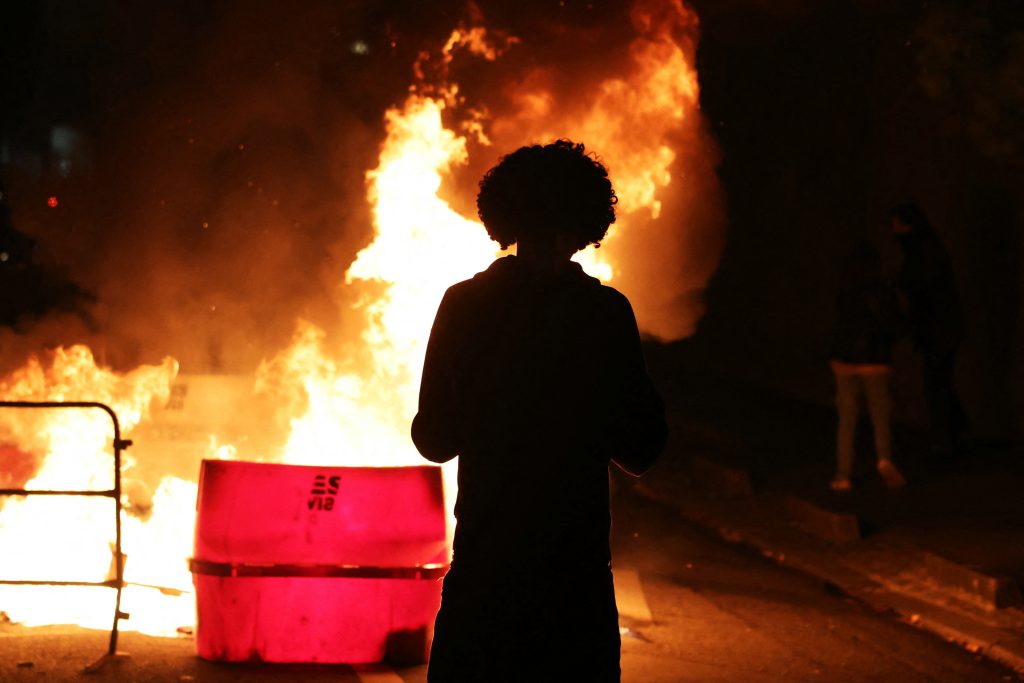
Hundreds of thousands of people took to the streets across France on Saturday, demanding action on rising living costs and police brutality, while police responded with tear gas, baton charges and water cannon in several cities, most notably Paris.
Key facts:
- Organisers claim about 320,000 participants nationwide, with roughly 70,000 gathering in Paris alone.
- Youth groups estimate close to half a million demonstrators, including 200,000 in the capital.
- Police reported that a “hard core of several hundred rioters” hurled projectiles, including a Molotov cocktail, at officers in Paris.
- Camille Guerin, a 31‑year‑old protester in Nantes, said, “We say no to the cost of living, no to the far right, yes to high school students’ demands, yes to giving citizens a voice.”
- Interior Minister [Laurent Nunez](https://www.gouvernement.fr/en/interior- minister) warned that authorities were preparing for street violence comparable to the unrest two weeks earlier.
What triggered the clashes in Paris?
After a sunny march on the outskirts of the capital, the procession reached its final destination where dozens of masked individuals in black began prying up paving stones with hammers and throwing them at police. At least one incendiary device was also launched, prompting officers to deploy tear gas and execute several baton charges.
Which groups were involved in the demonstrations?
The protests were a coalition of the Yellow Vest movement, trade unions, and high‑school and university students. Demonstrators dressed in Halloween costumes ranging from Spider‑Man to Frankenstein, and some wore historical outfits such as Marie‑Antoinette, holding placards that read “Give them brioche” and “A potion for the revolution.”
How did police respond in other cities?
In Lyon, the country’s third‑largest city, demonstrators threw projectiles at officers, leading police to fire tear gas. In Toulouse, police used water cannon against an unauthorised protest that attracted several thousand, mainly young participants. In Lille, 47‑year‑old Aurelie Herrmann danced at the rally, saying, “I dance because on television they only show damage and destruction, whereas you can perfectly well demonstrate in good spirits.”
What are the broader political implications?
The unrest comes as France heads toward a presidential election scheduled for early 2027, with far‑right leader Marine Le Pen leading the polls. The protest movement, originally focused on the cost of living and inequality, has expanded its demands to include stronger civil‑liberty protections and the right to protest after reports of serious injuries among demonstrators.
What actions are student groups planning next?
Student spokesperson Sabrine Kharbach of the Union Etudiante announced that starting Tuesday, protesters would block high schools and universities, repeat the action on Thursday, and then join a larger demonstration on 5 November organised by workers and trade unions.
How are businesses reacting?
Ahead of the protests, some shop owners fortified their premises. In eastern Paris, café employee Wael Boubaker covered his storefront with plywood, stating, “Everyone is staying home. No one is going to come and buy anything.”
The French government, facing a potential recession in the eurozone’s second‑largest economy, has limited fiscal room to meet the demonstrators’ demands. Meanwhile, social‑media calls for Halloween‑themed gatherings were detected, urging participants to spark a “revolution,” according to officials.