
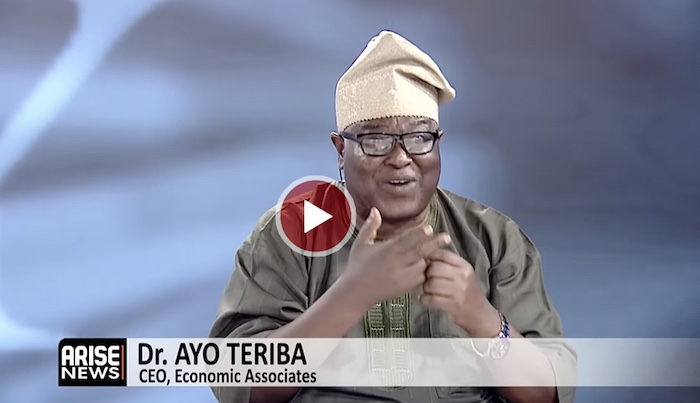
Dr. Ayo Teriba, CEO of Economic Associates, has warned the Federal Government against the sale of state-owned assets to address Nigeria’s expanding budget deficit for 2026. He proposed instead a thorough asset securitisation approach to unlock value without forfeiting ownership.
In an interview with Arise News on Sunday, Teriba stated that relying on asset sales to raise funds would hardly make a significant impact on the anticipated deficit exceeding ₦25 trillion, describing such moves as indicative of a loss of perspective.
He remarked, "If we think that the solution to funding a deficit of ₦24 trillion lies in selling assets — a language more suited to accountants than economists — we are losing touch with financial reality. Instead, we should consider asset securitisation."
Teriba commenced by addressing what he identified as a critical misunderstanding in discussions surrounding the budget.
"People claim Nigeria needs to spend ₦58 trillion, but it is actually the Federal Government of Nigeria that has this spending requirement. The government does not equate to Nigeria as a whole," he pointed out.
He insisted that neglecting the distinction between "federation" and "federal" revenues is central to the ongoing fiscal challenges.
"The federation is home to revenue-generating agencies, but the federal government itself does not possess any. The federation collects funds to populate the Federation Account, which is then allocated among three entities—of which the federal government represents just one. Despite this, the federal government enacts a budget that lacks a clear distinction between federation-related expenditures and federal ones, which is detrimental to the overall budget management."
According to Teriba, there is heavy focus by the National Assembly on spending, with a glaring lack of attention to revenue generation.
Relatedly, he reacted to assertions regarding the government's intention to auction off 91 state assets, clarifying that the Bureau of Public Enterprises had only identified assets listed under the National Council on Privatisation Act without any explicit commitment to their sale.
"The government has various options—it can choose to commercialise some or privatise others, with liquidation for sale only reserved for a select few," he stated, urging against any thought of outright disposal.
Teriba proposed that the National Assembly should publicly declare that none of the country's assets should be sold.
Instead, he recommended methods such as leasing, concessioning, and securitising assets. "Asset securitisation allows for retaining ownership while benefiting from financial inflows. For example, companies lease their assets for capital, and once the funding is no longer required, they reclaim ownership. This is a model Nigeria should adopt."
He stated that many of Nigeria’s state-owned enterprises and real estate assets possess an effective market value of zero due to their non-listing and lack of market testing.
"Consider showcasing state-owned enterprises on the market. Kenya is actively listing all its SOEs, and Saudi Arabia’s valuation of Aramco skyrocketed to $2 trillion just by listing a mere 2%. Prior to that listing, their assets weren’t considered worth anything."
He continued, "Discussions rarely focus on Nigeria’s assets; they predominantly revolve around its debts."
He identified three asset types eligible for financialisation: State-owned enterprises such as NNPC and other public corporations; real estate holdings encompassing federal secretariats and military facilities situated in prime locations; and infrastructure assets like airport terminals and rail facilities.
"Many federal secretariats have stood dormant for over ten years, including the National Stadiums in Lagos and Abuja, which generate no income. Meanwhile, taxes are raised from citizens," he remarked.
"By entering partnerships with developers who pay a portion of the revenue generated from these properties, that exemplifies asset securitisation. Eventually, when the concession term ends, ownership would revert back to us."
Teriba emphasised that such asset financialisation would necessitate institutional reforms.
"Neither house of the National Assembly has a dedicated revenue committee. They should create a joint committee focused on revenue and investments," he asserted.
"There are no regulations governing federal revenues; only federation revenue managers exist. Without a federal revenue authority, it’s unjust to assign blame for insufficient federal income or foreign investment."
Discussing inflation, Teriba shared a cautiously optimistic view that Nigeria could see a return to single-digit inflation rates, attributing this to signs of currency appreciation.
"Food continues to be a major contributor to the Consumer Price Index (CPI), but we expect improvements in January leading to single-digit inflation," he anticipated.
"The headline inflation index might decrease from around 15% in December to roughly 12%, potentially falling to single digits thereafter."
He noted, "Typically, inflation lessens when the currency strengthens. Conversely, depreciation leads to inflation spikes. Hence, with the current strengthening naira, further reduction should be expected."
Teriba reiterated that the core problem lies in a prevailing culture of spending without corresponding productivity.
"People are not focused on generating funds—they wait for the promised allocations from the National Assembly. The focus should shift to creating financial opportunities. The message is to not squander your potential," he concluded.
Comments (0)
You must be logged in to comment.
Be the first to comment on this article!