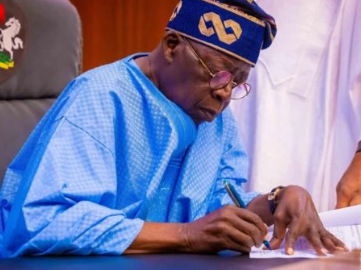
President [Bola Ahmed Tinubu](https://en.wikipedia.org/wiki/Bola_Ahmed_Tinubu) announced on 29 May 2023, shortly after his inauguration, that Nigeria would end its long‑standing fuel subsidy, unify the foreign‑exchange market and begin rebuilding external reserves. The moves triggered a sharp policy break, setting the stage for a series of fiscal and monetary reforms that aimed to restore macro‑economic stability.
**What were the immediate outcomes?**
- The petrol subsidy was eliminated, removing a multi‑billion‑naira fiscal drain.
- Multiple exchange‑rate windows were merged into a market‑determined system.
- The Central Bank of Nigeria’s (CBN) reliance on Ways and Means advances was curbed, freeing monetary policy space.
- External reserves rose from roughly $35 billion to over $54 billion by September 2026.
- Debt‑service‑to‑revenue fell below 50 percent, and non‑oil revenue surpassed the ₦20 trillion target in 2025.
**How have the macro‑economic indicators shifted?**
Non‑oil revenue surged, with August 2025 collections exceeding the ₦20 trillion goal and September 2025 alone generating ₦3.65 trillion – four times the May 2023 level. The debt‑service ratio dropped to under half of revenue, and the stock of Ways and Means advances was substantially reduced. External reserves climbed to their highest level in nearly two decades, providing a stronger buffer against external shocks.
Real GDP growth accelerated, reaching 3.89 % in Q1 2026 and 4.43 % in Q2 2026, averaging about 4.2 % for the first half of the year, according to the [World Bank](https://www.worldbank.org/). Both oil and non‑oil sectors contributed, with oil output posting strong year‑on‑year gains and non‑oil activity expanding. Trade surpluses persisted, and non‑oil exports topped $6 billion in 2025, a historic high. The Nigerian Stock Exchange’s All‑Share Index rose from the low 50,000s in 2023 to above 250,000 by 2026, while market capitalisation expanded from roughly ₦30 trillion to over ₦160 trillion.
Inflation, which peaked above 30 % and hit 34.8 % in December 2024, fell to the mid‑teens by late 2026, albeit with intermittent spikes due to geopolitical tensions and supply constraints. The current account moved into surplus, foreign direct investment announcements increased, and Nigeria was removed from the Financial Action Task Force’s increased‑monitoring list. The country also secured partnership status in BRICS and became an association member of the International Energy Agency, signalling broader economic diplomacy.
**What social and infrastructure initiatives accompanied the macro reforms?**
The Nigerian Education Loan Fund, launched early in the term, processed applications from over 1.6 million students and disbursed hundreds of billions of naira in interest‑free loans. The national minimum wage rose from ₦30,000 to ₦70,000, with earners exempted from income tax. Targeted cash‑transfer programmes reached more than ten million households.
Skill‑development programmes such as the Three Million Technical Talent initiative aim to equip youths for jobs in software, data, cybersecurity and the creative economy. The Consumer Credit Corporation began offering installment financing for essential purchases.
Infrastructure progress includes more than 2,700 km of highways under construction, reconstruction or rehabilitation, featuring projects like the Lagos‑Calabar Coastal Highway, the Sokoto‑Badagry Superhighway, the Abuja‑Kaduna‑Zaria‑Kano corridor and the East‑West Road. In the power sector, legacy debts were cleared, investment attracted, and transmission and billing improved, while the compressed natural gas (CNG) programme converted tens of thousands of vehicles and established fuelling stations. Oil‑and‑gas reforms reduced theft, boosted production and supported domestic refining, notably through the Dangote refinery, leading to higher petroleum‑product exports and lower imports.
Housing under the Renewed Hope initiative and the Federal Housing Authority delivered thousands of units, while health‑sector efforts saw the commissioning of cancer treatment centres and attempts to revitalize primary care. Pension reforms and more regular payment of federal salaries and pensions were also cited as improvements.
**What are the human costs and gaps in translation?**
The subsidy removal and exchange‑rate realignment caused an immediate surge in transport and energy costs, feeding higher food prices and eroding real incomes. Inflation, though lower, remains high enough to strain households. Poverty rates have stabilised but remain elevated, and many families still struggle to afford staples, transport and school fees.
Small and medium enterprises face higher input costs, elevated interest rates and uneven credit access, while power supply remains unreliable for many users. Logistics bottlenecks continue to raise the cost of moving goods, and policy implementation varies across states due to capacity constraints.
**Why is security a binding constraint?**
Banditry, kidnapping and residual terrorist activity persist, especially in the North‑West and North‑Central, disrupting agriculture and inflating food prices. The government has increased defence budgets, recruited additional police and military personnel, upgraded equipment, declared a national security emergency in late 2025, and pursued state police legislation, forest‑guard deployment and new army divisions. Despite these steps, terrorism‑related deaths and abductions in 2025‑2026 indicate that safety standards remain below public expectations, limiting the full transmission of macro‑economic gains.
**What remains on the agenda?**
- **Translating stability into lower living costs** – continue disinflation, improve food supply through security and agricultural productivity, reduce transport costs via CNG conversion and better roads, and foster job‑creating sectors.
- **Completing critical infrastructure** – move highways from construction sites to functional corridors, deliver reliable power, and upgrade ports, railways and digital networks to lower business transaction costs.
- **Deepening human‑capital programmes** – expand interest‑free student loans, align skills training with labour‑market demand, strengthen primary health care and specialised treatment, and improve targeting of social protection.
- **Overhauling security outcomes** – ensure recruitment and equipment translate into effective operations, enforce accountability, and restore state presence in contested rural areas.
- **Strengthening governance and institutions** – enhance transparency in public‑resource management, curb leakage, improve procurement, and maintain fiscal discipline while delivering visible services.
- **Managing the political economy of reform** – resist vested‑interest pressure as the 2027 elections approach, keep core reforms intact, and demonstrate flexible sequencing to mitigate social pain.
**What does the political horizon look like?**
Tinubu is seeking re‑election in the January 2027 presidential poll. A second term could allow completion of major infrastructure projects, consolidation of institutional reforms and deeper social interventions. Conversely, a loss of momentum or a change in administration could undo the policy space created, risking a return to partial reforms and reversal.
**How will history judge the Tinubu name?**
His legacy already includes Lagos‑state revenue expansion, urban transformation and the founding of the All Progressives Congress. As president, he is now associated with confronting entrenched fiscal and monetary distortions. Whether his name will be remembered for bold reform or for unfinished experiments depends on the delivery of tangible improvements to ordinary Nigerians – safer communities, productive farms, functional infrastructure, expanded opportunities for youth and a state that consistently delivers public value.
The window for completing this work is narrowing. The test now is not another headline announcement but the steady, visible delivery of benefits to households, businesses and the broader economy.