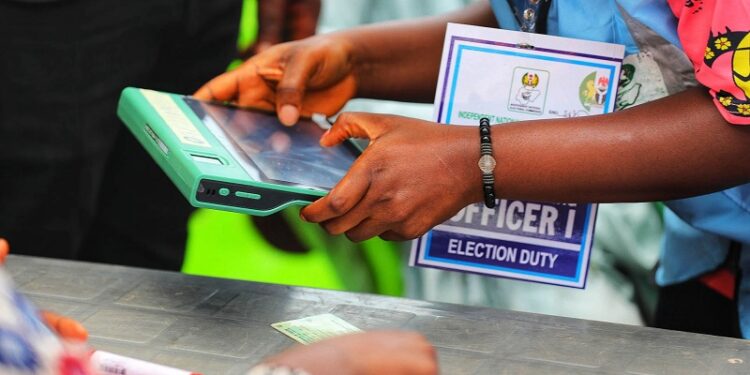
The Bimodal Voter Accreditation System (BVAS) is a handheld electronic unit employed by the [Independent National Electoral Commission (INEC)](https://www.inecnigeria.org) to confirm a voter's identity before they are allowed to cast a ballot in Nigerian elections. Introduced in 2021, the device combines fingerprint and facial‑recognition technology to ensure that the person presenting a Permanent Voter Card (PVC) is the legitimate holder, thereby reducing impersonation and multiple voting.
**Key facts**
- BVAS was rolled out ahead of the 2023 general elections, replacing the earlier Smart Card Reader.
- The system verifies registration details, scans fingerprints, and, if needed, switches to facial recognition.
- While it authenticates voters, the actual counting of ballots remains a manual process conducted at each polling unit.
- BVAS can capture a digital image of the Form EC8A result sheet and upload it to INEC’s Result Viewing Portal, IReV, for public access.
- INEC states that the technology “is designed to strengthen voter accreditation and reduce electoral fraud.”
How does BVAS work?
On election day, a voter presents their PVC at the designated polling station. The election official activates the BVAS unit, which first checks the voter’s name against the register for that specific polling unit. The device then proceeds with biometric verification, either by scanning the voter’s fingerprint or, if the fingerprint is unreadable, by using facial recognition in line with INEC’s procedures. Once the system confirms the voter’s identity and all other accreditation criteria are satisfied, the voter is cleared to receive a ballot.
Why was BVAS introduced?
The predecessor, the Smart Card Reader, relied solely on fingerprint authentication, which occasionally failed for voters with worn or difficult‑to‑read prints. BVAS added a second biometric option—facial recognition—to provide an alternative verification method. This dual‑biometric approach was intended to make it harder for individuals to impersonate registered voters or use another person’s PVC to vote.
Does BVAS count votes?
No. BVAS’s sole function during an election is voter verification and accreditation. After voting concludes, election officials manually count the paper ballots at the polling unit. However, BVAS does play a part in the electronic handling of results by photographing the Form EC8A result sheet and uploading it to the IReV portal, where the public can view the uploaded results.
Can BVAS prevent election rigging?
BVAS helps curb specific types of electoral fraud, notably voter impersonation and multiple voting, by requiring biometric confirmation. It does not, however, eliminate other malpractices such as vote‑buying, intimidation, or ballot‑box snatching. Effective monitoring, robust legal enforcement, and transparent counting procedures remain essential to safeguarding the integrity of elections.
What if BVAS fails at a polling unit?
Technical glitches—such as unreadable fingerprints or facial‑recognition errors—can occur. In such cases, officials must follow INEC’s prescribed contingency guidelines rather than allowing the voter to proceed unchecked. The facial‑recognition feature serves as a fallback when fingerprint scanning fails, and any other technical issues must be addressed according to the commission’s standard operating procedures. A malfunction should never be interpreted as proof of ineligibility nor be used to bypass the accreditation process.
Why does BVAS matter to voters?
BVAS represents the first checkpoint in the voting journey, confirming that each individual at the polling station is a registered and eligible voter for that specific location. Its deployment marks a shift toward greater technological integration in Nigeria’s electoral framework. Nonetheless, the overall credibility of an election still depends on strict adherence to procedural rules, transparent ballot counting, and accurate result collation. Voters who understand the capabilities and limits of BVAS are better equipped to follow the voting process and assess the legitimacy of the outcomes.