
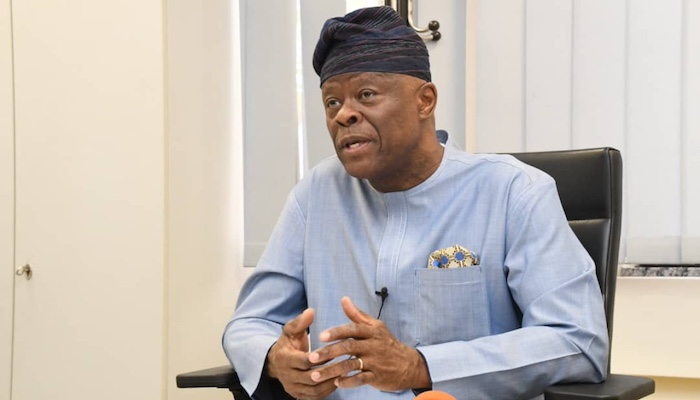
Wale Edun, the Minister of Finance and Coordinating Minister for the Economy, announced on Monday that the federal government is realigning its emphasis towards substantial capital mobilization and executing large-scale projects to enhance job creation and sustain economic development.
During his remarks at the Islamic Development Bank (IsDB) Group Day held in Lagos, Edun stated that Nigeria is transitioning from a phase focused on macroeconomic stabilization to one that emphasizes growth acceleration and investment mobilization as part of President Bola Tinubu's Renewed Hope Agenda.
On the same day, the federal government formalized a partnership and strategic agreement with the IsDB regarding the Country Engagement Framework, aimed at deepening cooperation and expanding development financing within Nigeria.
Edun further clarified that the administration's primary focus is to direct investments towards productive sectors that can increase output, enhance income levels, and alleviate poverty.
He articulated, "We are transitioning from stabilizing the economy to accelerating growth and mobilizing investments. It is through investments that we enhance productivity, stimulate economic growth, create employment opportunities, and lift people out of poverty, which is the cornerstone of the president's macroeconomic agenda."
The minister outlined the goal set by the President: to create a $1 trillion economy driven by productive sectors, private capital, innovation, and technology. To realize this aim, the government is shifting from a dependence on public financing to significantly scaling private sector investment.
Edun added, "Our current focus is on acquiring capital, implementing projects, and generating jobs at scale. We need a wider array of projects across diverse sectors—technology, climate initiatives, and agriculture—to address the employment challenges in a populous nation like Nigeria."
He described Nigeria's economy as one that is designed to be resilient, inclusive, and competitive globally. The focus is on boosting domestic production capabilities while ensuring sustainable growth and increased resilience.
Describing the partnership with the IsDB as strategic, Edun indicated that both sides are committed to attracting purposeful capital that achieves both social and economic impacts.
He highlighted four main pillars for their collaboration: infrastructure development particularly in energy, agriculture, and digital networks; social inclusion aimed at engaging millions in productive work; enhancing innovative financing instruments such as Sukuk; and fostering regional collaboration.
Edun announced that the government has designated 2026 as the “Year of Social Development,” intending to integrate approximately 10 million Nigerians into the economy through job creation and skills enhancement initiatives.
He mentioned that the government is increasing the utilization of non-interest finance and blended funding approaches to boost investments in sectors like housing, digital services, and the creative economy, thereby positioning Nigeria as a major Islamic finance hub in Africa.
According to Edun, "Our collaboration with the Islamic Development Bank is not only timely but also strategic. We aim to attract capital that not just offers financial returns but also achieves measurable social and economic impacts."
He stated the government is also committed to mobilizing savings at all levels through mass savings initiatives, allowing Nigerians to earn returns while contributing to national growth financing.
"In this manner, domestic savings will significantly support production and economic expansion," he remarked.
Discussing the agreement framework, Edun highlighted that it will cover three years from 2026 to 2028, underlining the importance of investments that provide financial stability along with tangible social benefits.
He noted, as Nigeria moves from economic stabilization into a phase marked by vigorous expansion in 2026, the focus on growth acceleration and investment mobilization is unwavering.
Edun expounded that achieving the goal of a $1 trillion economy by 2030 will necessitate capital with purpose—investments bridging the divide between financial stability and impactful social outcomes.
The cooperation with the IsDB and the Country Engagement Framework for 2026-2028 are pivotal in driving this goal forward. Edun emphasized modernization of the nation's infrastructure, industrialization of agribusiness, and integrating 10 million Nigerians into productive economic activities.
He further stressed the need for job-generating investments, noting Nigeria produces around 600,000 graduates each year, and there is an urgent demand for extensive job opportunities that improve living standards through reforms.
Edun accentuated the importance of resilience against emerging global economic and political uncertainties, urging that Nigeria must fortify its institutions, enhance strategic partnerships, and implement sound policies to tackle new challenges effectively.
He indicated that public financing alone cannot satisfy the country's developmental needs, highlighting that the government contributes only about 10% to the economy, while the private sector accounts for approximately 90%.
Anasse Aissami, the Director-General for Country Programmes at IsDB, conveyed that the bank is intensifying its collaboration with Nigeria through a comprehensive multi-institutional approach designed to hasten economic transformation.
Aissami noted that the IsDB Group has broadened its support across vital areas including agriculture, energy, transport, health, and education, concentrating on job creation, youth empowerment, and improvement in living conditions.
He remarked, "The IsDB Group remains steadfast in its mission to strengthen strategic partnerships in Nigeria, emphasizing operational excellence and propelling transformative projects that promote sustainable economic growth and enhance productivity."
He added that the IsDB Group is forming partnerships with Nigeria to improve infrastructure, foster inclusive human capital development, and reinforce private sector growth.
Aissami explained that this enhanced strategy transcends conventional project financing, fostering a holistic value proposition that merges project financing, private equity, and risk mitigation.
By utilizing these combined capabilities, the IsDB Group intends to deploy resources faster and with a broader impact, encouraging productivity.
He assured that the IsDB Group stands as a partner in Nigeria's economic transformation journey and seeks to amplify development support over the next five years, exceeding achievements of the previous 25 years.
Aissami revealed that by 2025, the bank had sanctioned over $2.3 billion for projects across essential sectors of Nigeria's economy.
He confirmed that Nigeria holds a crucial position within the bank's operations, with interventions that span agriculture, energy, transport, health, and education, all aimed at job creation and uplifting the living standards for youth and women.
According to Aissami, the funding portfolio includes commitments to insurance and trade support designed to enhance Nigeria's economic resilience against global challenges, such as economic volatility, climate shifts, and food insecurity.
He concluded by stating, "The partnership with Nigeria has grown significantly over the years. While infrastructure development is central to our engagement, we also prioritize human capital development because it is the people, not just infrastructure, who drive national progress."
Aissami elaborated that IsDB operates through multiple channels providing financing, technical assistance, insurance, and trade facilitation, which include the Islamic Development Bank Institute (IsDBI), Islamic Corporation for the Development of the Private Sector (ICD), International Islamic Trade Finance Corporation (ITFC), and the Islamic Corporation for the Insurance of Investment and Export Credit (ICIEC).
Comments (0)
You must be logged in to comment.
Be the first to comment on this article!