
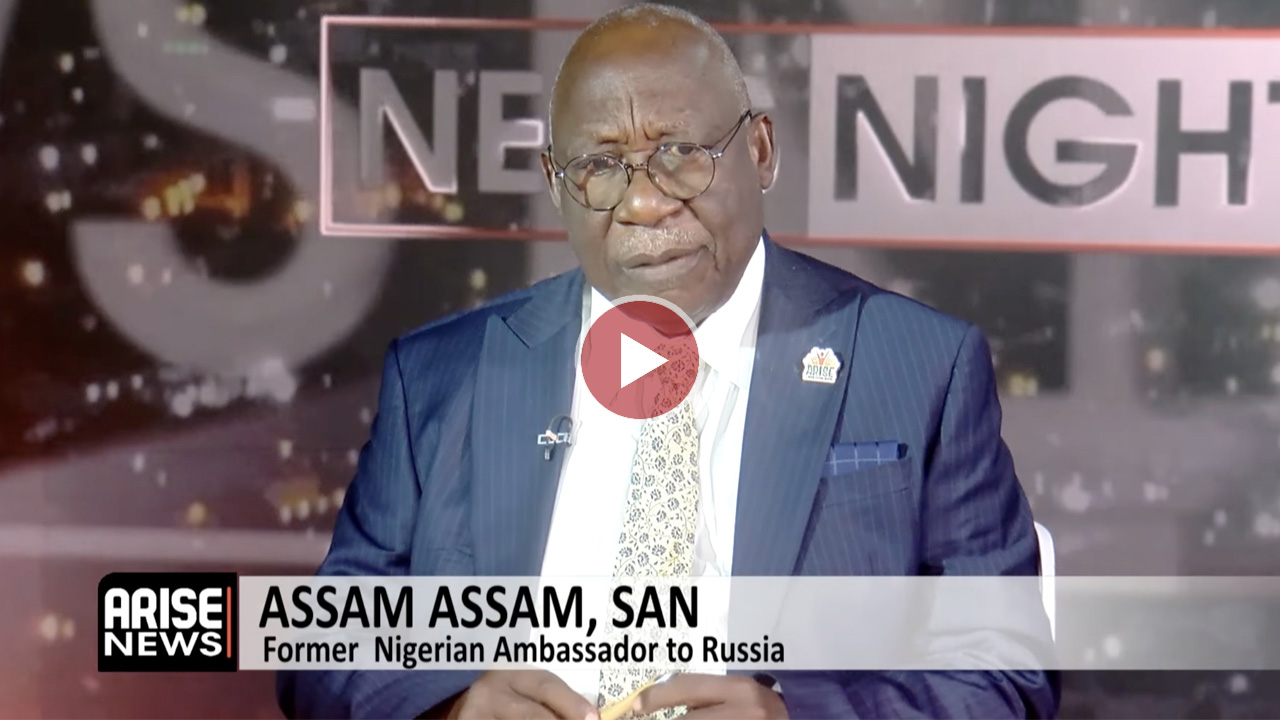
Assam Assam, a former Nigerian ambassador and Senior Advocate of Nigeria, asserts that the ongoing dispute between Akwa Ibom and Cross River states over offshore oil wells stems from disagreements concerning the allocation of 218 newly identified wells rather than any confusion regarding state boundaries.
In a recent interview with ARISE News, Assam clarified that the Revenue Mobilisation, Allocation and Fiscal Commission (RMAFC) is currently working to resolve this long-standing conflict, which has persisted for over twenty years. The row has been exacerbated by the identification of new oil wells, which differ from the previously acknowledged 76 wells often discussed in public.
"The root of the issue lies in the revenue mobilisation process for the new oil wells rather than the original set of wells. We are considering 218 new oil wells, not just the 76 referenced in past discussions," Assam stated.
He recounted that Cross River State first sought a Supreme Court ruling in June 1999, aiming to assert its claim over 76 oil wells thought to be located within its maritime boundaries.
"Our current predicament can be traced back to an action taken in the Supreme Court in 1999 when Cross River State requested the court to recognise that 76 oil wells situated in the estuary of the Cross River belonged within its maritime territory," he explained.
Assam elaborated that even though the matter remained unresolved for years, it was significantly influenced by a judgment from the International Court of Justice (ICJ) concerning the border between Nigeria and Cameroon in 2002.
"The ICJ's ruling inadvertently altered Nigeria's internal maps. According to the 1913 Anglo-German Treaty, the boundary was established along the thalweg, or the deepest part, of the Akwaiafe River, extending three nautical miles into the estuary," he said.
He added that the Akwaiafe River, which feeds into the Cross River estuary, has made the ICJ’s ruling pivotal regarding internal maritime boundaries.
Assam dismissed suggestions that boundary delineation issues are still outstanding, asserting that these matters were effectively resolved years ago.
"That is not correct. The lines are already clearly outlined as we speak today," he remarked.
He highlighted that a meeting of an inter-agency committee in Kano in 2008 resolved the boundary disputes, producing definitive maps with the assistance of the National Boundary Commission (NBC).
"The NBC generated accurate maps and I possess correspondence from the NBC chairman confirming these arrangements to the head of the Revenue Mobilisation and Fiscal Commission," Assam mentioned.
He also noted that the same NBC maps served as the foundation for the Supreme Court’s ruling in April 2012, which determined that Cross River State forfeited its maritime boundary due to the Green Tree Agreement stemming from the ICJ ruling.
"There has been no disagreement since then," he stated.
Idenfitying the critical issue is the location of the 218 new oil wells. Assam indicated that their coordinates were confirmed through joint verification by relevant government agencies.
"A joint committee consisting of state surveyors-general, the National Boundary Commission, the Revenue Mobilisation and Fiscal Commission, and the Office of the Surveyor-General of the Federation undertook the identification and verification of these wells’ coordinates," he said.
Assam asserted the permanence of geographical coordinates, arguing that the data is incontrovertible.
"Coordinates are constant. The only unchanging aspect on this planet is coordinates. Once an oil well is marked at a given point, that point remains fixed," he asserted.
He explained that entitlement to oil revenue must be based on whether the identified coordinates are within a state's acknowledged territory.
"If those coordinates lie offshore and beyond Nigeria's coastal line, then Cross River State cannot claim ownership since it is not a littoral state," he clarified.
While he acknowledged Cross River State’s right to contest the matter, Assam affirmed that resolution should come through technical assessments rather than political debate.
"They have the right to challenge the findings. However, the path forward involves technical panels reviewing these coordinates on a map, allowing the National Boundary Commission to ascertain the locations of the oil wells," he stated.
He maintained that disputes cannot alter established geographical truths.
"At no point will those coordinates shift the boundaries of Cross River State or Akwa Ibom State," he added.
Comments (0)
You must be logged in to comment.
Be the first to comment on this article!