
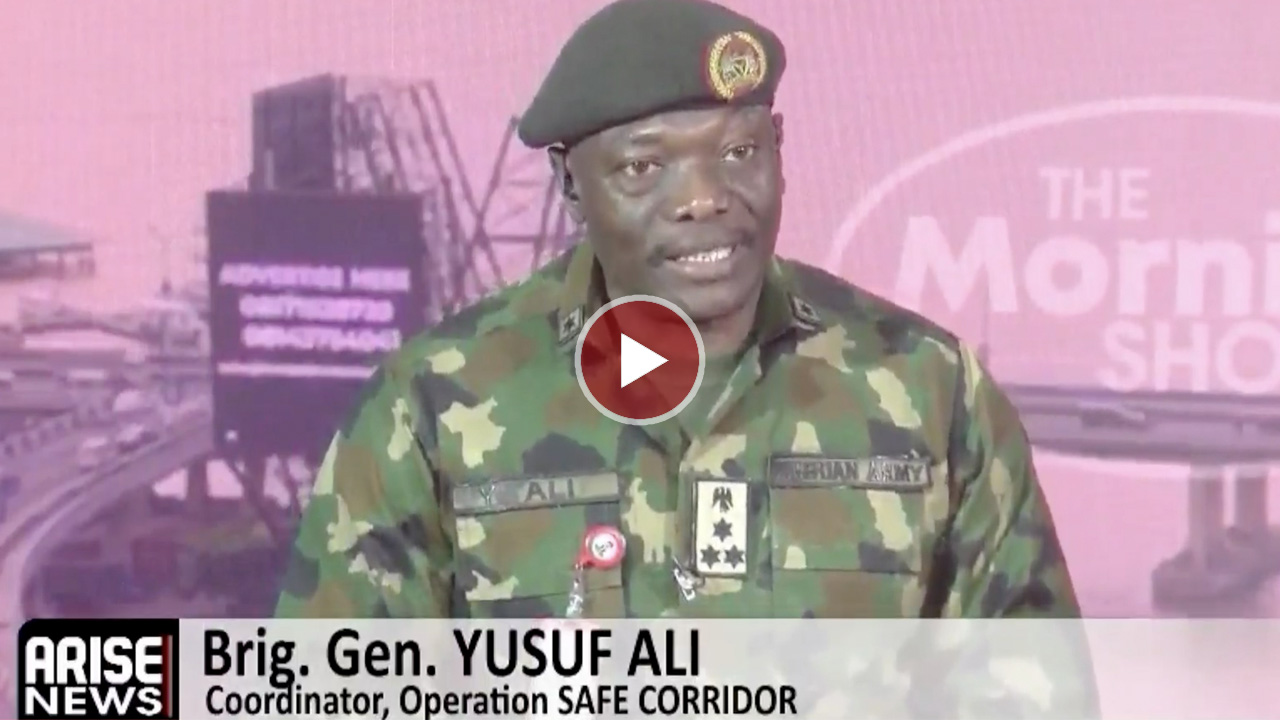
Brigadier General Yusuf Ali, the Coordinator for Operation SAFE CORRIDOR, has asserted that Nigeria's deradicalisation and reintegration initiative has successfully prevented individuals who have gone through the program from re- engaging in criminal or terrorist acts. Brig. Gen. Ali stated in an interview on ARISE News that claims of rehabilitated ex-insurgents rejoining violent groups do not align with the current situation on the ground, emphasizing that the program operates with a structured and transparent process, overseen by numerous security and civil institutions.
In response to queries regarding the efficacy of Operation SAFE CORRIDOR and allegations of relapse into crime by participants, he commented, "The reality on the ground does not support that assertion. Operation SAFE CORRIDOR is structured and a well-developed system of screening clients and providing psychosocial and other forms of support we provide for them."
He further explained the post-training process: "At the end of their training at the DDR camp, we don’t just insert them into society like that. Their integration is even done by the various state governments. We only provide the environment conducive for them to be reintegrated into their communities."
Brig. Gen. Ali highlighted that the reintegration process involves more than just the military, with state governments, traditional and local leaders, and security agencies all playing a part in ongoing monitoring after participants are released back into their communities.
"From there, the state governments, traditional rulers, and other key leaders, including security agencies at the local level, continue the monitoring of the clients, ensuring that their behaviours are consistent with the training they have imbibed at Operation Safe Corridor," he said.
He confidently stated, "I am bold to say that no member of clients that have left Operation Safe Corridor has been found to foment trouble in their various communities, cutting across Akwa Ibom in the south, Ebonyi in the southeast, down to the north and other parts of the country, including our neighbouring countries like Niger, Cameroon, Mali, Burkina Faso and others."
Brig. Gen. Ali expressed openness to suggestions for more structured tracking and accountability, such as monthly reports from community leaders. He described these ideas as constructive improvements, noting that while a formal monthly reporting system isn't currently in place due to a lack of adverse reports, such proposals will be considered for future implementation. He acknowledged that Operation Safe Corridor is a "work in progress" and is accountable and open to recommendations.
The discussion also touched upon the classification of surrendered individuals, distinguishing between those deemed "low-risk" and "high-risk." Ali clarified that Operation SAFE CORRIDOR does not automatically grant amnesty, with the Ministry of Justice playing a critical role in the screening and categorization process.
"Operation Safe Corridor does not provide amnesty just because you surrender. It comprises 17 ministries, departments, and agencies, including the Ministry of Justice. It is the Ministry of Justice that screens and categorises those that surrender… It is those low risks that are handed over to Operation Safe Corridor that we admit and administer deradicalisation and psychosocial therapy to," he explained.
Addressing the possibility of individuals involved in violent crimes being misclassified as low-risk, he pointed out that some participants had not directly engaged in killings and, in some instances, had been victims of abduction or coercion.
"Some of them have not even seen somebody killed in their life. Some of them are abducted and made to run errands, fetching water, firewood and going on different messages," he elaborated.
On the broader context of escalating terrorism in Nigeria and the program's effectiveness, Brig. Gen. Ali recognized the multifaceted nature of terrorism as a global challenge requiring both military and non-military solutions. "Terrorism has been a global phenomenon, and the causes are broad and many. What Operation Safe Corridor seeks to do is to reduce recruitment of gullible Nigerians who are brainwashed and recruited into terrorism and other violent crimes," he stated.
He argued that Nigeria's current security situation is a result of combined kinetic (forceful) and non-kinetic (non-forceful) interventions. "Relatively put together, what we are currently enjoying, despite some few incidences here and there, is the net product of the combination of kinetic and non-kinetic operations," he concluded.
Brig. Gen. Ali urged the public to collaborate with security agencies in the collective effort to combat terrorism, stating, "Terrorism thrives where there are various factors, and it takes the whole nation to defeat terrorism. I will urge Nigerians to join hands with the Chief of Defence Staff so that both kinetic and non-kinetic operations can provide the desired peace and security that Nigeria rightly deserves."
Comments (0)
You must be logged in to comment.
Be the first to comment on this article!