
Senator Seriake Dickson, a key member of the Senate Committee on Electoral Matters, has asserted that the amended Electoral Act mandates mandatory electronic transmission of polling unit results, thereby enhancing electoral transparency.
During an interview with ARISE News on Tuesday, Dickson addressed the controversy that arose from the removal of the term "real time" from the Electoral Act Amendment Bill. He affirmed that the Senate's recent actions should not be interpreted as a regression for democracy, emphasizing that the critical objective of securing the INEC Result Viewing Portal (IREV) has been achieved.
"I do not view today's proceedings and outcome as a loss for democracy," Dickson stated.
The Senate revisited Clause 60(3) of the bill in response to public backlash, reinstating the clause requiring electronic result transmission from polling units to INEC’s IREV portal while also adding a provision for manual collation in instances of network failure. Critics express concerns that without a direct requirement for real-time transmission, there is an increased risk of manipulation.
Nevertheless, Dickson clarified that he was sharing his personal perspectives, not acting on behalf of the Senate. "I’m not here as a spokesman of the Senate. I’m here to provide my insights as a long-standing member of this committee and as someone actively engaged in today’s discussions,” he explained.
He noted that discussions surrounding electronic transmission have been ongoing for nearly two years, including consultations, workshops, and direct engagements with INEC.
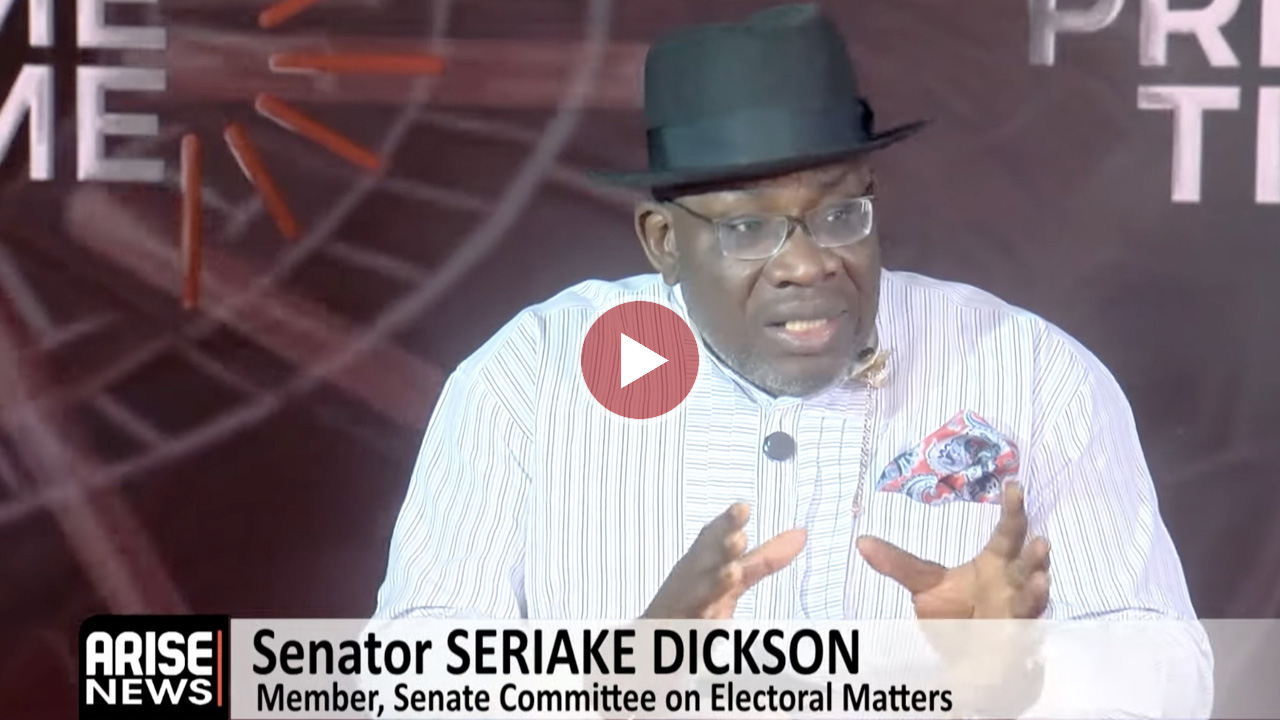
“This process has involved countless workshops, conferences at the Senate Committee, and collaborative efforts with INEC over approximately two years,” he elaborated.
Dickson revealed that he was absent during the Senate's initial controversial decision due to personal bereavement. "I was unable to attend the previous Senate session where the decision was made, as I recently lost a close brother, Nigeria's deputy governor of my state. Today marked my return to the Senate, underscoring the significance of this issue,” he said.
He attributed the ongoing resistance to electronic result transmission to entrenched political disagreements. "The matter of electronic transmission has historically faced challenges; even during the 9th Senate, we encountered significant opposition. The ruling party has consistently resisted these efforts,” he remarked.
Dickson indicated that there was a previous consensus in the Senate Committee and the House of Representatives on protecting the IREV before the Senate's subsequent alteration of the agreement on the floor. "There was a consensus among us. A similar report was presented by the House of Representatives committee, which passed without controversy. This was our joint agreement," he noted, labeling the Senate's prior reversal as unfortunate.
"What transpired in the Senate last week was regrettable, especially since INEC had already assured us of its capability to facilitate electronic transmission,” he added, expressing that upon returning to the Senate, he confronted the leadership about their commitment to finding a compromise.
In discussing the real-time transmission debate, Dickson pointed out that the term is often misconceived and overstressed. "What does real-time mean? We are not currently conducting electronic voting in Nigeria, where a button press instantly updates votes on a portal," he clarified, suggesting that the phrase may be unnecessary in the current electoral context.
He stated, "The term ‘real-time’ is, in this context, actually unnecessary. It does not inherently ensure an election's transparency." He further commented, "It should never have been included in the first place; however, it is never too late to amend something."
The senator emphasized the importance of securing polling unit results before they are collated. "The primary proof of an election's winner is the EC8A document. Once the votes are counted and agents sign, INEC requires presiding officers to transmit results to the IREV. That is sufficient for us,” he noted.
While expressing some reservations about the proviso for network failures, Dickson acknowledged that political realities necessitate compromise. "I do not support the included proviso, but parliament operates on a majority basis. We, in the opposition, do not hold the numbers to mandate the original provision,” he confirmed.
He maintained that the legislation still compels electronic result transmission. "The overarching rule is that every presiding officer must transmit results electronically. This is mandatory, and that is what we ratified today," he affirmed.
If he were on the conference committee focused on aligning the Senate and House versions, Dickson stated he would endorse the House position because it reflects their collective agreement in the joint committee.
Dickson also raised concerns over other provisions in the bill, particularly the proposal compelling all political parties to utilize direct primaries. "The introduction of direct voting is an initiative by the APC. They lack the authority to impose it on every other political party, especially the smaller parties,” he commented.
Regarding accountability in future elections, he reiterated that the responsibility would lie with INEC. "Ultimately, INEC is obligated to establish its own guidelines and regulations. Currently, even without this amendment, INEC’s guidelines require electronic transmission to the IREV,” he concluded.
Dickson defended the Supreme Court’s stance after the 2023 elections, asserting that "The Supreme Court accurately stated that the primary evidence for proving an election is the EC8A. The IREV was never designed to serve as primary evidence."
He maintained that electoral reform must be gradual, saying, "Progress is achieved incrementally. Reform is not always an either-or scenario. We have made electronic result transmission mandatory, and that represents progress.”
Comments (0)
You must be logged in to comment.
Be the first to comment on this article!