
The Kano State Peace Advocates (KASPA) aims to clarify recent public discussions surrounding civil liberties in Kano State.
In Nigeria, civil liberties, which are fundamental freedoms enshrined in the Constitution, protect citizens from governmental interference and promote equal rights under the law. These rights are outlined in Chapter IV of the 1999 Constitution (Sections 33–46) and encompass the right to life, dignity, personal liberty, fair trial, freedom of thought and worship, freedom of expression and the press, freedom of assembly and association, freedom of movement, and freedom from discrimination. In simpler terms, these liberties ensure that Nigerians can live without the fear of arbitrary detention, express themselves freely, practice their religion, gather peacefully, and enjoy fair treatment regardless of their backgrounds. They are foundational to democracy in Nigeria, enabling citizens to confront injustices, hold authorities accountable, and lead dignified lives. Therefore, we wish to reiterate our unwavering belief that His Excellency, Governor Abba Kabir Yusuf of Kano State, is a dedicated democrat who upholds the constitutional right to freedom of expression, as per the amended 1999 Constitution of the Federal Republic of Nigeria.
Since taking office, Governor Yusuf has consistently shown receptiveness to criticism, invited constructive dissent, and ensured open lines of communication between the government and the populace. His administration has not implemented any policy aimed at curtailing lawful speech or suppressing peaceful civic engagement. Conversely, the Governor has often advocated for dialogue, tolerance, and responsible public discussions to advance the state. However, it is vital to distinctly differentiate the political leadership from the operational mandates of federal and state security agencies. Bodies such as the Department of State Services (DSS) and the Nigeria Police Force function within established legal frameworks that empower them to act independently in the interests of public safety and national development.
When these agencies determine that certain actions or statements may incite violence, pose threats to public order, or violate existing laws, they are authorized to summon, interrogate, arrest, or detain individuals in accordance with due process. Such operational decisions do not necessitate the Governor's directive or prior approval, as clearly indicated by the amended 1999 Constitution.
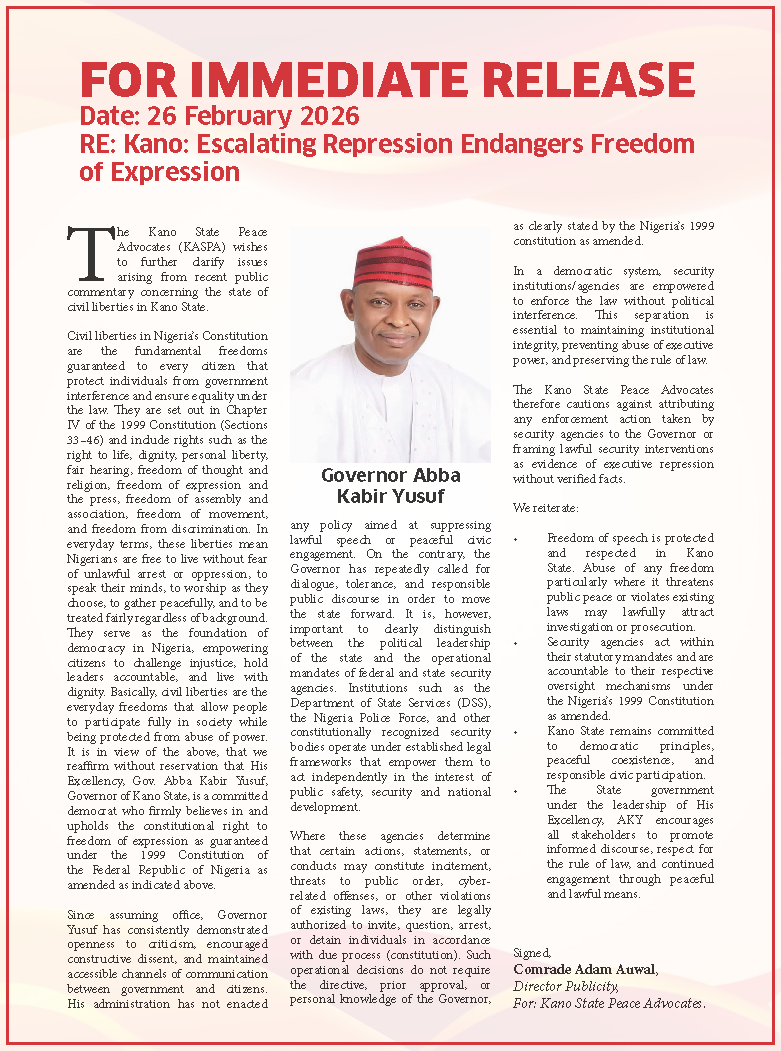
In a democratic framework, security agencies are tasked with law enforcement free from political interference. This separation is crucial for maintaining the integrity of institutions, preventing the misuse of executive power, and upholding the rule of law.
KASPA advises against misleading representations that attribute any enforcement actions taken by security agencies directly to the Governor, or that portray lawful security operations as instances of executive repression without concrete evidence.
We emphasize:
Ø Freedom of speech is protected and upheld in Kano State. Any misuse of this freedom, especially if it threatens public peace or breaches laws, may justifiably trigger investigations or prosecutions.
Ø Security agencies function within their statutory authority and are accountable to established oversight mechanisms under the amended 1999 Constitution.
Ø Kano State upholds its commitment to democratic principles, peaceful coexistence, and responsible civic participation.
Ø The state government, led by His Excellency, AKY, encourages all stakeholders to foster informed discussions, adhere to the rule of law, and engage through peaceful and lawful avenues.
Signed,
Comrade Adam Auwal,
Director of Publicity,
For: Kano State Peace Advocates.
Comments (0)
You must be logged in to comment.
Be the first to comment on this article!