
Nigeria's public discourse is often characterized by a segment of the population that favors harsh criticism over constructive dialogue, preferring acerbic remarks to encouraging ideas. These individuals are frequently petulant, easily irritated, and surprisingly sentimental.
Fortunately, a dedicated group of refined individuals continues to advocate for the redemption of harsh commentary through wit, elegance, and linguistic finesse.
Nyesom Wike, a former two-term governor of the oil-rich Rivers State and currently the Minister of the Federal Capital Territory, embodies the full spectrum of abrasive discourse, irreverent commentary, and ostentatious impoliteness within Nigeria's public communication arena. Despite this, he paradoxically commands significant attention and is even courted by the media, largely due to his considerable capacity for causing disruption.
The deficiency in refined communication skills and a general lack of appreciation for the subtleties of language have contributed to an unwarranted celebration of Wike's perceived character, despite its perceived hollowness. A significant portion of Wike's audience appears to lack the necessary intellectual grounding for engaging with the complexities of public life.
The strained relationship between Wike and his protégé, Governor Siminalayi Fubara, in the Rivers State political landscape has become a widely observed national spectacle. The anticipated harmony between them has predictably fractured, a development that is easily discernible and can be understood as another turn in the unfolding narrative of political consequence.
Governor Fubara is characterized as someone who expresses sentiments rather than holding independent opinions, whereas Wike, in the manner of a monarch, is expected to exert control and enforce adherence to established rules, overseeing Rivers State's affairs from his ministerial position in Abuja.
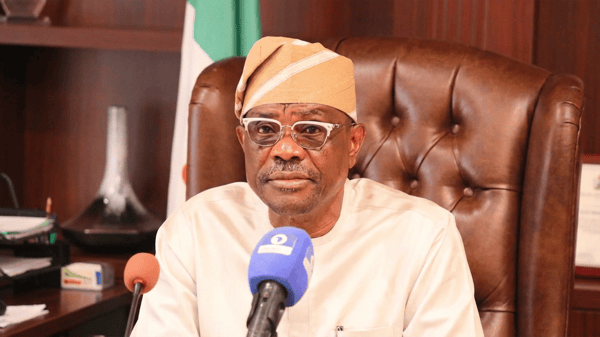
Wike is reputed for his ability to make significant misjudgments, particularly in his selection of individuals for prominent political roles. His purported patriotic intentions have reportedly been compromised on numerous occasions, with his choices often proving to be his undoing.
Furthermore, Wike is credited with significantly contributing to President Tinubu's vision of a one-party system by undermining the growth and development of Nigeria's primary opposition party, where he once held a dominant and seemingly unassailable position. Upon completing this task, Wike anticipated a triumphant reception into the President's political party. However, he was reportedly taken aback by Fubara's strategic move of registering as a member of the All Progressives Congress (APC) in Rivers State, effectively positioning himself as the party's leading figure. Wike had been strategically waiting for the opportune moment to join the APC, a moment that now seems indefinitely delayed.
In the lead-up to the current political friction, Fubara seemingly disregarded Rudyard Kipling's cautionary advice regarding relationships with difficult individuals: “Make ye no truce with Adam-zad – the bear that walks like a man.”
Wike had allegedly secured an agreement from Fubara, preventing him from seeking a second term in office. Wike's control over Fubara was perceived as suffocating and undignified.
Fubara, however, did what Wike believed was impossible: he defected to the APC and assumed the position of the party's foremost leader in Rivers State by virtue of his governorship. This move positioned him as a central figure, tasked with consolidating Rivers State's support for President Tinubu in the upcoming elections. This single act has significantly eroded Wike's widely acknowledged political influence.
True to his nature, Wike has reacted intensely to this perceived challenge to his authority, issuing ultimatums and threats. He has even hinted at retaliatory actions against President Tinubu, expressing strong sentiments on behalf of Rivers State.
Wike sternly warned the APC against taking Rivers State's support for Tinubu's 2027 presidential bid for granted, projecting an image of being cornered and diminished. He has reportedly held an unusually high number of press conferences since the current republic began, seemingly to maintain his public profile.
It has been suggested that Alhaji Ajibola Bashiru, the National Secretary of the APC, played a role in managing Wike's influence, with President Tinubu's backing. The combined efforts appear aimed at curtailing Wike's political ambitions.
Under the current political arrangement, Wike is expected to defer to Fubara on matters concerning Rivers State. While seeking to avoid appearing ungrateful, Tinubu has strategically used Fubara to diminish Wike's claimed leadership role in Rivers State and the South-South geopolitical zone. This approach aligns with the Yoruba proverb, “Ogbon j’agbara lo” (Wisdom is superior to strength). Despite the pragmatic nature of political practice, Wike is expected to navigate this situation privately while seeking opportunities to reassert his influence with Tinubu.
President Tinubu is reportedly relishing the political drama, seeing it as a testament to his strategic acumen, allowing him to orchestrate events from behind the scenes without direct involvement in the fallout. Tinubu's apparent detachment from the core issues seems to echo Sir William Schwenck Gilbert's observation: “He is like a man who sits on a stone and then complains that his backside is burning.”
The enduring human spirit has historically empowered individuals to endure hardship rather than compromise their loyalty to figures who falsely claim state authority. The freedom to act according to one's convictions is a fundamental aspect of this struggle.
The concepts of loyalty and majority consensus are rendered absurd when personal conscience and judgment are superseded by unwavering allegiance to ill-defined notions that contradict our natural purposes.
Conscientious objection must remain a legally protected right. Individuals who conscientiously object should be commended, not condemned.
This analysis concludes with a parable from Aesop's Fables, illustrating the tale of the Lion and the Wild Ass. The lion and the wild ass agreed to hunt together, with the lion providing strength and the ass offering speed. After a successful hunt, the lion divided the prey into three portions. He claimed the first for being the king, the second for his partnership in the hunt, and warned the wild ass that the third portion would be detrimental to him if he did not relinquish it.
The moral of the story suggests the importance of accurately assessing one's own capabilities and avoiding alliances with individuals or entities beyond one's control.
Rotimi John, a legal practitioner and public affairs commentator, serves as the Deputy Secretary General of Afenifere.
Comments (0)
You must be logged in to comment.
Be the first to comment on this article!