
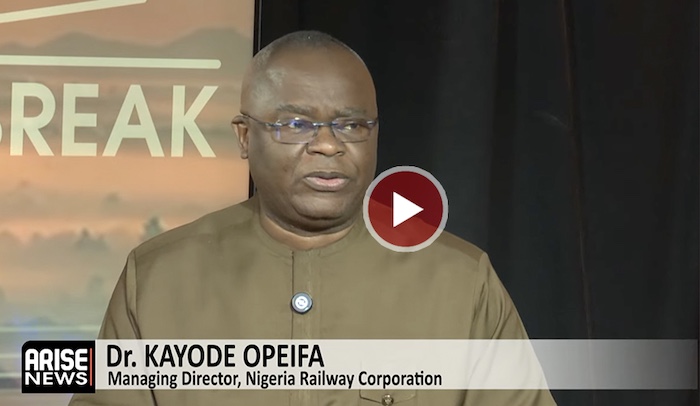
Dr. Kayode Opeifa, the Managing Director of the Nigeria Railway Corporation, stated that the railway sector in Nigeria is evolving swiftly, asserting that derailments are not unusual occurrences globally.
He made these comments during an interview with ARISE NEWS on Wednesday, where he also elaborated on the proposed national roadmap for railway development.
"The rail sector is gradually and rapidly advancing. Our mandate is to enhance trade, foster economic growth, and alleviate poverty, thereby facilitating easier access to jobs and connecting the manufacturing industry with markets, as well as farmers with their consumers, while improving logistics and supply chains for trading purposes," he stated.
Regarding derailments, Dr. Opeifa remarked, "These incidents are commonplace in the rail industry. For instance, in February alone, the UK experienced at least one major derailment, specifically on February 6th. Simultaneously, there were no fewer than 15 derailments globally. Such events are a standard aspect of rail operations, not only within Nigeria but internationally."
He went on to highlight that the Nigeria Railway Corporation has effectively managed derailments that occurred in various states across the country.
"In 2025, we recorded three significant derailments: one on August 26th in Asham, Kaduna, and two on the Warri-Itakpe line, occurring on November 1st and November 8th at Abraka and Agbor respectively. Nonetheless, these should not be viewed as setbacks; they are challenges that we have successfully addressed, with recovery times ranging from 24 hours to 28 days," he explained.
Dr. Opeifa insisted that derailments are a standard part of rail operations and should not be interpreted as failures on Nigeria's part.
"These occurrences are a normal part of rail transport. A derailment implies that a train has veered off its track, often due to switch issues or human error, which can include major accidents. For example, the recent derailment in Egypt was a significant accident, while the one in Spain resulted in tragic fatalities. Thankfully, in our case, we did not record any fatalities; however, the last incident in Spain saw about 38 deaths, and the UK�s incident earlier in February was similarly tragic," he noted.
Dr. Opeifa emphasized that while derailments should be avoided, they are not indicative of a systemic failure within Nigeria's rail operations.
"Incidents can be minimized, though they are often linked to weather conditions, signal malfunctions, or human error, including excessive speed. Aging infrastructure can also play a role. Thus, while derailments are serious, they do not signify major deficiencies in our operations," he asserted.
In response to accusations of financial mismanagement within the corporation, Dr. Opeifa stated:
"I am not a legal expert, and my understanding suggests that issues currently before the court should remain sub judice. Hence, I cannot comment further. I challenge anyone claiming there is mismanagement to substantiate that with specific evidence."
He highlighted that any allegations of mismanagement should be addressed by relevant authorities rather than be debated in public.
"If there are corrupt practices or mismanagement, those are matters for the appropriate bodies to investigate. My focus remains on transforming the Nigerian Railway Corporation to adhere to global best practices and ensure efficient service delivery, benefitting all Nigerians," he assured.
Dr. Opeifa committed to enhancing railway services, stating:
"We are revitalizing our rail lines and restoring our coaches. The coaches involved in recent incidents at Asham, Warri, and Agbor have been retrofitted to meet operational standards, thanks to the expertise of Nigerian engineers. This demonstrates that our railway system is operational and responsive. As we mentioned earlier, we are developing a functional railway framework. The Warri-Itakpe and Abuja-Kaduna lines are fully operational and will soon increase services from two to three trips on Fridays."
On the national railway roadmap, Dr. Opeifa indicated that the Nigerian Railway Corporation is working on expanding its services and developing comprehensive rail connections throughout the country, contingent on funding availability.
"Our achievements reflect our capacity to maintain and construct railway tracks. Feedback from users of the Lagos train service indicates that our offerings meet international standards. We are also launching tourism and entertainment initiatives alongside these improvements," he mentioned.
"Looking ahead, our goal is to connect every major city in Nigeria through railway lines. The roadmap is outlined; what remains are funding and execution. This will shape our future direction and objectives," he stated.
Refuting allegations of incomplete projects, Dr. Opeifa clarified that the Nigerian Railway Corporation is advancing its projects in phases due to the inherent capital demands.
"I am not aware of any currently abandoned projects. For context, the Lagos- Ibadan corridor, part of the broader Lagos-Kano project, was completed within an unprecedented three to four years. That's a remarkable achievement. We’re advancing on the Kano-Maradi project, linking Abuja to Daura, Funtua, and Jibia, which is also scheduled for completion this year. None of our projects are stalled; they are progressing according to the available resources," he stated.
Addressing the southern expansion plans, Dr. Opeifa indicated that the NRC is working to bolster connections from Warri to Abuja and from Lekki Port to Onitsha for both passenger and cargo transport.
"The central rail line runs from Warri to Itakpe, with plans to connect to the Warri Port. In 2026, we intend to award a contract to link the Itakpe segment to the Federal Capital Territory, which will enhance connectivity for individuals traveling from the South-South region directly to Abuja. Furthermore, upcoming projects will facilitate cargo and passenger movement from Lekki Deep Sea Port to Kajola, and on the eastern side, extensions to Benin, Onitsha, and Aba are also planned," he detailed.
Dr. Opeifa further announced that Nigeria's railway system is steadily modernizing, emphasizing improvements in signaling and the introduction of modern metro lines slated for development, which will enable the operation of faster trains.
"We acknowledge that considerable improvements are still necessary. The extent of digitalization is influenced by various factors, including the gauge and the construction standards applied. The signaling system currently in use for the Abuja Rail Mass Transit is among the best in Nigeria, while the Lagos- Ibadan route is undergoing upgrades to meet the signaling standards necessary for upcoming metro operations," he elaborated.
"New metro lines for Kaduna, Kano, and Lagos, backed by the federal government, will incorporate advanced signaling systems. We are transitioning from narrow gauge to standard gauge, and with time, we will introduce fast trains. We are steadily progressing despite previous years of inactivity in this sector," he concluded.
Comments (0)
You must be logged in to comment.
Be the first to comment on this article!