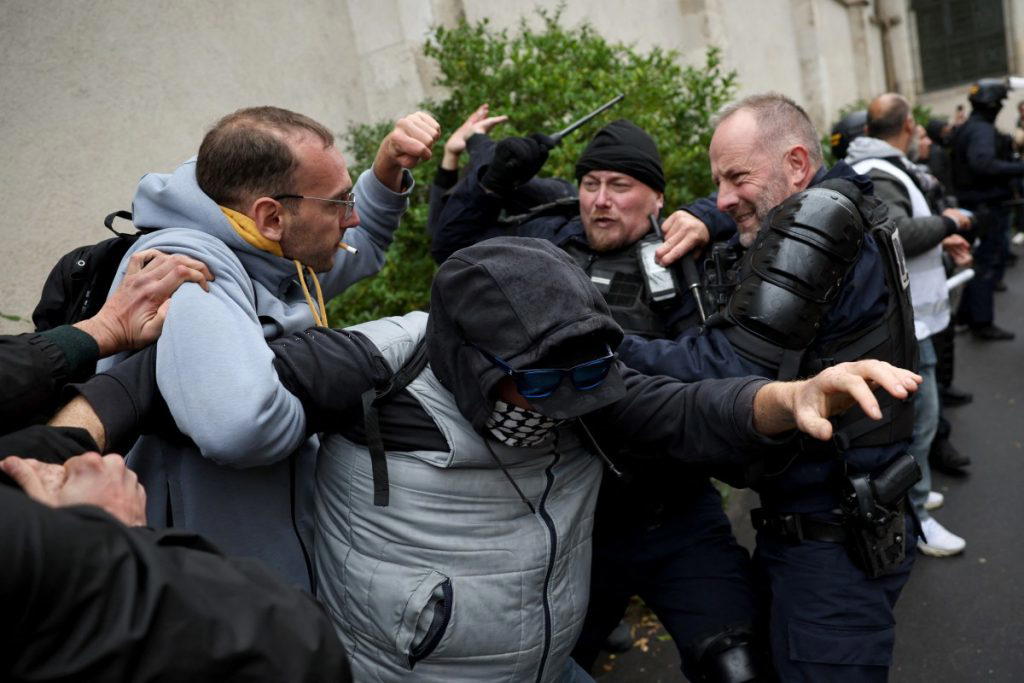
On Saturday, police in Paris and a number of other French cities clashed with demonstrators who were marching against rising living costs, leaving nearly 1,000 people detained and two individuals seriously injured.
The Interior Ministry reported that officers faced "an extremely elevated level of violence" from participants described as black‑clad "ultra‑left" activists. Interior Minister [Laurent Nunez](https://www.interieur.gouv.fr) said riot squads deployed tear‑gas in the capital as well as in Marseille, Lyon, Bordeaux, Lille, Toulouse, Montpellier and Nantes.
Two protesters suffered grave wounds, according to Nunez: a man in Toulouse allegedly lost several fingers, and another individual was injured in Clermont‑Ferrand, though details were not disclosed.
Authorities had positioned roughly 70,000 security personnel nationwide for the latest round of marches, which were organised to protest the soaring cost of living.
The unrest followed a previous wave of rioting a week earlier that saw public buildings vandalised, hundreds of shops looted and 2,700 arrests, casting a shadow over France’s upcoming presidential election scheduled for six months from now.
Nunez claimed Saturday’s outcome was more "positive" than the earlier disturbances, citing faster police response, increased pre‑demonstration checks and better protection of commercial premises. Nevertheless, many citizens criticised the crackdown as an infringement on the right to protest.
How many people took part?
Estimates of total turnout vary widely, with authorities and the organising [CGT union](https://www.cgt.fr) putting the figure between 410,000 and 800,000 across the country. In Paris alone, attendance was estimated at between 110,000 and 250,000 participants.
What measures did the government impose?
The Macron administration ordered police to block protesters from reaching city centres where shops are concentrated, and imposed partial curfews in several urban zones. President [Emmanuel Macron](https://www.elysee.fr) also declared non‑union demonstrations "illegitimate" and banned them.
In Paris, many retailers boarded up windows to deter looting, and the Louvre and Musée d’Orsay remained closed for the day. The main march was redirected to the city’s southeast fringe after a last‑minute police order. After the procession ended, clashes erupted as crowds dispersed; Nunez said the fighting lasted two hours and involved about 500 rioters at the rear of the march.
AFP journalists observed police repeatedly charging demonstrators, using tear‑gas and batons, particularly against younger protesters. One demonstrator named David, who suffered a facial injury from a baton, told AFP that police were "just taking people down, beating protesters."
Which groups were involved?
In Nantes, thousands broke through police lines, confronting officers with tear‑gas and a water cannon. In Rennes, a 23‑year‑old named Emma expressed anger over the bans on demonstrations and the repression of high‑school protests. In Lille, 47‑year‑old Delphine said, "Neither the president nor the weather will stop me from demonstrating."
Lyon saw tear‑gas deployed against roughly 1,000 participants, and a 20‑year‑old protester called Silem warned that banning protests was steering the country toward a "fascist, dictatorial" regime.
In Cannes and Montpellier, far‑right activists deliberately sought confrontations with "ultra‑left" militants, a development authorities described as unprecedented. Police also reported looting in Marseille and Grenoble.
The legacy Yellow Vests movement called for further demonstrations on 31 October, demanding "the freedom to protest." Far‑left presidential candidate Jean‑Luc Mélenchon, who marched in Paris, warned that President Macron would see repeated weekly unrest if grievances are ignored.
How does the political climate influence the unrest?
Tensions were heightened by a rally in Orléans organised by far‑right leader Marine Le Pen’s [National Rally](https://en.wikipedia.org/wiki/National_Rally_(France)) as she launched her presidential campaign. Police estimated 13,000 counter‑protesters, while organisers claimed twice that number.
The series of disturbances underscores a volatile political atmosphere ahead of the election, where Le Pen currently leads in opinion polls. Inflation, especially fuel prices, has surged since the onset of the Middle East conflict in February, fueling public discontent.
Similar protests have erupted in Italy, Belgium, Spain and Portugal over inflation and education issues, with Italy even deploying 500 troops to Milan after street violence there.