
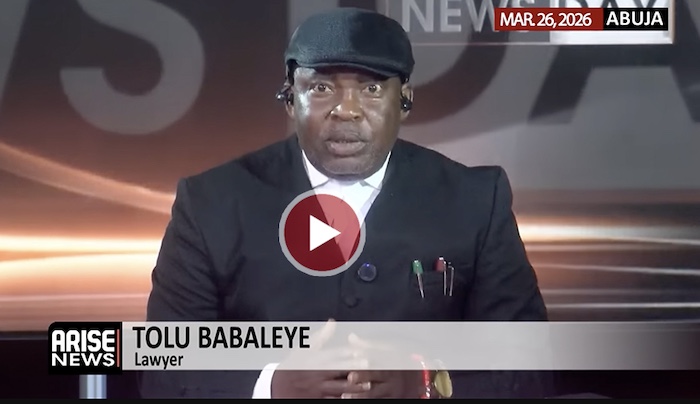
Tolu Babaleye has urged President Bola Tinubu to take steps to enforce court rulings in the ongoing conflict within the National Union of Road Transport Workers (NURTW), cautioning that failure to do so undermines the rule of law.
During an appearance on ARISE News last Thursday, Babaleye noted that the conflict traces back to 2023, coinciding with the conclusion of Comrade Ipegunle Barua’s term as NURTW president, which officially ended on August 27, 2023. Barua had been re-elected and inaugurated on August 23, 2023, during the National Delegate Conference held in Nasarawa State.
Shortly after his inauguration, a faction led by former president Usuma Yassin sought to appoint another leader, Ginabuja, in direct violation of the NURTW Constitution. "They forcibly suspended Barua’s inauguration, which is illegal," Babaleye stated, reiterating that the actions of this faction were unlawful.
In response, Barua filed a case with the National Industrial Court in Abuja, successfully obtaining a ruling that validated his election and nullified the actions of the so-called caretaker committee. The appeal made by the opposing faction was dismissed by the Court of Appeal, reaffirming Barua’s leadership position.
Despite these judicial decisions, Babaleye reported that Barua has encountered significant challenges in taking office. "In the early hours, thugs and security personnel forcibly removed Barua from the office. There was even a death involved," he recounted, highlighting ongoing harassment and intimidation faced by the president of the union.
Further legal proceedings clarified that Barua, the president recognized by the court, should have access to the union's office. An order issued on March 6 mandated that all individuals vacate the premises within 24 hours; however, this directive remains unfulfilled.
Babaleye expressed frustration with the Nigerian police and other security forces for their failure to execute court orders, indicating that procedural justifications are often used to postpone compliance. "The National Industrial Court does not have a unit for enforcing non-financial judgments," he pointed out, emphasizing structural hurdles that obstruct the delivery of justice.
He stated that letters requesting enforcement of the court's decisions have been dispatched to significant government entities, including the President, the Minister of Labour, the National Security Advisor, and the Inspector General of Police. Babaleye perceived the lack of response as indicative of a more extensive institutional reluctance to uphold the law.
The advocate suggested that political interference is at play, asserting, "It is evident that Barua has offended individuals in high positions, which explains the non-implementation of the court’s judgment." He stressed that the lawful authority of the union president is being impeded by vested interests.
Babaleye cautioned that unresolved disputes could destabilize forthcoming elections within the NURTW, forecasting, "There may be parallel elections, ongoing conflict, and lack of peace during leadership transitions," underlining the potential long-term ramifications for the labor union.
He called upon President Tinubu to take decisive action, emphasizing the necessity for commitment to the rule of law that transcends mere rhetoric. "Barua has waited for justice for two and a half years. The Presidency must ensure compliance with legal mandates to avert further disruptions," Babaleye urged.
As Babaleye elaborated, the NURTW crisis extends beyond a union matter; it serves as a litmus test for Nigeria's commitment to the rule of law. "The refusal of the executive to enforce court rulings creates a perilous precedent," he concluded, pressing for immediate action to restore lawful leadership and protect institutional integrity.
Comments (0)
You must be logged in to comment.
Be the first to comment on this article!