
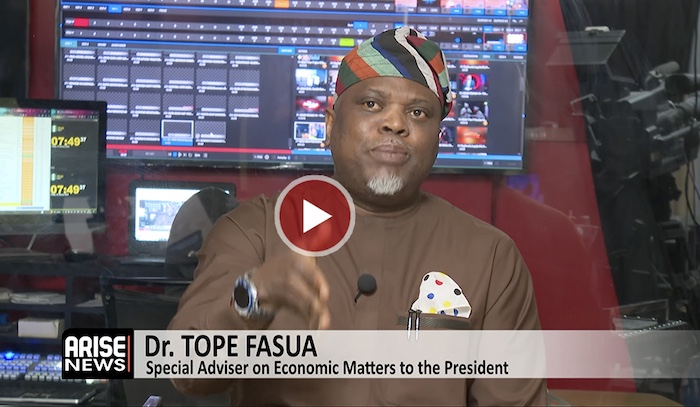
Dr. Tope Fasua, who serves as the Special Adviser on Economic Matters to President Bola Tinubu, has revealed that tax reforms implemented by the administration have resulted in increased salaries for many workers across Nigeria.
In a recent interview with ARISE NEWS, Fasua emphasized the positive impact of these reforms, stating that they have contributed not only to a rise in salaries but also to a reduction in inflation and overall economic growth in Nigeria. He encouraged Nigerians to adopt a constructive outlook towards these economic changes.
Fasua mentioned that many Nigerians are already noticing enhancements in their economic situations, attributing these advancements to the President's tax initiatives. He pointed out that a report from Business Day indicated that as many as 90% of workers could expect to see their take-home pay rise due to these tax reforms affecting January’s salaries alone.
"Currently, training seminars are being conducted to ensure that human resource professionals understand the tax reforms and can properly guide those employed across various sectors. These adjustments are designed to lessen the financial strain on individuals earning less than N25 million annually—a demographic that comprises approximately 95% of the Nigerian workforce," he noted.
He also mentioned that while some farmers have expressed concerns over declining food prices, the overall economic trends appear to benefit the majority of the population.
Fasua stated, "Prices for food items are decreasing, yet some in the agricultural sector are reluctant to return to farming. However, these reforms seem to favor the larger part of Nigeria, as most people are not engaged in agriculture. With lower prices, increased exports, and reduced imports, the naira has gained strength, trading at N1,394 in the official market—the strongest it has been in over two and a half years. Our living conditions are gradually improving, albeit this is an ongoing process."
He continued by addressing the farmers’ complaints about price drops, arguing that falling food prices could be a crucial element in driving down inflation, thus needing a shift in public perception towards these changes.
Fasua highlighted that Nigeria's revenue challenges stem more from inefficiencies and collection issues rather than inadequate tax payments by citizens.
"The recent tax reforms aim to create a comprehensive overhaul that encompasses multiple aspects of the economic structure. They seek to ensure that accurate data is collected from taxpayers, putting pressure on the Nigeria Revenue Service to enhance its collection efficiency. Since about 70% of the economy is informal, part of these reforms is to move more of this sector into the formal economy, potentially raising it to 80%. Compliance levels are currently quite low, with only about 15%. It's remarkable to observe the shifts in state budgets; for instance, certain states like Enugu and Lagos have seen substantial budget improvements since 2019," he explained.
In response to questions about the feasibility of tax harmonization in Nigeria, Fasua stated that any current confusion regarding tax policies is temporary. He assured that efforts are underway to clarify these systems.
He added, "As we implement these large-scale reforms, there will inevitably be some challenges along the way. However, the Senate is finalizing and will soon release comprehensive details about new tax guidelines through the Ministry of Information to help clarify these issues for everyone. Our ongoing tax review process is the most thorough we have seen, addressing not just rates but also collection methods and compliance requirements."
On future economic strategies, Fasua mentioned discussions with the Minister of State for Finance regarding policies intended to support disinflation and stimulate overall economic growth, including a comprehensive national development plan.
He concluded by challenging the perception of widespread poverty in Nigeria, encouraging citizens to foster a more optimistic view towards the government's economic reform efforts. "We often label Nigeria as one of the poorest countries, but our understanding of poverty must evolve. The narrative that 139 million people live below the poverty line does not accurately reflect realities. We need to enhance our focus on improving access to facilities and resources to enact positive change in our economy," he stated.
Comments (0)
You must be logged in to comment.
Be the first to comment on this article!