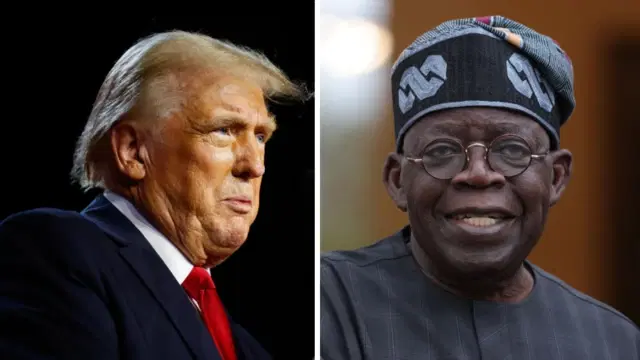
The Republican defeat in the 2024 United States midterm elections has become a focal point for Nigerian opposition figures seeking to draw parallels with President Bola Ahmed Tinubu’s prospects in the 2027 general election. However, analysts stress that the two political contexts differ markedly, and the US result cannot reliably forecast Tinubu’s electoral fate.
Democrats secured control of both chambers of Congress, delivering a decisive rebuke to the Republican administration. Real GDP growth reached 4.43% in the second quarter of 2026, up from 4.23% a year earlier. Headline inflation fell to 15.39% in August 2026 from 23.14% a year earlier. External reserves climbed to about $54.7 billion on 18 September 2026. Federation Account revenue rose to N21.9 trillion in 2025, a 44% increase from 2024. Vice‑President JD Vance later said, “the reason we lost is the war.”
Opposition voices in Nigeria have seized on the US outcome, attempting to liken Trump’s setbacks to potential difficulties for Tinubu. While such comparisons may make for catchy political talking points, they are largely superficial and risk importing foreign circumstances into a distinct domestic arena.
Iran conflict
One of the most cited factors behind the Republican defeat was the prolonged conflict between the United States and Iran. The war heightened concerns about overseas military involvement, pressured energy markets, and contributed to rising fuel prices. For American households already coping with living‑cost pressures, the conflict added another layer of economic anxiety. President Trump acknowledged the war’s impact, noting it had hurt his party’s electoral standing, while his Vice President, JD Vance, bluntly declared, “the reason we lost is the war.”
These dynamics are specific to US voters’ calculus. Nigeria did not initiate the Iran‑US dispute, and Tinubu holds no authority over American foreign policy, trade tariffs, or the Republican Party’s domestic strategy. To treat the Republican loss as a direct verdict on Nigeria’s president stretches political analogy beyond reasonable limits.
Structural weaknesses
Nigeria entered the Tinubu administration in May 2023 with deep‑rooted economic challenges. An expensive petrol subsidy regime, multiple exchange‑rate arrangements, weak revenue mobilisation, infrastructure deficits, heavy import dependence, and a productive sector hamstrung by years of distortions had accumulated under successive governments. These issues progressively narrowed fiscal space for any administration.
The new government chose to confront some of these problems by removing the petrol subsidy, implementing foreign‑exchange reforms, restructuring fiscal policy, and boosting domestic revenue generation. The measures were neither politically convenient nor painless. Millions of Nigerians have faced heightened hardship as food, transport, electricity and other essential services become costlier. Any credible assessment of the Tinubu presidency must acknowledge this reality.
However, hardship alone does not negate the need to address the underlying structural flaws that prompted the reforms. Continuing an unsustainable subsidy, maintaining multiple exchange rates, and allowing fiscal liabilities to grow would have jeopardised competitiveness and investor confidence. The opposition must answer how it would finance a return to subsidy payments or revert to the old exchange‑rate system without jeopardising fiscal stability.
Context
Macroeconomic indicators show some improvement. Real GDP growth of 4.43% in Q2 2026 outpaced the 4.23% recorded in the same period of 2025. Inflation slowed to 15.39% in August 2026 from 23.14% a year earlier. External reserves rose to roughly $54.7 billion by 18 September 2026, and Federation Account revenue climbed to N21.9 trillion in 2025, up 44% from 2024. These figures signal better revenue mobilisation and stronger external buffers.
Yet the gains must be viewed in context. Lower inflation means price increases are slowing, not that prices have returned to earlier levels. Larger reserves and higher government revenue do not automatically boost household purchasing power. The real test for the Tinubu administration is converting macro‑economic progress into tangible improvements: affordable food, reliable electricity, lower production costs, enhanced security, job creation, and stronger social protection for vulnerable groups.
Communicating achievements
As the 2027 election approaches, the government must focus on delivering visible benefits. Infrastructure programmes, transport investments, food‑production drives, education reforms, and business‑environment improvements are essential components of national development. Projects such as the Lagos‑Calabar Coastal Highway and the Sokoto‑Badagry Superhighway illustrate the administration’s ambition to expand strategic transport links, but their ultimate value will be measured by delivery, quality, economic impact, and community benefits.
Governance is multi‑dimensional. Economic performance cannot be reduced to the price of a bag of rice, nor can an administration’s success be judged solely by project announcements. Both household welfare and long‑term development must inform a balanced assessment.
The opposition also bears responsibility. Democracy thrives on a credible opposition that can scrutinise policy, expose shortcomings, and propose alternatives. Economic hardship provides legitimate grounds for robust political scrutiny, and the opposition should be encouraged to challenge the government and present its own vision.
But criticism alone does not constitute a governing programme. Nigerians deserve to know what the opposition would do differently. Would it restore the petrol subsidy, and how would it fund it sustainably? Would it revert to multiple exchange‑rate regimes? What concrete steps would it take to curb inflation, improve food security, strengthen the naira, attract investment, and create jobs? How would it finance the infrastructure Nigeria urgently needs without returning to unsustainable borrowing?
These are not unreasonable questions; they represent the minimum requirements of a serious political alternative.
The ruling All Progressives Congress (APC) also has lessons to learn. The US experience shows that political loyalty, electoral victories, and presidential popularity cannot be taken for granted. Voters ultimately respond to lived experiences, expectations, and perceived performance. Even if an administration believes its policies are necessary, citizens may not accept the associated hardships indefinitely.
Conclusion
Tinubu and the APC must understand that the 2027 election cannot be won merely by explaining why reforms were needed. The government must demonstrate the tangible outcomes of those reforms, communicate achievements more effectively, address public dissatisfaction, and ensure economic recovery becomes visible in everyday Nigerian life. It must also resist dismissing legitimate criticism as opposition propaganda; citizens struggling with food prices, transport costs, insecurity, and unemployment are not political adversaries but constituents whose concerns demand practical responses.
Ultimately, the 2027 contest will be a judgment of records, ideas, leadership capacity, and public confidence. Tinubu will defend his administration’s performance, while the opposition must prove it possesses a credible and workable alternative. The US midterm elections may offer useful lessons on the consequences of unpopular policies and the importance of accountability, but they cannot dictate the outcome of Nigeria’s presidential race. American voters have made their choice based on American circumstances; Nigerians will make theirs based on their own experiences and expectations.
The attempt to turn Trump’s defeat into a prediction of Tinubu’s political future may generate headlines and energise opposition discourse, but it does not resolve the more critical questions about Nigeria’s economic direction and political choices. The burden of persuasion rests on both sides: the government must deliver results, and the opposition must demonstrate capacity.
In the final analysis, America will judge Trump, just as Nigeria will judge Tinubu. Neither president can borrow the electoral fortunes or misfortunes of the other. America is not Nigeria. Trump is not Tinubu. The road to Nigeria’s 2027 presidential election will be shaped not in Washington, but by the choices of Nigerians themselves.