
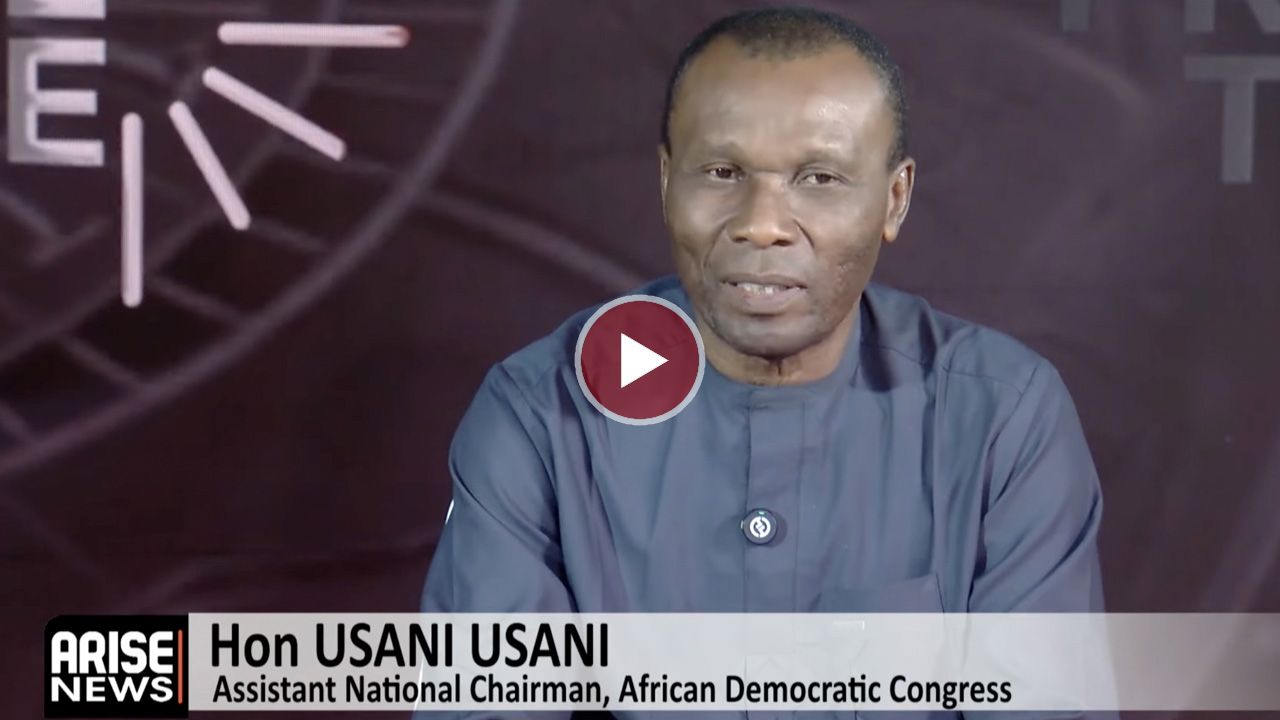
Honourable Usani Usani, who serves as the Assistant National Chairman of the African Democratic Congress (ADC), has expressed that the party is in anticipation of a structured and transparent process for selecting its presidential candidate.
This statement was made during an interview with ARISE NEWS on Monday.
He noted, "We are awaiting a formal process. Presently, we have three individuals who have expressed interest in running for president: Peter Obi, Rotimi Amaechi, and Atiku Abubakar."
"I assure you that the ADC will present a candidate rooted in transparency, integrity, and honesty," he continued.
Regarding the South-South region's endorsement of Rotimi Amaechi, Usani acknowledged the region's considerable support, yet reiterated that the final choice will follow the party's national selection process.
"We convened a leadership meeting in the South-South, which was chaired by Chief John Odigie-Oyegun. Amaechi participated and sought our support as ‘one of our own.’ A voice vote concluded with overwhelming support, albeit without dissenting votes. While it may appear that the region has reached a consensus on backing Amaechi, this does not exclude individual member autonomy or the predetermined national process," he clarified.
On the topic of power rotation between the North and South, Usani refrained from articulating the party’s stance, categorizing it as premature given the ongoing internal evaluations.
"We currently have committees conducting reviews of our policies, manifesto, and constitution. It is too early for me to divulge specifics before their conclusions are presented. The ADC aims to embody the collective opinion of the populace whilst remaining democratic. Though I might have personal views, as a representative of the party, I must defer to the party’s official standpoint," he stated.
Addressing the ADC's objection to the Independent National Electoral Commission's (INEC) election timetable, Usani explained:
"Our opposition extends beyond merely the timetable; it touches on the integrity of policy. In a value-driven system, there ought to be a policy- making process that involves public consultation. This hastily constructed timetable seems designed to marginalize certain interests and undermine the democratic framework. Presently, those in positions of power are quietly maneuvering behind the scenes while misleading the electorate with sudden changes."
He elaborated further, saying, "The various branches of governance—National Assembly, INEC, the Executive, and the APC—are interconnected in this regard. It is ironic that the law mandates consensus among all candidates for internal party selections, yet at the national level, the absence of a signature from an agent does not invalidate a result. They value internal party processes more than the national presidential elections."
Usani also indicated that the reliability of the upcoming 2027 elections hinges on the actions of INEC Chairman, Mahmood Yakubu.
"We need to observe how his conduct measures up to that of Professor Humphrey Nwosu during the 1993 elections, which are considered the most credible in our history. While the initial announcements have been positive, I hope he will uphold integrity regardless of the pressures he may face," Usani remarked.
In light of INEC's policy on electronic transmission of election results, Usani criticized:
"Their comment on glitches indicates that while they may 'be able' to transmit results electronically, 'can' signifies a possibility rather than a guarantee. Given that we engage in electronic transactions daily, the failure to transmit votes through similar means reflects systemic dishonesty perpetuated by legislative authorities."
He further raised concerns about the implications of low voter turnout, stating that both the electorate and political leaders bear responsibility.
"Voter apathy is a significant concern for all. If this continues, there is a risk that Nigerians may resort to 'self-help', ultimately resulting in national instability. While politicians typically come from a specific elite class, the general populace holds a duty. It is crucial for the public to actively participate, cast their votes, and safeguard those votes to ensure effective governance," he cautioned.
Comments (0)
You must be logged in to comment.
Be the first to comment on this article!